
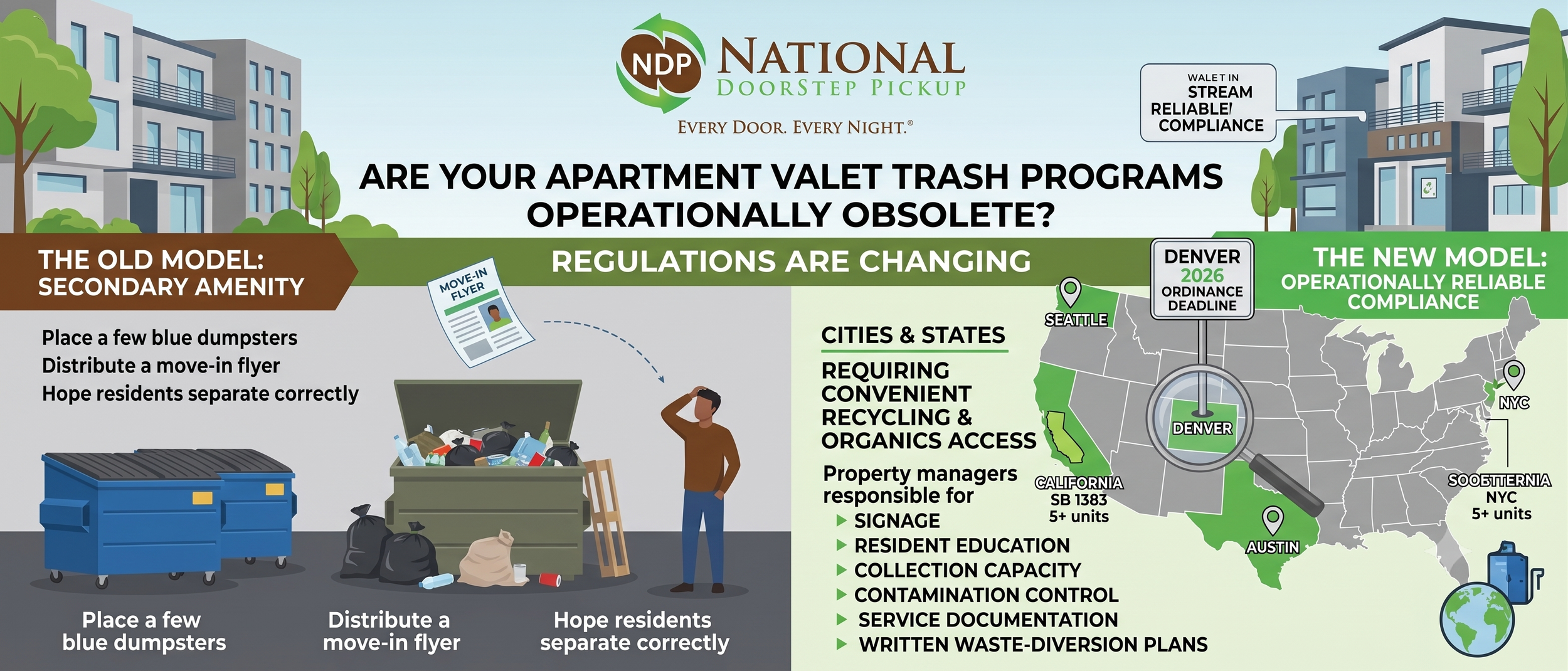
Valet Trash, Recycling & Organics Service for Denver, CO Apartments
Premium Doorstep Collection for High-Rises, Mid-Rises & Garden-Style Communities
Every Door. Every Night.® | Technology-verified doorstep waste operations.
Residents in Denver want convenience—not long walks to smelly, noisy, or overflowing dumpsters and compactors. National Doorstep provides professionally managed doorstep trash, recycling, and organics collection designed to improve the resident experience, support cleaner communities, and strengthen operational visibility for Denver multifamily properties.
- Help reduce dumpster and compactor overflow
- Reduce bulk-item dumping with on-demand bulk-item removal
- Support cleaner waste areas with compactor and enclosure cleanup services
- Create an ancillary revenue opportunity and support property-level NOI
- Improve resident access to properly separated trash, recycling, and organics streams
Prepare for Denver’s September 1, 2026 Compliance Deadline
Beginning September 1, 2026, Denver’s Universal Recycling and Composting Ordinance generally requires multifamily properties with eight or more dwelling units to provide on-site recycling and organic-material diversion services for tenants, residents, employees, and contractors.
The requirements also apply to manufactured home communities and covered congregate-living properties. Townhomes or rowhomes that hold an account with Denver Solid Waste Management are not subject to the multifamily requirements.
Core Multifamily Requirements
- Provide access to trash, recycling, and organics at the property.
- Group all three streams at centralized collection areas or provide clear directional signage when physical constraints prevent grouping.
- Maintain recycling capacity equal to at least 30% of total weekly service capacity.
- Maintain organics capacity equal to at least 10% of total weekly service capacity.
- Use a waste hauler licensed by the City and County of Denver when contracting for final hauling.
- Clearly label containers and post signs identifying accepted and prohibited materials.
- Provide sorting education to residents, employees, and contractors on the required schedule.
- Create and maintain a current Waste Diversion Plan documenting how the property complies.
Official Denver multifamily guidance:
Denver Universal Recycling and Composting Requirements for Multifamily Properties
Denver-licensed waste hauler information:
Denver Waste Hauler Licensing and URCO-Ready Haulers
National Doorstep local overview:
Denver Apartment & Multifamily Recycling Rules
Operational note: A doorstep or valet collection program can function as part of the property’s collection system, but it does not replace the property’s responsibility to provide compliant containers, capacity, signage, education, documentation, and licensed final hauling.
Denver URCO Enforcement & Civil Penalties
Noncompliance can result in administrative citations, civil penalties, and additional enforcement. After a responsible party receives a notice of violation involving Denver’s Universal Recycling and Composting Ordinance or its implementing rules, the responsible party generally has 30 calendar days to correct the violation before an administrative citation is issued.
Maximum Administrative Citation Amounts
- First administrative citation: Up to $150.
- Second administrative citation: Up to $500.
- Third and each subsequent administrative citation: Up to $999.
These maximum amounts apply to each administrative citation issued for violations of the same code section, sections, rules, or regulations, regardless of the number of individual violations included in that citation or which authorized Denver entity conducts the enforcement.
Continuing and Repeat Violations
- Additional citations may be issued when the responsible party fails to correct the cited violation.
- Additional citations may be issued if the responsible party commits the same violation again.
- Additional citations may be issued for failure to comply with an administrative enforcement order.
- Paying a civil penalty does not eliminate the obligation to correct the violation.
- Payment of a penalty does not prevent Denver from pursuing further enforcement.
Potential Licensing Actions
Without limiting other enforcement authority, Denver’s licensing and consumer protection officials may pursue licensing actions where applicable. These actions may include suspension during an investigation and suspension or revocation of a license after notice and an opportunity for a hearing.
Appeal Rights
A person disputing a violation for which a civil penalty has been assessed may file an appeal under the applicable Denver Revised Municipal Code procedures. The required appeal process may depend on which Denver department issued the violation.
Official Denver enforcement rules:
URCO Rules & Regulations — Buildings and Food Waste Producers
This summary is provided for operational planning and does not constitute legal advice. The adopted ordinance, rules, regulations, notices, administrative orders, and applicable Denver Revised Municipal Code provisions control in the event of a conflict.
How Our Valet Trash Service Works in Denver
Visual workflow:
How Valet Trash Works
GPS-Verified Routes
- GPS-tracked porter tours
- Time and route verification
- Photo-supported Proof of Pickup® documentation
- Property-management visibility into service conditions and exceptions
Technology overview:
Proof of Pickup® Valet Trash Service Software
Leak-Resistant Valet Trash Totes
Durable, leak-resistant totes or tilt trucks support cleaner hallways, breezeways, and nighttime collection routes. Residents must still use properly tied, leak-free household bags and follow community set-out rules.
5-Night Collection Standard
National Doorstep’s standard service configuration is five nights per week, typically Sunday through Thursday. Final service nights, set-out windows, and collection times are established for each community’s operating plan.
Three-Stream Doorstep Waste SOPs
- Defined resident set-out and container-retrieval windows
- Bagging, containment, sanitation, and leak-prevention rules
- Separate identification of trash, recycling, and organics
- Physical separation of each stream through collection and delivery
- Recycling and organics contamination prevention
- Rejected-item and incorrect-set-out documentation
Clear blue or blue-translucent bags may be used to help identify recycling, while approved compostable liners or sealed containers may be used for organics. Bag and liner requirements must first be confirmed with the property’s licensed hauler and receiving recycling or composting facility.
Recycling & Organics Education
Resident and staff education can be delivered through move-in materials, lease or community-rule addenda, door hangers, email, resident portals, common-area signage, and QR-linked sorting guides.
Denver requires education within 90 days after the property’s compliance date and at least annually thereafter. Information must also be provided within 30 days of new resident occupancy, a new employee or contractor beginning work, or a service change that affects accepted materials or sorting procedures.
Required information and text-based signage must generally be provided in English and Spanish. Another primary resident language may be substituted for Spanish where permitted by Denver’s rules.
Contamination Documentation
Proof of Pickup® can document incorrect set-outs, visible contamination, leaking bags, oversized items, and other service exceptions by location, date, time, and photograph. National Doorstep documents the condition; property management controls resident communication and enforcement under the lease and community rules.
Connect the Doorstep Program to the Entire Waste Chain
A compliant doorstep program must be designed from the apartment door through final delivery to the property’s designated trash, recycling, and organics containers.
- Confirm the materials accepted by the property’s recycling hauler and processing facility
- Confirm acceptable organics, liners, and contamination thresholds with the compost processor
- Verify that bagged recyclables are accepted before selecting recycling bags
- Provide adequate container capacity and collection frequency for all three streams
- Group containers or install compliant directional signage
- Establish procedures for cardboard, leaks, spills, rejected loads, odors, and pests
- Train porters and maintenance employees for their separate operational responsibilities
- Maintain contracts, education materials, training records, and service documentation
National Doorstep’s role should be coordinated with the property owner or manager, licensed waste hauler, recycling processor, organics processor, and on-site maintenance team before resident-facing service begins.
Designed for Denver Multifamily Assets
- Downtown and Union Station high-rises
- Capitol Hill, Cherry Creek, and Uptown mid-rises
- Southeast Denver and other garden-style apartment communities
- Mixed-use properties with residential towers or multifamily components
- Condominium and cooperative communities subject to Denver requirements
Properties outside the City and County of Denver may be governed by different municipal or county recycling, composting, hauling, and licensing requirements.
Optional Add-On Services
- Bulk-item removal
- Pet waste station servicing
- Common-area trash pickup
- Compactor and waste-enclosure cleanup
- Recycling and organics contamination documentation
- Resident communication and sorting collateral
New Construction & Renovation Guidance
When designing or renovating a trash room or centralized collection area, consider the following operational features in coordination with the architect, engineer, licensed hauler, and applicable codes:
- Provide sufficient space for trash, recycling, and organics containers
- Group all three streams or provide space for clear directional signage
- Add a spigot for sanitation and wash-downs where permitted
- Install a properly designed pitched floor to direct wash water
- Include an approved floor drain for safe and efficient cleanup
- Provide ventilation, lighting, pest controls, and safe hauler access
- Account for compactor ratios when calculating required service capacity
Denver Valet Trash, Recycling & Organics FAQ
How many units trigger Denver’s multifamily recycling and composting requirements?
Denver’s Universal Recycling and Composting Ordinance generally applies to multi-unit dwellings with eight or more dwelling units, as well as manufactured home communities and covered congregate-living properties.
When must covered Denver multifamily properties comply?
Covered multifamily properties must comply by September 1, 2026. Properties beginning operation after that date are generally subject to separate 30-day compliance timing.
What are the fines for violating Denver’s recycling and composting requirements?
After receiving a notice of violation, the responsible party generally has 30 calendar days to correct the violation before an administrative citation is issued. Maximum civil penalties are $150 for the first citation, $500 for the second citation, and $999 for the third and each subsequent citation involving the same code provisions. Paying a penalty does not eliminate the obligation to correct the violation or prevent additional enforcement.
Can valet collection be used as part of the required collection system?
Yes. Denver’s rules recognize that a centralized collection system may include valet services when they are used in place of a designated shared collection location. The overall property system must still provide compliant access, capacity, separation, signage, education, licensed hauling, and documentation.
Does a doorstep provider replace the property’s licensed waste hauler?
Not necessarily. Doorstep collection moves separated materials from resident set-out locations to the property’s designated containers. Final hauling must be coordinated with a waste hauler licensed by the City and County of Denver unless the property follows Denver’s lawful self-hauling requirements.
Can recycling and organics be collected during the same service window?
Yes, provided each stream remains clearly identifiable and physically separated through doorstep collection, internal transport, consolidation, and placement in the appropriate property container.
Additional valet trash questions:
View the Full Valet Trash FAQ
Official Denver questions may also be directed to:
UniversalRecycling@Denvergov.org
Evaluate your Denver property’s doorstep collection, three-stream capacity, licensed-hauler coordination, signage, resident education, contamination controls, and Waste Diversion Plan readiness.
Interested in talking about how we can work together? Here's our contact info.
