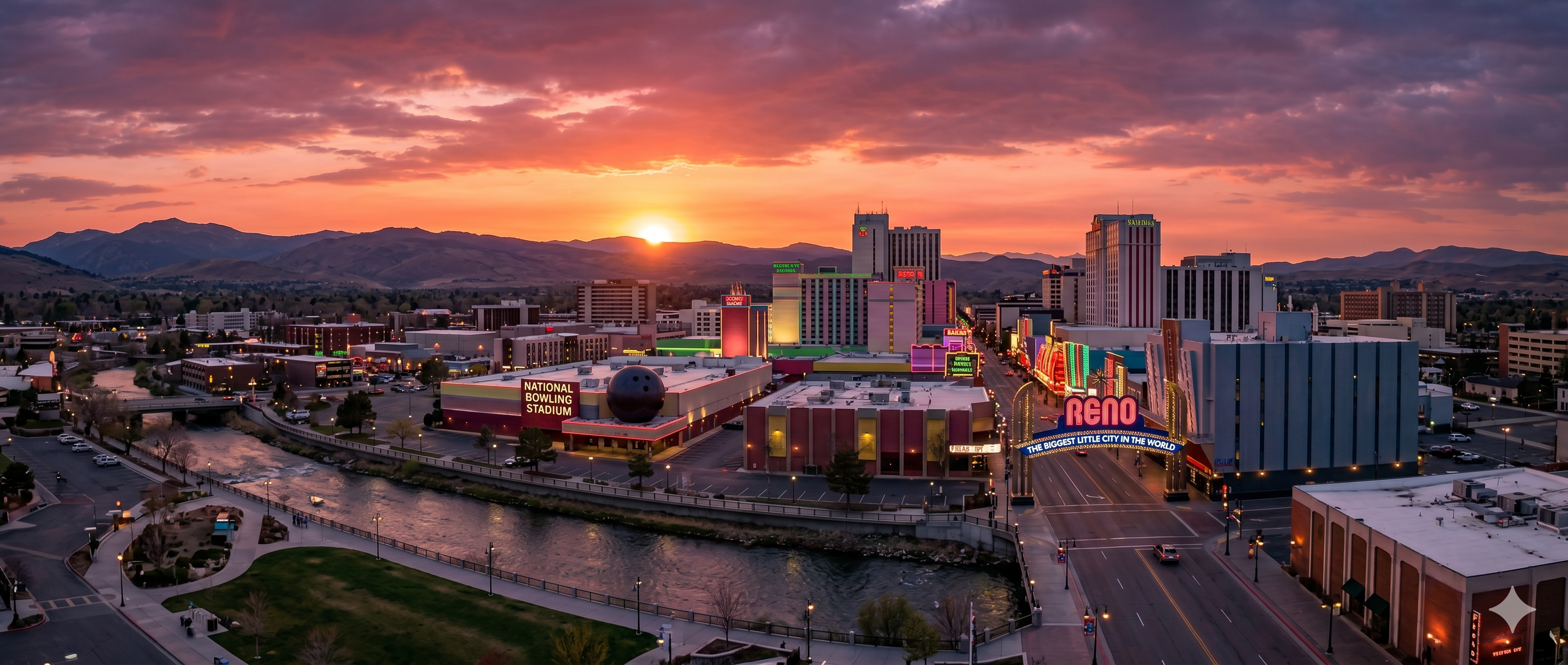
Regional Compliance Hub: Free Recycling + Household Hazardous Waste & Electronics Resources — Reno–Sparks, NV
Reno–Sparks residents have separate local pathways for
recycling,
Household Hazardous Waste (HHW),
electronics, and
bulky-item disposal.
These programs do not all use the same location, schedule, fees, or eligibility rules.
Northern Nevada Public Health describes residential recycling participation in
Reno, Sparks, and Washoe County as voluntary. Nevada law nevertheless
requires qualifying recycling programs to include apartment complexes and condominiums
where recycling collection services are provided.
[1][2]
For residents whose apartment community does not provide on-site recycling,
Waste Management identifies its Reno Eco-Center recycling locations as an
authorized drop-off option.
[3]
Existing apartment communities:
Residential recycling participation in Reno, Sparks, and Washoe County is described
locally as voluntary. The authorities cited here do not establish a blanket rule
requiring every existing apartment property to purchase recycling service solely
because it exceeds a specified number of units.
[1]
Nevada recycling framework:
NRS Chapter 444A requires qualifying recycling programs to address apartment complexes
and condominiums where recycling collection services are provided.
[2]
New construction / qualifying major renovation:
NRS 278.02315 requires plans for covered apartment-complex and condominium construction,
or a qualifying major renovation, to provide for
placement of recycling containers.
A “major renovation” under the statute means destruction or reconstruction exceeding
50% of replacement value.
[4]
Free Community Recycling: Know the Correct Commercial Row Location
Mixed recycling:
Waste Management identifies the Eco-Center mixed-recycling drop-off at
1391 E. Commercial Row, Reno.
Residents whose landlord does not provide recycling may use the Eco-Center
recycling option without an additional recycling charge, subject to current
accepted-material rules.
[3]
Mixed-recycling hours:
Monday–Friday, 7:30 AM–3:00 PM.
[5]
Visual cue:
WM's Reno guidance directs customers to the
yellow recycling bins at the Eco-Center.
[3]
Accepted examples:
Current local guidance includes common materials such as
glass bottles and jars, aluminum/steel/tin cans, plastic bottles and containers,
flattened cardboard/paperboard, and loose paper.
Recyclables should follow WM's current preparation and contamination rules.
[3]
- Mixed Recycling: 1391 E. Commercial Row, Reno, NV [3]
- Hours: Mon–Fri, 7:30 AM–3:00 PM [5]
- Resident Access: WM states residents whose landlord does not provide recycling may use the Eco-Center recycling option without an additional recycling charge. [3]
- Preparation: Follow current WM accepted-material and preparation rules and keep recyclables loose unless current facility instructions state otherwise.
Cardboard Hub: Moving Boxes & Large Loads
Separate cardboard location:
The dedicated cardboard-only recycling location is
1100 E. Commercial Row, Reno.
[5]
Hours:
Monday–Friday, 7:30 AM–3:00 PM.
Current NDEP guidance also notes a
12:00 PM–12:30 PM closure for this cardboard location.
[5]
Property-manager / resident practice:
Flatten cardboard before transport and confirm current site instructions before
directing residents with move-in or move-out loads.
1391 E. Commercial Row:
Mixed-recycling Eco-Center drop-off.
1100 E. Commercial Row:
Cardboard-only recycling drop-off.
1390 E. Commercial Row:
Commercial Row Transfer Station — a separate disposal facility with its own
operating hours, rates, and accepted-material requirements.
Manager takeaway:
Do not direct residents simply to “Commercial Row.”
Provide the correct street number for the material being discarded.
[3][5]
Household Hazardous Waste: Voucher + Authorized Drop-Off Options
HHW does not belong in ordinary WM trash or recycling carts.
WM identifies household hazardous waste such as certain paints, oils, chemicals,
and similar materials as unacceptable in the ordinary residential cart stream.
[6]
Important 2026 update:
Household hazardous waste in Reno–Sparks should no longer be described as
“paid or event-only.”
WM currently advertises a
Free Hazardous Waste Disposal Voucher
through GrayMar Environmental for qualifying residential customers.
[6]
Sparks / Washoe County:
WM states qualifying residential customers receive an HHW voucher with their
May bill.
[6]
Reno:
WM states qualifying residential customers receive the voucher with their
July bill.
[6]
Apartment residents:
Eligibility can depend on the property's/account's service arrangement.
Residents should check with property management and WM before assuming a voucher
applies to their individual household.
HHW Providers: GrayMar + HERO Environmental
GrayMar Environmental:
13203 S. Virginia Street, Reno, NV.
GrayMar publishes residential HHW drop-off information and currently lists
weekday HHW drop-off hours of
Monday–Friday, 8:00 AM–3:00 PM.
Outside an applicable voucher or program, fees may apply.
[7]
HERO Environmental:
4900 Mill Street #7, Reno, NV.
HERO publishes household-HHW services and currently lists
Monday–Friday, 8:00 AM–3:00 PM and
Saturday, 8:00 AM–2:00 PM.
HERO recommends confirming current acceptance and pricing before arrival.
[8]
Material-specific rule:
Do not characterize every product commonly called “hazardous” as universally
illegal in ordinary trash. Disposal instructions vary by material.
For example, NDEP states that properly dried latex paint may be placed in ordinary trash,
while wet paint may be directed to an HHW program.
[5]
Electronics: Use a Dedicated E-Waste Program
Electronics are a separate waste stream.
Do not place electronic waste in ordinary residential WM trash or recycling carts.
[6]
Intelligent Lifecycle Solutions:
The company's current Reno/Stead facility is located at
13960 Mt. Anderson Street, Reno, NV 89506.
Its current information identifies electronics such as computers, laptops,
servers, printers, televisions, and other electronic equipment as accepted categories.
[9]
Fees:
Do not promise free electronics disposal.
Fees and accepted-material requirements may vary by equipment type.
Confirm current pricing and acceptance directly with the receiving facility
before transporting TVs, CRTs, monitors, computers, or other e-waste.
Bulk Trash & Transfer-Station Access: Apartment Residents May Have an Authorization Path
Reno residential benefit:
WM's Reno service information identifies qualifying residential transfer-station
access for customers in good standing, including up to
four qualifying pickup-truck-load visits per year without an additional disposal charge,
subject to WM's current program terms.
[3]
Apartment residents are not automatically excluded.
When the WM account is held by the property owner or property-management company,
WM provides a
Property Manager Permission Form
that can authorize a tenant or other third party to use qualifying transfer-station access.
[6]
Property-manager action:
Before telling a resident that a sofa, mattress, or move-out load will require a standard
gate fee, check the property's account eligibility and current WM authorization procedure.
Conversely, residents should not assume free access applies automatically without
the required account documentation.
Reno–Sparks Property-Manager Compliance Checklist
- Confirm jurisdiction: Determine whether the community is inside Reno, Sparks, or unincorporated Washoe County before issuing resident instructions.
- Confirm recycling service: Identify whether the property currently provides on-site recycling and document the provider, accepted materials, container locations, and pickup frequency.
- Use the correct Eco-Center address: 1391 E. Commercial Row for mixed recycling and 1100 E. Commercial Row for cardboard.
- Keep HHW separate: Do not place HHW in the ordinary doorstep collection stream. Direct residents to the applicable WM voucher program or authorized HHW provider.
- Keep e-waste separate: Provide a current electronics-recycling option and tell residents to verify fees and accepted equipment before drop-off.
- Review tenant transfer-station authorization: If the property holds the WM account, determine whether the resident may use the WM Property Manager Permission Form for qualifying transfer-station access.
- Plan for move-ins and move-outs: Provide residents with separate instructions for flattened cardboard, ordinary trash, electronics, HHW, mattresses, furniture, and other bulky items.
- Review redevelopment projects: For new apartment construction or qualifying major renovation, verify NRS 278.02315 recycling-container-space requirements.
- Keep current documentation: Maintain current WM service information, recycling instructions, resident notices, HHW/e-waste resources, bulky-item procedures, and property authorization forms.
How National Doorstep Helps Reno–Sparks Property Management
Compliance is operational.
National Doorstep helps Reno–Sparks apartment communities reduce contamination and
improper set-outs through standardized resident routines, clear signage,
prohibited-material instructions, and routing information for authorized recycling,
HHW, electronics, and bulky-item programs.
Important service distinction:
Household hazardous waste, electronics, chemicals, and other materials prohibited by
the property's doorstep program are
not collected through the ordinary National Doorstep waste stream.
Residents should be directed to the appropriate property-approved or authorized
recycling or disposal program.
National Doorstep's role:
National Doorstep operates upstream from municipal and private off-site waste hauling.
Authorized doorstep personnel move approved resident-set-out material from apartment
doors to property-designated collection points on private property.
Off-site hauling, transfer-station disposal, recycling processing, HHW management,
e-waste processing, and landfill operations remain with the applicable authorized provider.
No affiliation:
National Doorstep Pickup is not affiliated with Waste Management, GrayMar Environmental,
HERO Environmental, Intelligent Lifecycle Solutions, or any other valet-trash company.
References to third-party companies and government agencies are provided for informational
and operational-compliance purposes and do not imply endorsement or affiliation.
CTA:
Request a Free Compliance Audit for your Reno–Sparks Property
Compliance note:
This page provides general operational and regulatory information and is not legal advice.
Facility hours, accepted materials, voucher eligibility, disposal fees, municipal requirements,
service-contract terms, and recycling procedures can change.
Property managers and residents should confirm current information with WM,
the applicable municipality or Washoe County, Northern Nevada Public Health,
NDEP, and the receiving facility before implementing or relying on a disposal procedure.
Regulatory information reviewed: August 10, 2026.
EEAT Sources: [1] Northern Nevada Public Health — Waste Reduction, Recycling & Disposal FAQ (Reno/Sparks/Washoe residential recycling participation) | [2] Nevada Legislature — NRS Chapter 444A (Nevada recycling-program framework and apartment complexes) | [3] WM — Reno Residential Waste & Recycling (Eco-Center access, recycling, transfer-station program information) | [4] Nevada Legislature — NRS 278.02315 (recycling-container space for apartment/condominium construction and major renovation) | [5] Nevada Division of Environmental Protection — Where Can I Recycle? (1391 E. Commercial Row mixed recycling; 1100 E. Commercial Row cardboard; hours and material-specific guidance) | [6] WM — Reno Service Information (2026 HHW voucher, unacceptable cart materials, tenant/property-manager authorization resources) | [7] GrayMar Environmental — Reno Household Hazardous Waste Drop-Off (location, hours, HHW service and current pricing information) | [8] HERO Environmental — Household Hazardous Waste Disposal (Reno location, hours and service information) | [9] Intelligent Lifecycle Solutions — Nevada Electronics Recycling (Reno/Stead facility and accepted electronics)
Reno, Sparks, and Washoe County apartment owners, asset managers, and on-site property managers: multifamily waste and recycling compliance in Northern Nevada is governed by a combination of Nevada recycling statutes, municipal solid-waste requirements, franchise agreements, and Northern Nevada Public Health (NNPH) solid-waste oversight.
The region should not be described simply as having “no apartment recycling law.” Northern Nevada Public Health describes participation in the Reno–Sparks–Washoe residential recycling program as voluntary, while Nevada law separately requires qualifying recycling programs to include apartment complexes and condominiums where recycling collection services are provided.
For existing multifamily properties, the authorities cited on this page do not establish a blanket rule requiring every apartment owner to purchase on-site recycling solely because the property exceeds a specified unit count. However, Nevada separately imposes recycling-container-space requirements on new apartment/condominium construction and qualifying major renovations.
- Protect NOI & Asset Value: Reduce avoidable overflow, contamination, illegal-dumping exposure, service problems, and cleanup costs through adequate capacity, documented procedures, and prompt response.
- Resident-First Convenience: Doorstep collection can reduce unnecessary resident trips to centralized waste areas while giving management a consistent set-out and education program.
- Jurisdiction-Specific Design: Reno, Sparks, unincorporated Washoe County, Sun Valley, and Incline Village/Crystal Bay do not all operate under identical service provisions.
- Operational Compliance Support: National Doorstep can support resident education, set-out standards, route documentation, contamination reduction, and coordination with authorized downstream providers. Ownership and management remain responsible for applicable laws, contracts, permits, franchise requirements, and NNPH requirements.
Nevada Multifamily Recycling — Existing Properties vs. New Construction
NRS 444A.0103 — Apartment-complex definition: For NRS Chapter 444A, an “apartment complex” means a building or group of buildings, each building of which contains at least five units designed for independent housekeeping.
NRS 444A.020 & NRS 444A.040: Nevada's recycling framework requires qualifying source-separation programs to include, without limitation, placement of recycling containers at apartment complexes and condominiums where collection services are provided. Washoe County falls within the population category for which such a program must be made available.
Existing apartment communities: These provisions should not be marketed as a blanket unit-trigger subscription mandate. Northern Nevada Public Health currently describes participation in the Reno, Sparks, and Washoe County residential recycling program as voluntary.
NRS 278.02315 — New construction / major renovation: A governing body or its designee may not approve a plan or revised plan for construction or a qualifying major renovation of an apartment complex or condominium unless the plan includes provisions for placement of recycling containers on the premises. A “major renovation” means destruction or reconstruction exceeding 50% of the property's replacement value.
Official links: Nevada Legislature — NRS Chapter 444A · Nevada Legislature — NRS 278.02315 · NNPH — Waste Reduction & Recycling
At a Glance: Reno vs. Sparks & Unincorporated Washoe County
City of Reno
- Solid-waste framework: Reno operates under a Waste Management franchise/service system. The City's current residential program describes mandatory cart service and single-stream recycling.
- Multifamily caution: Do not automatically assume every apartment property receives the same residential cart benefits or account classification. Larger multifamily communities may operate under commercial service arrangements.
- Recycling: No blanket existing-apartment subscription mandate tied solely to unit count is identified here. Nevada's NRS 444A multifamily program requirements still apply.
- Property-manager priority: Confirm the property's WM account classification, container capacity, collection frequency, recycling service, bulky-item procedures, and transfer-station eligibility before issuing resident instructions.
Sparks & Unincorporated Washoe County
- Sparks: Sparks Municipal Code §7.12.030 requires owners or managers of multiple-family dwellings to subscribe to solid-waste collection.
- Sparks recycling distinction: The City's current guidance states commercial/industrial source-separated recycling is outside the garbage franchise and qualifying businesses may use another recycling vendor. Property managers should confirm how their multifamily account is classified.
- Unincorporated Washoe: Under the County franchise, a Multi-Family Complex means 5 or more attached dwelling units and is treated as Commercial Premises for purposes of that agreement.
- County recycling distinction: The exclusive commercial franchise grant expressly excludes Recyclables. The franchise also contains separate conditions governing when a customer may elect not to use WM's recyclable-material services.
Reno–Sparks–Washoe County Multifamily Property-Manager Guide
Do not apply one Reno-area rule to every Washoe County property. Service arrangements differ by incorporated city, County franchise area, general improvement district, and account classification. Verify the actual jurisdiction and service arrangement before changing a waste or recycling program.
| Jurisdiction / Community | Multifamily Recycling Status | Garbage / Franchise Track | Property-Manager Information | Official Links |
|---|---|---|---|---|
| City of Reno | No blanket existing-property unit-trigger subscription mandate identified. Nevada's statewide multifamily recycling-program requirements still apply. | Reno operates under a WM franchise/service system. The City's current residential program includes mandatory cart service and single-stream recycling, but multifamily account structures can differ. |
For property managers:
|
Reno — Solid Waste & Recycling
Reno — Solid Waste Ordinance WM — Reno Service |
| City of Sparks | No blanket apartment recycling-subscription mandate based solely on unit count is represented here. Nevada's NRS 444A framework still applies. | Sparks Municipal Code §7.12.030 requires owners or managers of multiple-family dwellings to subscribe to solid-waste collection. WM/Sparks Sanitation is the garbage franchisee. |
For property managers:
|
Sparks — Garbage Service Information |
| Unincorporated Washoe County | No blanket existing-property recycling-subscription rule based solely on apartment unit count is represented here. Nevada recycling-program requirements still apply. | The Washoe County franchise defines a Multi-Family Complex as 5+ attached dwelling units and treats that property as Commercial Premises for purposes of the franchise agreement. |
For property managers:
|
Washoe County — WM Franchise Agreement
Washoe County — Code Compliance |
| Sun Valley | Separate district overlay. Sun Valley General Improvement District Rule 26 governs local solid-waste / recycling collection in conjunction with the Washoe County franchise arrangement. | SVGID's rules state that the carrier is the garbage-collection entity operating under Washoe County's franchise and that the District is subject to that franchise through an interlocal arrangement. |
For property managers:
|
Sun Valley GID — Rule 26
Sun Valley GID |
| Incline Village / Crystal Bay | Separate solid-waste service track. Do not automatically apply the standard unincorporated Washoe County WM franchise assumptions to these communities. | Washoe County's franchise materials identify the Incline Village General Improvement District (IVGID) as managing the solid-waste franchise arrangement for Incline Village and Crystal Bay. |
For property managers:
|
Incline Village GID
Washoe County Franchise Background |
| Spanish Springs / Cold Springs / Lemmon Valley / Verdi / Mogul / Galena & Other Unincorporated Areas | Nevada's statewide multifamily recycling framework applies. No separate blanket apartment-subscription mandate is represented here. | Properties located within the standard unincorporated County franchise area generally follow the Washoe County franchise track, but parcel-specific jurisdiction and service area should always be confirmed. |
For property managers:
|
Washoe County
NNPH — Waste Management Program |
Unincorporated Washoe County — 5+ Unit Multifamily Franchise Rule
Franchise definition: A “Multi-Family Complex” is a parcel in the franchise area containing five or more attached dwelling units. For purposes of the Washoe County franchise agreement, a Multi-Family Complex is deemed a Commercial Premises.
Garbage vs. recycling: WM's exclusive commercial franchise covers Garbage and other waste exclusive of Recyclables. However, property managers should not interpret that phrase to mean that every alternative recycling-collection arrangement is automatically permitted. Section 5.8 of the franchise contains additional conditions concerning when a customer may elect not to use WM's Recyclables services.
Service adequacy: The franchise authorizes WM or the County to determine whether the service requested by a residential or commercial premise is adequate to prevent unlawful accumulation of garbage or a health hazard or nuisance.
Property-manager practice: Where an alternative off-site recycling arrangement is contemplated, verify that the proposed arrangement complies with the current franchise, NNPH requirements, licensing requirements, and any other applicable law before implementation.
Reno–Washoe Enforcement & Penalty Snapshot
- NRS 444.630 — Unlawful dumping: Nevada prohibits placing, depositing, dumping, causing to be dumped, or causing or allowing solid waste to overflow onto specified streets, public areas, or private property in circumstances covered by the statute. A first qualifying offense within the statutory period is a misdemeanor; subsequent convictions can escalate to gross misdemeanors.
- NRS 444.635 — Civil penalties after conviction: For a conviction subject to this provision, the court must order a civil penalty of $500–$5,000 for a first offense, $1,000–$5,500 for a second, and $1,500–$6,000 for a third. Later offenses increase further under the statute.
- Cleanup / community service: NRS 444.630 also contains cleanup and community-service consequences following conviction. Those requirements differ for natural persons and business entities.
- Do not equate every overflowing dumpster with an NRS 444.630 conviction. Liability depends on the facts, location, applicable provision, enforcement action, and proof. Operational overflow should nevertheless be corrected promptly.
- NRS 444.610 — Continuing regulatory violations: Violations of applicable regulations adopted by the State Environmental Commission or applicable solid-waste ordinances/resolutions adopted by a municipality or district board of health are subject to a separate statutory framework under which a continuing or repeated violation can constitute a separate offense for each day or part of a day. Do not confuse this provision with the separate NRS 444.630 illegal-dumping offense.
- Unincorporated Washoe County administrative enforcement: For applicable County Code violations, Washoe County Code Compliance currently describes a progressive administrative process beginning with a warning/compliance period and monetary penalties of $100, then $200, then $400, with subsequent notices potentially carrying additional $400 penalties and costs. This County process should not be represented as the City of Reno or City of Sparks penalty schedule.
- Risk-management practice: Keep contracts, account classifications, collection schedules, service-change requests, site maps, resident rules, photographs, contamination documentation, and responses to complaints or overflow conditions.
Official penalty sources: Nevada Legislature — NRS 444.610, 444.630 & 444.635 · Washoe County — Administrative Enforcement
Reno–Sparks Multifamily Waste & Recycling Risk-Management Checklist
| Task | Property-Manager Action | Why It Matters | Helpful Links |
|---|---|---|---|
| ☑ Confirm Jurisdiction | Determine whether the property is in Reno, Sparks, standard unincorporated Washoe County, Sun Valley, Incline Village/Crystal Bay, or another special service area. | Franchise terms, account classifications, recycling rights, billing, and local service rules differ. | Washoe County |
| ☑ Confirm Garbage Service Requirement | Verify the property's required garbage-service provider and current account status. In Sparks, §7.12.030 expressly requires owners/managers of multiple-family dwellings to subscribe to solid-waste collection. | National Doorstep does not replace a legally required franchise garbage service. | Sparks Garbage Service |
| ☑ Verify Multifamily Classification | For an unincorporated County property with 5+ attached units, review the County franchise's Multi-Family Complex / Commercial Premises provisions. For Reno and Sparks, confirm the particular account classification rather than assuming County definitions apply. | Account classification can affect service, rates, recycling rights, and eligibility for residential benefits. | Washoe County Franchise |
| ☑ Review Recycling Arrangement | Document who collects recycling, the applicable contract, accepted materials, contamination standards, container locations, service frequency, and whether an alternative provider is legally permissible. | Recycling is not governed identically under Reno, Sparks, and unincorporated County franchise arrangements. | NNPH — Recycling |
| ☑ Right-Size Containers & Frequency | Compare current dumpster/compactor capacity and collection frequency with actual occupancy, move-outs, holidays, seasonal peaks, student turnover, and recurring overflow. | Under the unincorporated County franchise, WM or the County may determine whether service is adequate to prevent unlawful accumulation, a health hazard, or nuisance. | County Franchise §5.8 |
| ☑ Keep Collection Access Clear | Keep dumpsters, compactors, recycling areas, gates, and designated collection approaches accessible to the applicable authorized service provider. | Missed service can quickly create overflow, nuisance, contamination, and resident-complaint problems. | NNPH — Waste Management Program |
| ☑ Separate Special Waste Streams | Maintain different resident instructions for ordinary trash, recycling, HHW, electronics, batteries, cardboard, and bulky items. | These materials can have different collection providers, facility locations, fees, and handling rules. | Reno — Disposal Resources |
| ☑ Plan for Move-Out Waste | Create written procedures for mattresses, furniture, appliances, large cardboard, electronics, and abandoned resident property. | Move-outs create predictable spikes in overflow and unauthorized enclosure staging. Sun Valley's rules expressly place responsibility for refuse left after tenant surrender on the owner or agent. | Sun Valley Rule 26 |
| ☑ Review Construction / Renovation Plans | For new apartment construction or qualifying major renovation, ensure plans address recycling-container placement. | NRS 278.02315 applies statewide and defines major renovation using the greater-than-50%-of-replacement-value threshold. | NRS 278.02315 |
| ☑ Maintain Documentation | Keep current service agreements, account classifications, invoices, site maps, container information, pickup schedules, resident communications, photos, contamination notices, and service-adjustment requests. | Organized records help ownership and management respond to service disputes, inspections, nuisance complaints, code inquiries, and ownership transitions. | NNPH |
| ☑ Integrate Doorstep Service Correctly | Use National Doorstep to move approved resident set-outs from apartment doors to property-designated collection points on private property. | Off-site transportation remains with the applicable authorized garbage, recycling, transfer, HHW, or disposal provider. | National Doorstep |
National Doorstep — Service Position & Compliance Support
National Doorstep operates upstream from off-site waste hauling. Authorized doorstep personnel move approved resident-set-out material from apartment doors to property-designated containers or collection points on private property.
Off-site garbage transportation, transfer-station disposal, landfill disposal, recycling processing, HHW transportation/management, and e-waste processing remain with the applicable authorized provider.
National Doorstep can support property management with standardized set-out rules, resident education, contamination reduction, route documentation, prohibited-material procedures, and coordination with the property's downstream waste and recycling providers.
Important: National Doorstep's operational support does not transfer the property's legal responsibilities to National Doorstep and does not replace any required municipal, franchise, NNPH, or other authorized collection service.
No affiliation: National Doorstep Pickup is not affiliated with Waste Management, Sparks Sanitation, Sun Valley General Improvement District, Incline Village General Improvement District, or any other valet-trash company. References to government entities and third-party providers are informational and do not imply endorsement, partnership, or affiliation.
Want to reduce overflow, contamination, move-out waste, and resident complaints at your Reno–Sparks property? Request a Free Compliance & Amenity Audit for your Reno–Sparks / Washoe County community . We can review your doorstep workflow, container utilization, resident procedures, recycling access, and operational documentation and recommend a program designed to work alongside the property's authorized downstream providers.
Regulatory information reviewed: August 10, 2026.
Authoritative Statute, Franchise & Property-Manager Sources
- Nevada Legislature — NRS Chapter 444A — apartment-complex definition; multifamily recycling-program provisions; source-separation requirements.
- Nevada Legislature — NRS 278.02315 — recycling-container placement in apartment/condominium construction and qualifying major renovations.
- Nevada Legislature — NRS Chapter 444 — including NRS 444.610, 444.630 and 444.635 enforcement / unlawful-disposal provisions.
- Northern Nevada Public Health — Waste Management Program — regional solid-waste regulatory oversight.
- Northern Nevada Public Health — Waste Reduction & Recycling — regional recycling program information.
- City of Reno — Solid Waste & Recycling — Reno franchise/service information, recycling resources and regulatory links.
- City of Reno — Collection & Transportation of Solid Waste and Recyclable Materials .
- City of Sparks — Garbage Service Information — multifamily subscription requirement, franchise scope, commercial recycling distinction and current service guidance.
- Washoe County — Waste Management Franchise Agreement — Multi-Family Complex definition, Commercial Premises classification, commercial franchise scope, recycling provisions and service-adequacy provisions.
- Washoe County — Code Compliance Common Questions — administrative enforcement process, property-owner responsibility, abatement and progressive administrative penalties.
- Sun Valley General Improvement District — Rule No. 26 — solid-waste/recycling subscription, multifamily classifications, storage requirements, owner responsibility and billing.
- Incline Village General Improvement District — local solid-waste service resources for Incline Village / Crystal Bay.
- Waste Management — Reno Service Information — current operational service and resident-disposal resources.
Interested in talking about how we can work together? Here's our contact info.
