By Les Leith, CEO & COO at National Doorstep Pickup
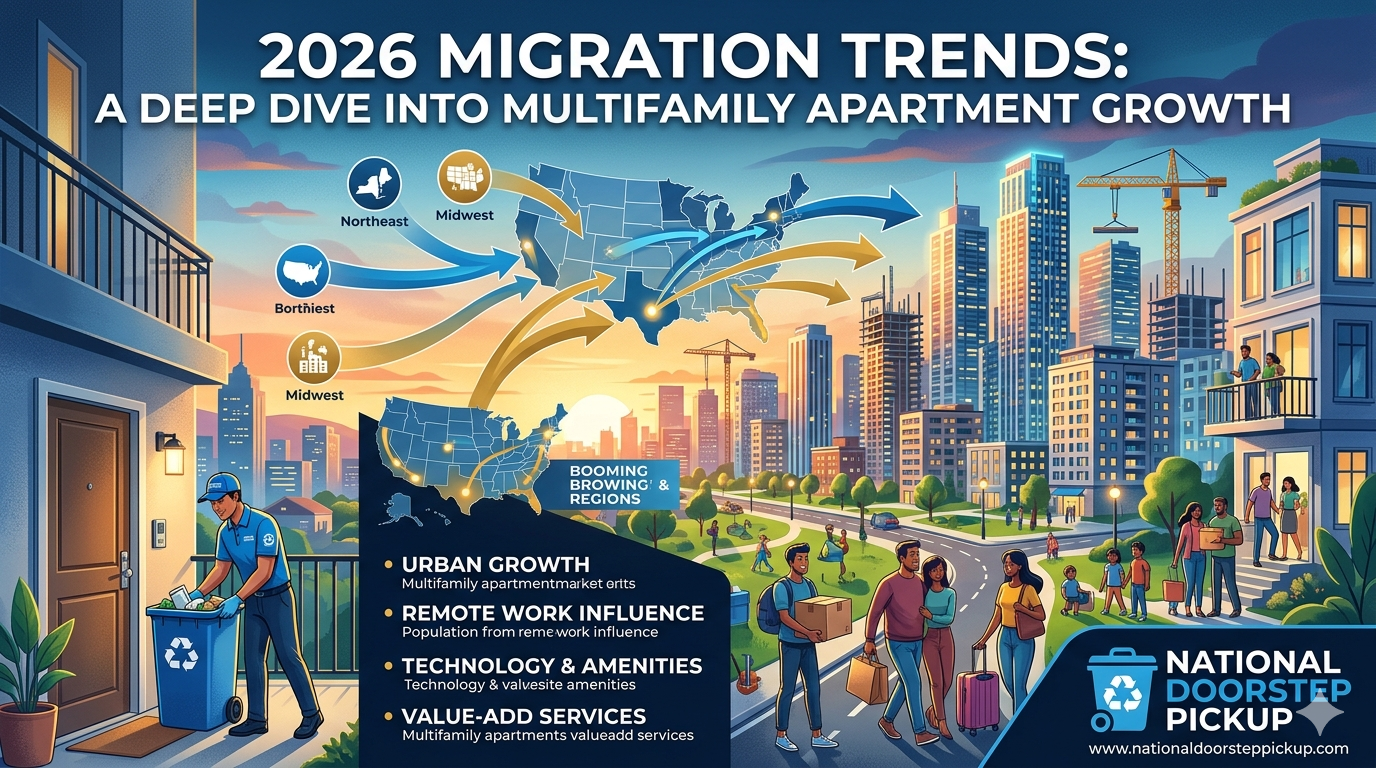
The old migration story was simple: people were leaving expensive coastal markets and flooding the Sunbelt.
The 2026 story is more complicated — and much more important for multifamily.
According to Bank of America Institute’s January 2026 migration report, fewer Americans are moving each year, and the total number of movers has fallen by more than half since 2021. But when households do relocate, they overwhelmingly prefer to stay within their same region. The big trend is not a dramatic national reshuffling. It is residents trading one nearby metro for another that better fits their budget, lifestyle, job situation, or housing needs.
For apartment owners, regional managers, and asset managers, that matters.
Because migration is no longer just a population story.
It is an operations story.
It affects leasing velocity. It affects renewal pressure. It affects amenity expectations. It affects dumpster volume. It affects recycling compliance. And in fast-growing metros, it can quietly turn trash operations into a major resident-experience and NOI issue.
The Migration Map Is Uneven — And Multifamily Operators Need to Read It Correctly
Bank of America’s report shows that affordability and climate remain two of the biggest forces behind migration. Smaller, comparatively less expensive cities continue to gain traction, while several high-cost coastal and large metro markets are still seeing outflows.
The biggest takeaway for apartments:
Growth is becoming more local, more selective, and more operationally demanding.
Residents are not simply moving anywhere cheaper. Many are staying within familiar regions and choosing cities that offer a better balance of price, quality of life, and access to jobs.
That creates opportunity for multifamily communities in markets like:
Austin
Austin continues to attract residents from other Texas metros and from major coastal cities. The report notes that nearly one in four new Austin residents came from other major Texas metros in 2025, with additional inflows from the South and West.
Denver
Denver remains a major lifestyle and affordability alternative for residents leaving pricier coastal hubs. Bank of America’s data shows Denver drawing heavily from the West and South, with meaningful inflows from Los Angeles, San Francisco, Seattle, Washington, D.C., and Miami.
Philadelphia
Philadelphia is benefiting from New York migration. More than one in four new Philadelphia residents came from New York City, reinforcing the city’s role as a nearby affordability alternative for Northeast renters.
Indianapolis, Columbus, and Cleveland
The Midwest is gaining momentum. Bank of America notes that three of the five fastest-growing MSAs in Q4 2025 were in the Midwest, with Indianapolis and Columbus holding the top two spots for the second straight quarter and Cleveland joining the group.
For apartment operators, these are not just “where people are moving” headlines.
They are signals that certain markets may see stronger household formation, more move-ins, higher resident churn, greater service expectations, and more strain on property infrastructure.
Including waste infrastructure.
Why Migration Trends Hit Apartment Operations First
When a market gains residents, multifamily communities feel the operational pressure quickly.
More residents means more packages, more move-in waste, more bulk items, more cardboard, more trash room use, more dumpster traffic, and more recycling contamination.
And when renters are moving from expensive coastal markets into value-oriented metros, they often bring higher expectations with them.
They expect convenience.
They expect clean hallways.
They expect easy waste disposal.
They expect recycling options.
They expect a community that feels organized, modern, and professionally managed.
That is where many apartment communities fall behind.
The leasing team may win the resident — but the operations team has to keep them.
And one of the fastest ways to create resident frustration is to let waste operations break down.
Overflowing dumpsters. Loose trash. Leaking bags. Bulk items left by enclosures. Trash rooms that smell. Recycling bins filled with garbage. Cardboard stacked outside compactors after move-in weekends.
These are not minor housekeeping issues.
They are resident-experience issues.
They are review-risk issues.
They are maintenance-labor issues.
They are compliance issues.
And ultimately, they are NOI issues.
The Apartment Growth Markets Have a Waste Problem Coming
The fastest-growing or migration-positive markets are often the exact places where multifamily operations need more structure.
Why?
Because growth increases friction.
A 300-unit property operating near stabilized occupancy does not experience waste the same way as a 300-unit property dealing with constant leasing activity, new move-ins, resident turnover, and amenity competition.
In growth markets, operators should expect:
More cardboard from move-ins
More bulk items during turnover
Higher compactor usage
More resident complaints around dumpster areas
Higher contamination risk in recycling streams
More pressure on maintenance teams
More visible cleanliness issues during tours
More demand for convenience-based amenities
This is especially important in cities attracting renters from more expensive metros. A renter leaving New York for Philadelphia, Los Angeles for Denver, or a coastal market for Austin may be moving for value — but that does not mean they are lowering their expectations.
They still want convenience.
They still want cleanliness.
They still want a professionally run apartment experience.
That makes doorstep valet trash and valet recycling more than an amenity.
It becomes an operating system.
The Big Multifamily Lesson: Resident Mobility Is Slowing, So Retention Matters More
One of the most important findings from the Bank of America report is that fewer Americans are moving overall. The number of people moving to different states or MSAs has declined faster than those moving within the same MSA, and overall mover volume is down sharply from 2021 levels.
That creates a major implication for multifamily:
If fewer residents are moving, winning renewals becomes even more important.
In a slower-mobility environment, property managers cannot rely only on new demand to replace dissatisfied residents. They need to protect the resident experience inside the community.
That means the everyday details matter more.
The hallway matters.
The dumpster enclosure matters.
The trash room matters.
The recycling area matters.
The Monday morning property walk matters.
The resident who has to carry trash across a dark parking lot notices.
The resident who sees overflowing dumpsters before work notices.
The prospect touring near a smelly compactor notices.
The online reviewer definitely notices.
Waste operations are one of the most visible parts of property management because every resident interacts with trash every day.
A clean waste system helps protect renewals.
A broken waste system quietly pushes residents toward the exit.
Why Doorstep Collection Fits the New Migration Economy
In the current market, apartment communities need amenities that do more than look good on a brochure.
They need amenities that solve operational problems.
Doorstep valet trash and valet recycling help multifamily communities respond to migration-driven demand in four practical ways.
1. It reduces maintenance labor drag
When residents are moving in and out, maintenance teams often get pulled into trash-related work: cleaning enclosures, picking up loose bags, breaking down cardboard, clearing bulk items, responding to complaints, and dealing with overflow.
That is expensive labor being redirected away from higher-value work.
A structured doorstep collection program helps remove that burden by creating a consistent nightly collection rhythm.
Instead of waste problems accumulating until maintenance has to react, the property gets a proactive operating system.
2. It improves resident convenience
Migration is driven partly by lifestyle. Residents are choosing communities that make daily life easier.
Doorstep collection does exactly that.
Residents do not have to carry bags across the property at night. They do not have to load trash into their car. They do not have to navigate overflowing dumpsters or trash rooms.
That convenience is simple, visible, and easy to understand.
It is the kind of amenity residents actually use.
3. It supports recycling compliance
Mandatory recycling laws and local waste diversion requirements are expanding across many markets. For multifamily properties, the challenge is not just having recycling bins available. The challenge is getting residents to use them correctly and consistently.
Doorstep valet recycling creates a better behavioral pathway.
Residents are more likely to participate when recycling is easy, clearly explained, and built into the property’s normal service rhythm.
For mandated markets, that matters.
It can help reduce contamination, improve documentation, and support a more inspection-ready compliance posture.
4. It protects NOI
Trash is not just an expense line.
It affects labor, hauling, resident satisfaction, online reputation, renewal probability, compliance risk, and asset perception.
When waste operations are inefficient, NOI leaks from multiple places at once.
Doorstep collection can help multifamily operators reduce operational drag, improve resident satisfaction, and create a cleaner path to ancillary revenue when communities structure the service as a resident-paid amenity.
What Austin, Denver, Philadelphia, and Midwest Growth Markets Should Be Watching
The Bank of America report highlights multiple markets with meaningful population inflows, including Austin, Denver, Philadelphia, Indianapolis, Columbus, and Cleveland.
For apartment operators in these markets, the question is not just:
“Are people moving here?”
The better question is:
“Is our property operationally ready for the demand that comes with them?”
That means asking:
Do our dumpsters overflow during peak move-in periods?
Are recycling areas clean enough for residents to actually use?
Are bulk items being managed before they become an eyesore?
Are maintenance teams spending too many hours on trash problems?
Are residents complaining about convenience, cleanliness, or safety?
Are we documenting waste and recycling service performance?
Are we prepared for local recycling or organics compliance requirements?
Are we turning waste operations into an amenity — or letting it become a liability?
The properties that answer these questions early will be better positioned to compete.
The properties that ignore them may find themselves losing the resident experience battle in markets where renters have more options.
What Outflow Markets Can Learn Too
Migration outflow markets like Los Angeles, New York, and Miami are also important for multifamily strategy.
For operators in these markets, resident retention becomes even more critical.
If affordability is already pressuring renters, communities need to be careful about every operational friction point that makes residents question value.
That does not mean every property needs luxury amenities.
It means every property needs the basics to feel clean, controlled, and convenient.
Trash cannot be a daily reminder that the resident is paying more and getting less.
In higher-cost or outflow markets, a clean, documented, resident-friendly waste program can help defend perceived value.
That matters when every renewal counts.
The New Competitive Advantage: Clean, Compliant, Convenient Communities
The apartment industry spends enormous energy on rent growth, concessions, supply pipelines, and migration trends.
But the resident experience is often won or lost in the operational details.
A community can have a strong location, attractive units, and competitive pricing — but if the dumpster area is overflowing, the hallways smell, or residents are frustrated by trash logistics, the property experience suffers.
That is why migration trends should trigger an operational review.
Not just a leasing strategy.
Not just a rent strategy.
An operations strategy.
Because new residents bring new volume.
New volume brings new stress.
And unmanaged stress becomes cost.
How National Doorstep Helps Multifamily Communities Prepare
National Doorstep helps apartment communities turn waste operations from a maintenance headache into a cleaner, more scalable resident amenity.
Through doorstep valet trash, doorstep valet recycling, and National Doorstep GreenPlus™ with Compliance Shield, communities can create a more consistent, documented, resident-friendly waste system.
That means:
Cleaner hallways and common areas
Reduced trash-related maintenance burden
More convenient resident disposal
Improved recycling participation
Better support for local compliance requirements
Proof of Pickup® documentation
A stronger resident experience
A clearer path to NOI protection
For growth markets, this helps properties scale with demand.
For slower or outflow markets, it helps protect retention and perceived value.
For mandated recycling markets, it helps communities move from “we have bins” to “we have a system.”
And that difference matters.
Final Takeaway: Migration Is a Leasing Signal — But Waste Is the Operational Test
The 2026 migration story is not just about where Americans are going.
It is about what they expect when they arrive.
Residents are moving less often, staying closer to familiar regions, and choosing cities that offer a better balance of affordability and lifestyle. That creates a sharper competitive environment for multifamily operators.
The communities that win will not just be the ones with the best rent specials.
They will be the ones that operate better.
Cleaner. Faster. More conveniently. More compliantly.
In today’s apartment market, waste operations are no longer back-of-house.
They are part of the resident experience.
And in the next wave of migration-driven multifamily demand, that may be the difference between a property that simply fills units — and one that protects renewals, reputation, and NOI.
See how National Doorstep can help your property reduce trash headaches, improve resident convenience, support recycling compliance, and turn waste operations into a cleaner NOI strategy.