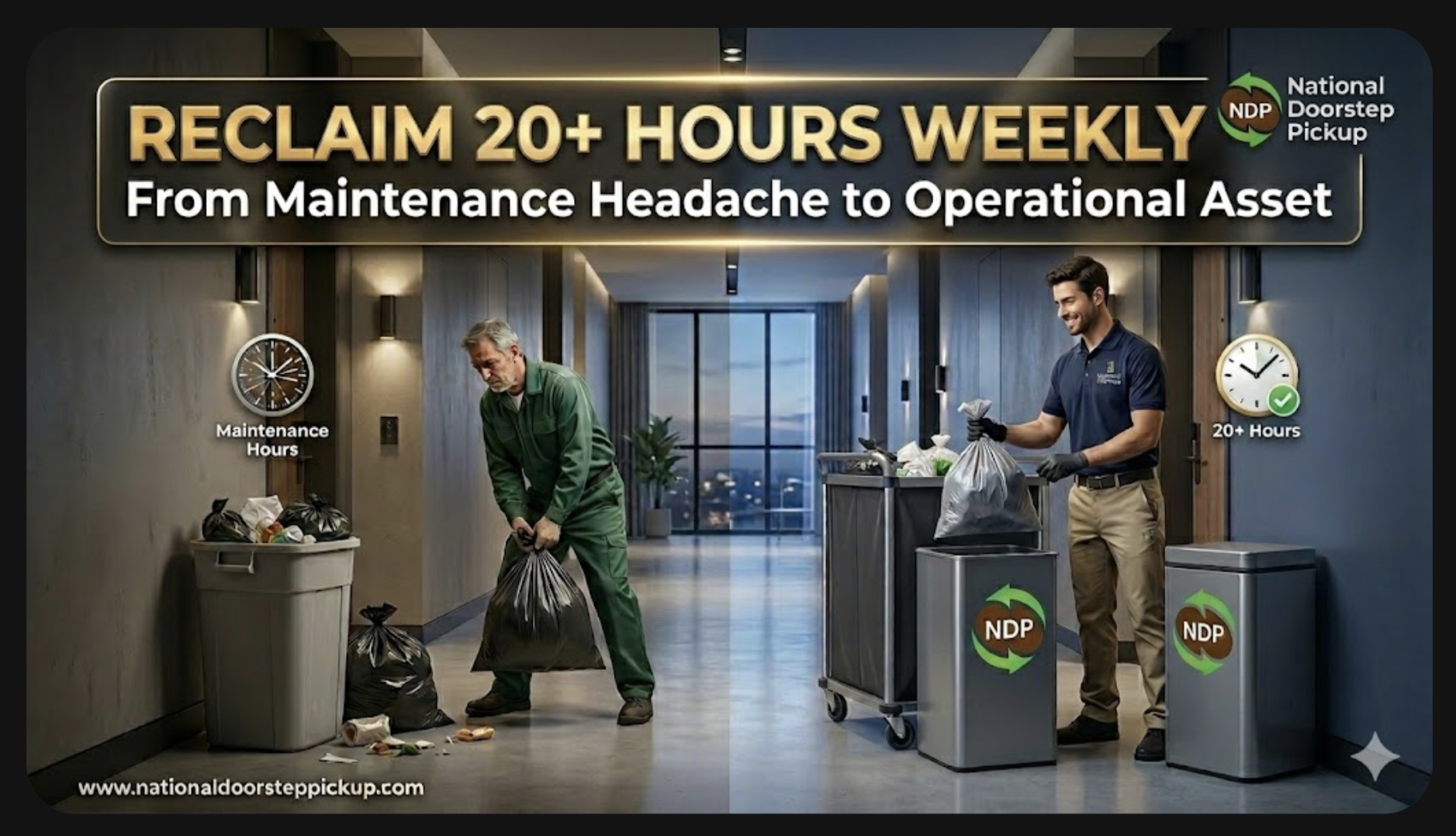
By Les Leith, CEO & COO at National Doorstep Pickup
The Hidden Time Drain Sitting Outside Every Apartment Door
Trash should not be one of your property’s biggest operational distractions.
Yet for many multifamily communities, it quietly becomes exactly that.
Overflowing dumpsters. Missed hauls. Bulk items left beside compactors. Residents ignoring trash rules. Maintenance teams pulled away from turns, service requests, inspections, curb appeal, and preventative work because waste problems keep popping up.
For regional managers, this creates inconsistency across the portfolio.
For asset managers, it shows up as labor inefficiency, resident dissatisfaction, and preventable operational drag.
For on-site property managers, it becomes another daily fire to put out before the real work can begin.
The good news: trash does not have to stay a recurring maintenance headache.
Why Trash Becomes a Property Management Problem
On paper, trash collection sounds simple.
Residents take trash to the dumpster. The hauler removes it. The property stays clean.
In reality, multifamily waste management is rarely that clean.
Most communities deal with some combination of:
Trash left in breezeways, hallways, stairwells, or near doors
Overflowing dumpsters or compactors
Bulk items abandoned without notice
Maintenance teams making repeated trash runs
Resident complaints about smell, pests, or appearance
Staff time spent sending reminders, notices, and violation letters
Move-out debris and improper disposal
Weekend or after-hours trash issues
Curb appeal problems before tours or inspections
The issue is not just trash. The issue is time leakage.
Every hour your maintenance team spends chasing bags, cleaning dumpster areas, or correcting resident behavior is an hour they are not spending on higher-value property operations.
That is where the 20+ hours per week add up.
The 20-Hour Problem Most Properties Don’t Measure
Many properties underestimate how much labor waste issues consume because the work is fragmented.
It may look like:
15 minutes here.
A maintenance tech clears bags from a stairwell.
30 minutes there.
Someone cleans around the compactor before a tour.
Another hour later.
The team handles trash complaints, resident notices, and overflow.
Across a week, those moments compound quickly.
A typical on-site team may lose time to:
Daily trash patrols
Dumpster area cleanup
Resident education and enforcement
Bulk item coordination
Extra maintenance walks
Odor and pest-related cleanup
Overflow response
After-hours complaints
Move-in and move-out disposal problems
And that is before you account for the opportunity cost.
What could your maintenance team accomplish with 20 hours back?
More turns completed on time.
Faster service request response.
Cleaner amenities.
Better curb appeal.
Fewer resident complaints.
More consistent property standards.
That is the operational value of valet trash.
What Valet Trash Actually Solves
Valet trash is not just door-to-door trash pickup.
Done correctly, it is a structured operational system that removes friction from daily waste management.
A professional apartment valet trash service typically helps by:
Collecting resident trash directly from designated areas
Reducing trips residents make to dumpsters or compactors
Keeping breezeways, hallways, and common areas cleaner
Supporting consistent nightly or scheduled collection standards
Reducing overflow and improper disposal
Creating a more convenient resident experience
Helping on-site teams maintain cleaner community presentation
Providing documentation, reporting, and accountability
The best valet trash programs do not simply move bags from doors to dumpsters.
They help management teams create a repeatable process.
That matters because multifamily operations depend on consistency. A system that works on Monday but falls apart by Friday is not an asset. It is another vendor problem.
A strong valet trash partner gives your team a cleaner, more predictable workflow.
For Regional Managers: Standardize Waste Operations Across the Portfolio
Regional managers are responsible for performance across multiple communities. That means inconsistency is expensive.
One property may have a strong maintenance team that keeps trash issues under control. Another may struggle with overflow, resident compliance, or dumpster area appearance. A third may lose hours every week to problems that never make it into a formal report.
Valet trash gives regional managers a way to standardize expectations.
Instead of each property improvising, you can create a clear waste management process across communities:
Consistent collection schedules
Clear resident instructions
Defined service expectations
Cleaner common areas
Easier vendor accountability
Reduced burden on maintenance teams
Better visibility into recurring issues
For regionals, the goal is not just cleaner properties.
The goal is operational control.
When valet trash is managed properly, it becomes easier to compare performance, spot issues, and protect site teams from being buried in avoidable tasks.
For Asset Managers: Turn a Cost Center Into NOI Support
Asset managers look at valet trash differently.
The key question is not only, “Does this make the property cleaner?”
The better question is, “Does this improve the asset’s operating performance?”
When structured correctly, valet trash can support the asset in several ways.
First, it reduces operational inefficiency. Maintenance labor is expensive, and it becomes even more expensive when skilled team members are spending time on low-value trash tasks.
Second, valet trash can improve resident satisfaction. Convenience matters in multifamily. Residents notice when a property is clean, easy to live in, and professionally managed.
Third, valet trash can support ancillary income strategies when offered as a resident amenity or service fee, depending on the property’s lease structure, market, and compliance requirements.
Fourth, cleaner communities can help protect curb appeal, online reputation, and renewal confidence.
In other words, valet trash is not simply an expense line.
It can become part of a broader NOI protection and value-creation strategy.
For On-Site Property Management: Fewer Daily Fires, Cleaner Operations
On-site teams feel the trash problem most directly.
They are the ones fielding resident complaints. They are the ones walking the property before tours. They are the ones asking maintenance to “just grab that bag real quick” for the fifth time that day.
Valet trash helps on-site teams regain control of the day.
Instead of constantly reacting, your team can rely on a defined collection process. Residents know when trash is picked up. Staff knows what to expect. Maintenance gets fewer interruptions. The community looks cleaner with less manual intervention.
That operational relief matters.
A property manager’s day is already full: leasing, renewals, resident relations, delinquency, vendor management, inspections, reporting, and team leadership.
Trash should not dominate the schedule.
With the right partner, valet trash removes a recurring source of friction so the team can focus on managing the property, not chasing bags.
The Before-and-After Impact of Valet Trash
Here is what the operational shift often looks like.
Before Valet Trash
Maintenance starts the day clearing trash from common areas.
The office receives complaints about overflowing dumpsters.
Residents leave bags outside at random times.
Bulk items appear without notice.
The team sends repeated reminders.
Trash areas hurt curb appeal before tours.
Maintenance loses hours every week to cleanup.
After Valet Trash
Residents follow a clear collection process.
Trash is picked up on a reliable schedule.
Common areas stay cleaner.
Maintenance handles fewer trash-related interruptions.
Management has better visibility into service issues.
Curb appeal improves.
The property feels more professionally operated.
The difference is not just aesthetic.
It is operational.
Why the Right Valet Trash Partner Matters
Not all valet trash providers create the same result.
A weak provider can create new headaches: missed pickups, poor communication, inconsistent crews, resident confusion, and more work for your team.
A strong provider should make operations easier, not more complicated.
Look for a valet trash partner that provides:
Reliable nightly or scheduled collection
Clear communication with management
Resident-facing instructions and support
Issue reporting and documentation
Professional, uniformed service teams
Scalable service across single-site or portfolio needs
Flexibility for property layout, access, and community rules
Support for compliance-oriented waste and recycling programs
The right partner should understand that multifamily waste management is not just a janitorial task.
It is a resident experience, labor efficiency, risk reduction, and asset performance issue.
How Valet Trash Helps Reclaim 20+ Hours Per Week
The time savings come from removing recurring low-value tasks from the maintenance and management workflow.
Valet trash can reduce time spent on:
1. Daily Property Trash Walks
Instead of staff repeatedly checking breezeways, stairwells, and dumpster areas, valet collection creates a scheduled service rhythm.
2. Dumpster Area Cleanup
When residents are less dependent on dumpster trips, properties often see fewer loose bags, spills, and overflow issues around disposal areas.
3. Resident Complaints
Cleaner, more convenient waste removal can reduce complaints related to odor, pests, trash buildup, and unsightly common areas.
4. Maintenance Interruptions
Maintenance teams can stay focused on work orders, turns, inspections, and preventative maintenance instead of being redirected to trash issues throughout the day.
5. Staff Enforcement
A structured valet trash program makes expectations clearer for residents and easier for management to communicate.
6. Turnover and Move-Out Debris
With the right procedures, valet trash partners can also help identify recurring disposal issues and support cleaner transition periods.
Valet Trash Is Also a Resident Experience Upgrade
Residents value convenience.
They want simple, predictable services that make daily life easier. Taking trash across the property at night, in bad weather, or while carrying multiple bags is not a premium living experience.
Valet trash changes that.
It gives residents a service they can understand immediately.
They place trash out according to the property’s guidelines. The service team collects it. The community stays cleaner.
That convenience can support:
Higher perceived value
Better resident satisfaction
Stronger amenity positioning
Improved renewal conversations
A cleaner first impression for prospects
Fewer negative interactions around trash rules
For competitive apartment markets, the small daily conveniences matter.
The Operational Asset Mindset
The biggest mistake is viewing valet trash as just another vendor line item.
A better way to evaluate it is as an operational asset.
Ask:
How many maintenance hours are currently being spent on trash issues?
How often does trash affect curb appeal?
How many resident complaints involve waste, odor, pests, or overflow?
How often are site teams pulled into preventable cleanup?
Could a structured program reduce labor leakage?
Could this improve resident convenience and perceived property value?
Could this support ancillary income or expense control?
When you evaluate valet trash through that lens, the value becomes clearer.
You are not just paying for pickup.
You are buying back staff time, consistency, cleanliness, resident convenience, and operational focus.
Signs Your Property Is Ready for Valet Trash
Your community may be ready for valet trash if you are seeing any of the following:
Maintenance is regularly pulled into trash cleanup
Dumpsters or compactors are frequent problem areas
Residents complain about trash, odor, pests, or overflow
Common areas are difficult to keep clean
Trash issues hurt tours or curb appeal
Staff spends too much time enforcing disposal rules
Your property wants to add a high-use resident amenity
You manage multiple properties and need consistency
Your team is trying to improve operational efficiency
You want to reduce low-value maintenance labor
If trash is showing up in daily operations, resident complaints, or property walks, it is already costing more than you think.
How National Doorstep Helps Properties Reclaim Time
National Doorstep helps multifamily communities turn waste management into a cleaner, more reliable, and more efficient process.
Our valet trash programs are designed for the realities of apartment operations: busy site teams, resident compliance challenges, portfolio standards, and the need for dependable service.
We help properties reduce maintenance burden, improve resident convenience, and create cleaner communities through structured doorstep trash collection and operational support.
For regional managers, we help standardize service across communities.
For asset managers, we help support efficiency, resident satisfaction, and value creation.
For on-site property teams, we help remove a recurring daily headache.
The result is simple: less time chasing trash and more time operating the property.
Final Takeaway: Trash Is Either Draining Your Team or Supporting Your Operations
Trash will always exist at multifamily properties.
The question is whether it remains a recurring maintenance headache or becomes a managed operational system.
When handled reactively, trash drains staff time, hurts curb appeal, frustrates residents, and pulls maintenance away from higher-value work.
For regional managers, asset managers, and on-site teams, that is the real value.
Valet trash is not just a convenience.
It is an operational advantage.
Ready to Reclaim 20+ Hours Per Week?
Stop letting trash consume your maintenance team’s time.
Request a Free Valet Trash Assessment for Your Property and see how National Doorstep can help your community reduce trash-related labor, improve resident convenience, and turn waste management into an operational asset.