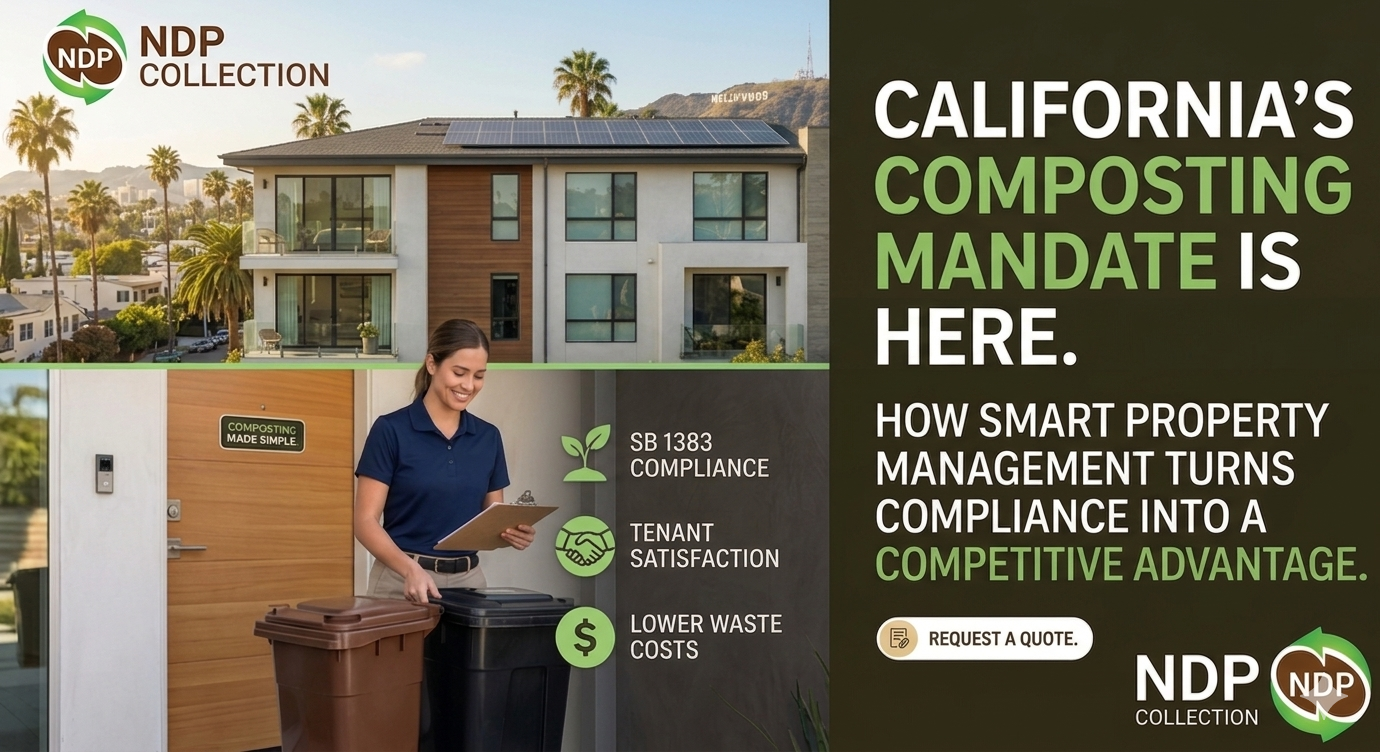
California’s Composting Mandate: How Smart Property Management Turns Compliance Into a Competitive Advantage
By Les Leith, CEO & COO at National Doorstep Pickup
California’s composting law is no longer optional—and for multifamily property management, it represents both a regulatory obligation and a strategic opportunity. As the state pushes aggressively (missed 2025 diversion goals) to reduce methane emissions and organic waste in landfills, properties that fail to adapt face rising compliance risks, while those that act decisively can strengthen NOI, resident satisfaction, and long-term asset value .
This guide breaks down what California’s composting law requires, why it matters specifically for multifamily communities, and how property management teams can implement compliant programs without adding operational friction.
What California’s Composting Law Means for Multifamily Properties
California’s organic waste recycling requirements place multifamily communities squarely in scope. Property management is still responsible for ensuring organic materials—food scraps, food-soiled paper, and other compostables—are diverted from landfills through approved collection or processing methods .
Unlike past recycling initiatives, this law goes beyond “best effort.” It introduces enforceable expectations around:
Organic waste diversion
Approved collection and processing
Ongoing resident education
Monitoring and documentation
Fines and penalties for non-compliance
For multifamily operators, the takeaway is clear: composting is now a core operational function, not a nice-to-have sustainability perk.
Why Composting Matters Beyond Compliance
Environmental Impact With Regulatory Teeth
Organic waste in landfills generates methane, a greenhouse gas significantly more potent than carbon dioxide. California’s composting law directly targets this issue as part of the state’s climate strategy, positioning property management as frontline partners in emissions reduction .
Resident Expectations Are Changing
Today’s residents increasingly expect visible sustainability initiatives. Communities that demonstrate environmental leadership differentiate themselves in competitive leasing markets—especially across California metros where green living is a baseline expectation, not a bonus.
Financial and Operational Upside
Effective composting programs can reduce landfill-bound waste volume, helping control hauling frequency, contamination penalties, and long-term disposal costs. When executed correctly, compliance aligns with cost optimization rather than cost escalation.
Core Compliance Requirements Property Management Must Address
1. Organic Waste Diversion
Property management must implement a clear, intuitive system that enables residents to properly separate organic waste from landfill and recycling streams—without friction or ambiguity.
Contamination remains a persistent operational risk. While source separation appears straightforward in theory, in practice it routinely breaks down. Residents often place conventional plastics or non-compliant “compostable” bioplastics into organics bins, driving contamination rates well above acceptable thresholds. This creates downstream processing issues for composting facilities, which are required to meet stringent state quality standards and can reject entire loads when contamination is excessive..
2. Collection and Processing
Communities are required to either:
Contract with an approved organic waste hauler, or
Implement and maintain a compliant on-site composting system
However, hauling constraints introduce real friction. Many jurisdictions enforce exclusive franchise agreements that lock properties into designated municipal haulers. These systems are not always optimized for circular recovery, leading to inefficiencies in material routing. As a result, high-value pre-consumer food waste is frequently misdirected to landfill streams instead of being captured for composting or anaerobic digestion—undermining both diversion goals and sustainability ROI.
3. Education and Training
Education is not optional. Property management must actively inform residents and staff how, where, and why composting is required. At the same time, post-pandemic conditions have slowed adoption. Persistent supply chain disruptions, inflationary pressure on capital projects, and limited resident education have delayed the large-scale behavioral changes required at both the residential and commercial levels.
4. Monitoring and Recordkeeping
Documentation of services, education efforts, and diversion practices must be maintained to demonstrate compliance during inspections or audits.
5. Infrastructure Investment
Proper bins, signage, and storage areas are often necessary to support successful participation and reduce contamination.
A Practical Compliance Roadmap for Property Management
Step 1: Assess Your Current Waste Stream
Identify how much organic waste your community generates and where it currently ends up.
Step 2: Design an Organic Diversion Plan
Determine bin placement, collection schedules, and resident access points that minimize friction.
Step 3: Partner With Qualified Providers
Work with certified waste and recycling partners that understand California’s regulatory framework and reporting requirements.
Step 4: Educate Residents Consistently
Clear signage, move-in materials, digital reminders, and periodic refreshers drive sustained participation.
Step 5: Monitor, Adjust, and Document
Track contamination rates, resident feedback, and service performance to continuously improve outcomes.
How National Doorstep® Simplifies Composting Compliance
One of the biggest challenges in composting compliance is participation. Convenience directly impacts success.
National Doorstep®’s doorstep valet trash and recycling services reduce resident friction by enabling consistent, reliable waste separation at the source. By improving compliance behavior at the unit level, property management can:
Reduce contamination in compost and recycling streams
Improve participation without constant enforcement
Demonstrate good-faith compliance efforts during inspections
Align sustainability goals with a premium resident experience
This approach turns composting from an enforcement challenge into an amenity-driven solution.
The Business Case for Acting Now
Complying with California’s composting law is not just about avoiding fines. It is about future-proofing assets in a state where environmental regulation will only tighten. Adopters benefit from:
Lower long-term compliance risk
Stronger resident retention and satisfaction
Enhanced ESG positioning for owners and investors
Operational systems that scale with future mandates
Final Takeaway
California’s composting mandate is actively redefining multifamily operations across the state. Operators who take a proactive, systems-driven approach—rather than a reactive compliance posture—can convert a regulatory burden into a clear operational and marketing advantage while avoiding economic and logistical hurdles.
Although the 2025 deadline fell short of the 75% diversion goal, SB 1383 has permanently restructured how waste is managed statewide. Cities, property managers, and businesses continue to invest heavily in organics diversion programs, green infrastructure, and food recovery systems to close the gap in the coming years.
Processing capacity remains the critical bottleneck. California needed more than 160 new or expanded composting and anaerobic digestion facilities to handle the anticipated waste stream. In practice, development has lagged due to complex permitting requirements, funding challenges, and rising construction costs—driving projected infrastructure investment beyond $10 billion by 2030.
With the right local operational partners (city and county/parish) and resident-facing logistics, composting can be streamlined, contamination reduced, and compliance costs controlled—while elevating your property’s position as a sustainability-forward community.
To evaluate how doorstep collection can support your composting and recycling compliance strategy, request a quote from National Doorstep® today.