Composting Made Simple for Multifamily Apartments: How Valet Trash, Compostable Bags, and Smart Systems Drive Compliance and NOI
By Les Leith, CEO & COO at National Doorstep Pickup
Composting is no longer an optional sustainability feature for multifamily housing. It is rapidly becoming a core operational requirement driven by municipal mandates, rising landfill costs, and increasing resident expectations for environmentally responsible living.
For property management, the challenge is not understanding why composting matters—it is understanding how to implement composting in a way that is compliant, operationally efficient, resident-friendly, and financially positive.
This comprehensive playbook blends education with execution. It explains what composting is, how it works in apartment communities, and how valet trash, compostable bags, and smart systems transform composting from a headache into a high-performing amenity.
What Composting Is—and Why It Matters in Multifamily Housing
Composting is the controlled diversion of organic waste—primarily food scraps and compostable paper—from landfills to commercial composting facilities, where it is processed into nutrient-rich material.
From a multifamily perspective, composting delivers three strategic advantages:
Landfill diversion – Organic material often represents 30–40% of an apartment community’s waste stream.
Regulatory compliance – Many jurisdictions now require organics separation for multifamily properties.
Cost control – Less landfill waste means fewer compactor pulls, lower tipping fees, and reduced contamination penalties.
Why Composting Often Fails in Apartments (and How to Fix It)
Traditional composting programs fail in multifamily communities for predictable reasons:
Residents must carry food waste long distances
Trash rooms are confusing or poorly labeled
Collection schedules are inconsistent
Contamination is unchecked
Convenience and accountability are the missing links.
This is where valet trash–supported composting fundamentally changes outcomes.
How Valet Trash Transforms Apartment Composting
Valet trash removes friction from composting by making participation routine, convenient, and verifiable.
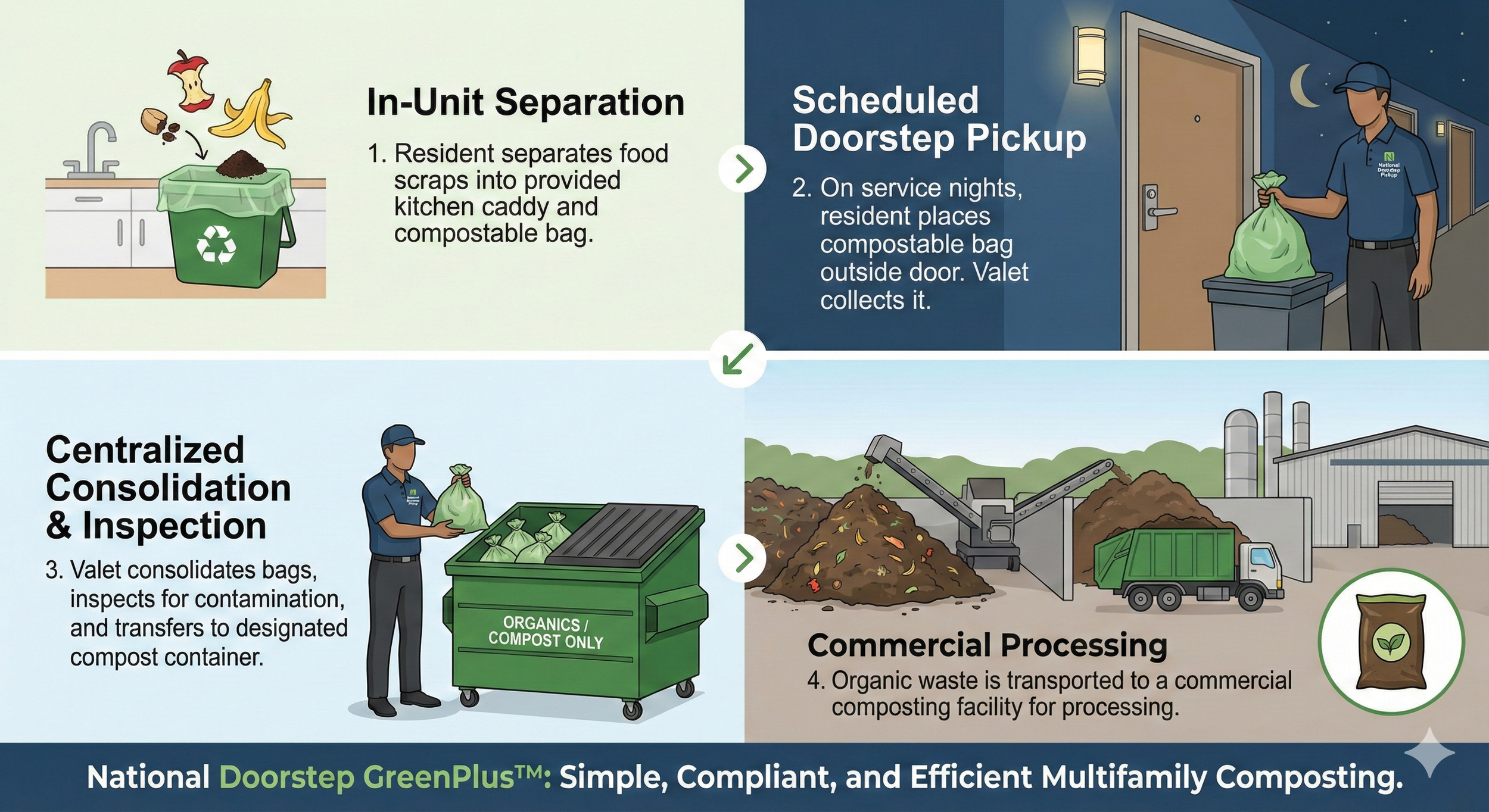
How the System Works
In-unit separation
Residents place food waste and compostable paper into approved compostable bags using a small kitchen caddy.Scheduled doorstep pickup
On designated service nights, residents place compostable bags outside their doors—just like trash or recycling.Centralized consolidation
Valet teams collect, inspect, and transfer organics into designated compost containers for licensed hauling.Commercial processing
Organic waste is transported to an industrial composting facility and processed under controlled conditions.
This model dramatically improves:
For property management, composting becomes a managed service, not a resident guessing game.
What Can and Cannot Be Composted in Apartment Communities
Common Compostable Items
Fruit and vegetable scraps
Meat, poultry, and fish (commercial composting)
Dairy products
Coffee grounds and filters
Bread, grains, and rice
Food-soiled paper (napkins, paper towels, pizza boxes)
Common Contaminants (Must Be Avoided)
Plastic bags of any kind
“Biodegradable” bags not certified for composting
Glass, metal, or aluminum
Liquids, oils, or chemicals
Packaging not approved by the local compost hauler
Clear rules, consistent signage, and valet inspection are essential to prevent rejected loads and fines.
Compostable bags are foundational to successful multifamily composting.
Why They Matter
Improve sanitation and cleanliness
Reduce odors during in-unit storage and pickup
Protect valet teams during handling
Increase resident participation
What Property Management Should Require
Certified compostable bags (BPI-certified or locally approved)
No plastic or petroleum-based liners
Sizes compatible with kitchen caddies and pickup standards
Retail Availability Is Key
Residents should be directed to easily accessible retail options, including:
Grocery stores
Big-box retailers
Online marketplaces
When approved bags are easy to find, compliance increases and contamination decreases.
Green Paper Products: The Hidden Composting Multiplier
Food waste is only part of the organics stream. Green paper products significantly expand diversion volume and improve program performance.
Common compostable paper items include:
Food-soiled napkins and paper towels
Pizza boxes
Uncoated paper plates
Paper takeout containers
Benefits include:
Moisture absorption inside compostable bags
Reduced odors
Cleaner handling during valet pickup
Explicitly allowing and promoting these items helps maximize landfill diversion and reduces compactor usage. Material types can vary by market. For example, Iowa City bans cardboard.
Composting and Compliance: Why Property Management Must Lead
Municipalities increasingly require:
Mandatory organics separation
Proof of resident education
Ongoing contamination monitoring
Enforceable compliance measures
Valet-supported composting provides:
Predictable participation
Visual inspection at pickup
Photo-documented proof of service
Reduced staff policing of trash rooms
For audits and enforcement, this documentation is critical.
Operational and Financial Benefits
Reduced Waste Costs
Lower landfill tonnage
Fewer compactor pulls
Reduced tipping and overage fees
Cleaner Waste Areas
Fewer odors
Reduced pest activity
Improved hygiene and safety
Improved NOI
Lower operating expenses
Increased resident satisfaction and retention
Stronger positioning as a “green” community
When implemented correctly, composting is cost-neutral to cost-positive, not an added expense.
How to Launch a Successful Composting Program (Step-by-Step)
Conduct a waste audit to understand diversion potential
Select a valet-integrated collection model
Standardize approved compostable bags and materials
Deploy clear, visual resident education
Train onsite teams and vendors
Monitor contamination and reinforce rules consistently
Composting succeeds when it is treated like any other essential building system.
Composting Is a System—Not a Bin
The most common mistake property management makes is viewing composting as a container placement issue. In reality, composting is a managed operational system that requires:
Convenience
Education
Oversight
Accountability
Valet trash, compostable bags, and green paper products form the backbone of a system that works at scale.
Final Takeaway for Property Management
Composting in multifamily communities works best when it is simple for residents and controlled by property management.
By integrating composting with valet trash service, standardizing compostable bags, and promoting green paper products, properties:
Reduce regulatory risk
Control operating costs
Deliver a cleaner, more attractive resident experience
When composting is executed as a service—not a suggestion—it becomes a competitive advantage and a long-term operational win.
Welcome to National Doorstep GreenPlus™. Our objective is to ensure a smooth, compliant, and fully documented service launch that supports onsite operations, resident adherence, and long-term NOI performance.