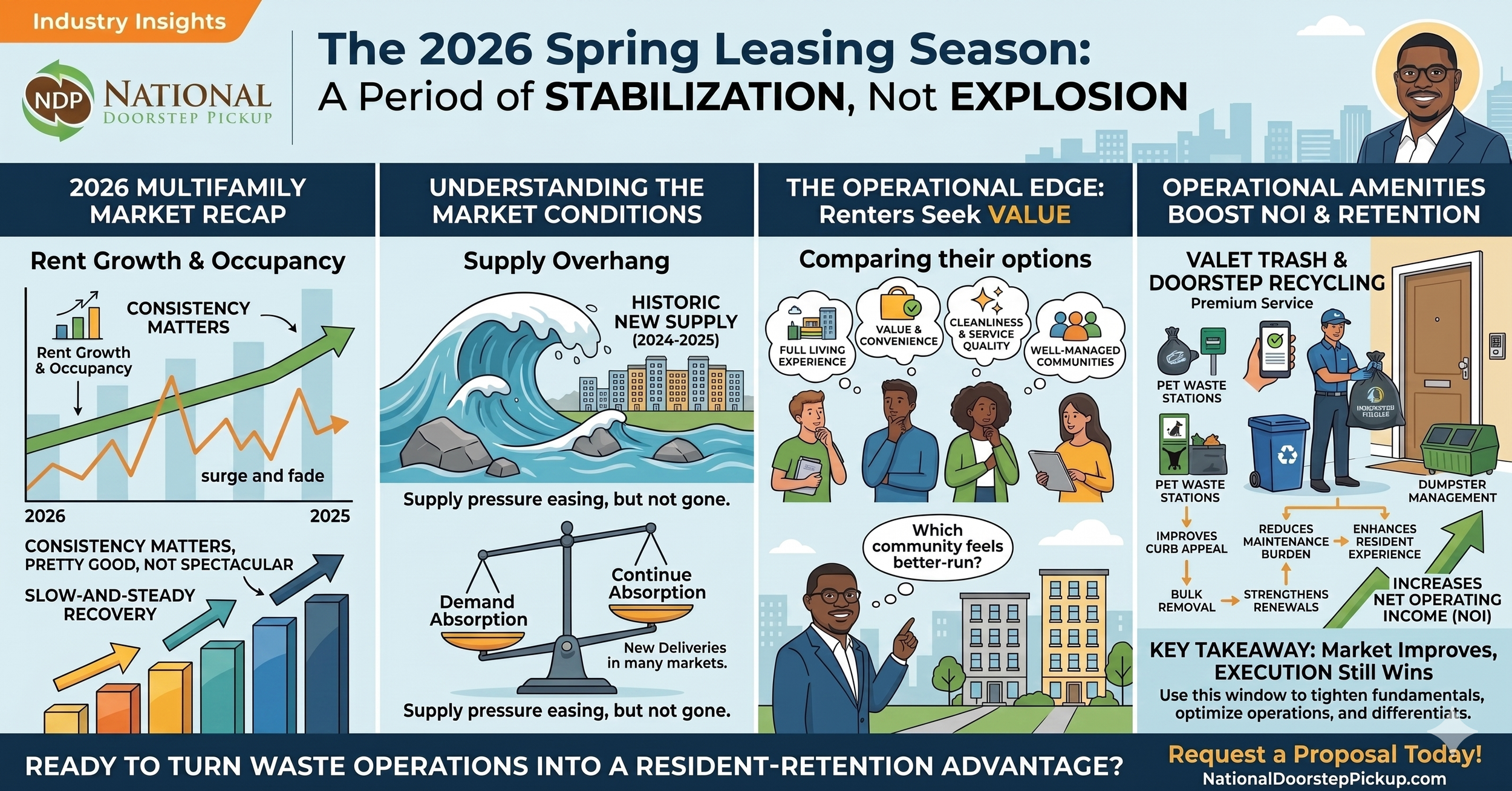
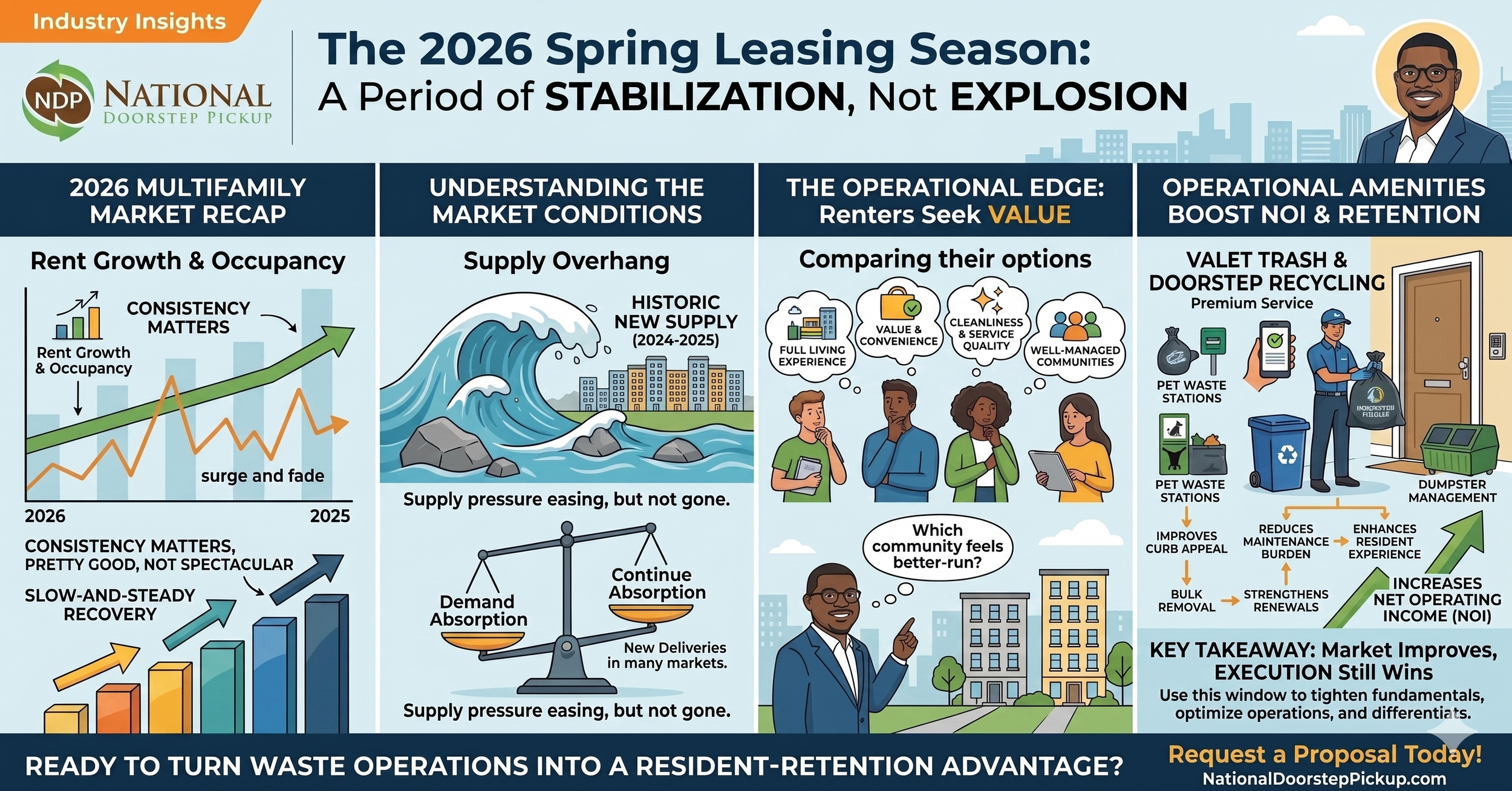
The 2026 spring leasing season did not explode. It stabilized.
By Les Leith, CEO & COO at National Doorstep Pickup
Now that the apartment industry is entering the summer months, we can finally call the spring leasing season what it was:
Pretty good. Not spectacular. Not a breakout. But meaningfully better because it was consistent.
And in today’s multifamily market, consistency matters.
After several years of uneven demand, elevated concessions, aggressive lease-up competition, and historic new supply, apartment fundamentals are finally showing signs of slow-and-steady recovery. The recovery is not happening overnight. Rent growth is not racing back to pre-pandemic strength. But the market is moving in the right direction.
The real story is not that spring leasing was red hot.
The real story is that it did not fall apart.
For apartment owners, regional managers, and property management teams, that matters because 2026 is shaping up to be a year where operational discipline, resident retention, amenity value, and service consistency can have a direct impact on NOI.
The Market Is Recovering From the Supply Wave—Slowly
The biggest headwind facing apartments over the past few years has been new supply.
In fact, completions have been the No. 1, No. 2, and No. 3 challenge for many multifamily markets.
Thousands of new units delivered into already competitive submarkets, creating pressure on occupancy, rent growth, concessions, and renewal pricing. Even as new completions begin to drop off, the industry entered the 2026 leasing season with a major overhang: nearly 100,000 units of excess lease-up inventory compared to historic norms.
That means many properties completed in 2024 and 2025 are still working toward stabilized occupancy.
Those communities are still competing hard.
They are still offering concessions.
They are still trying to pull renters out of neighboring assets.
And those concessions limit how fast effective rent growth can rebound.
This is why the recovery feels real but restrained. Supply pressure is easing, but it has not disappeared.
Demand Is Strong Enough to Absorb Supply—But Not Strong Enough to Ignite Rent Growth Yet
Despite the supply overhang, apartment demand has held up better than many expected.
Occupancy rates are improving because absorption is finally topping supply in more markets. That is the signal operators have been waiting for. When demand consistently exceeds new deliveries, the market starts to regain balance.
But demand-side conditions have not been perfect.
Job growth has been choppy, especially among recent college graduates. Consumer confidence has remained low. Renters are still cautious. Household budgets are still tight. Many residents are making housing decisions with more friction, more price sensitivity, and more scrutiny than they were a few years ago.
That explains why rent growth has improved, but not surged.
April and May rent growth was steady, but still below the pre-pandemic norm. That is not a bad outcome. It is actually close to what many apartment analysts expected.
The stronger point is this:
2026 looks healthier than 2025 because the momentum has been more consistent.
2026 Feels Different Than 2025
In 2025, rent growth started strong in early spring. For a moment, it looked like the apartment market was ready to rebound faster.
Then the second half of spring hit.
Momentum faded.
Rent growth weakened.
The market struggled through summer and fall.
That is what makes 2026 different.
This year, leasing did not start with a dramatic spike. It started okay, then improved gradually as the weather warmed. The numbers were not spectacular, but they were steadier. That is often a healthier signal than a short-lived surge.
Multifamily operators should pay close attention to this distinction.
A market that spikes and fades is difficult to manage.
A market that improves steadily is one where execution matters.
If supply pressures continue to taper and lease-up competition eases, the pace of recovery should gradually accelerate, assuming there is no major economic shock.
That means owners and managers should not wait for the market to rescue performance. They should use this window to tighten operations, protect occupancy, improve resident experience, and reduce preventable friction.
The New Leasing Reality: Renters Are Comparing the Full Living Experience
In a slower-growth market, residents are not just comparing rent.
They are comparing value.
They are comparing convenience.
They are comparing cleanliness.
They are comparing service quality.
They are comparing whether a community feels well-managed or neglected.
That is where operational amenities can become a leasing and retention advantage.
When concessions are still active in nearby lease-ups, a stabilized property needs more than a slightly better location or a basic amenity package. It needs reasons for residents to stay, renew, and feel that the monthly rent is justified.
A clean, consistent, well-run property creates confidence.
A community with overflowing dumpsters, hallway trash issues, missed pickups, odors, pest pressure, and resident complaints creates doubt.
And in a competitive leasing environment, doubt costs money.
Why Valet Trash and Doorstep Recycling Matter More in a Steady Recovery
During a booming market, some operational issues get hidden by demand.
During a choppy market, those issues become visible.
That is why services like professional valet trash, doorstep recycling, bulk removal support, pet waste station service, and photo-verified porter accountability matter more when the market is recovering slowly.
They help property teams protect the resident experience without adding unnecessary operational burden.
When residents see trash problems, they do not think, “The market is recovering from excess supply.”
They think, “This property is not being managed well.”
That perception can hurt reviews, leasing velocity, renewal conversations, and staff workload.
Operators Should Use 2026 to Tighten the Fundamentals
The spring leasing season shows that apartment fundamentals are improving. But this is not the type of market where operators can afford sloppy execution.
The communities that outperform are likely to be the ones that combine market recovery with operational consistency.
That means:
Reducing visible trash issues before they become resident complaints.
Improving property appearance before tours and move-ins.
Supporting leasing teams with a cleaner, more consistent community environment.
Reducing maintenance distractions caused by waste overflow, bulk trash, and missed collections.
Creating amenity value that residents can see and use every week.
Strengthening renewal conversations by making daily living easier.
The NOI Angle: Small Operational Improvements Can Protect Big Financial Outcomes
The spring leasing verdict should encourage operators, but it should not make them complacent.
If occupancy is improving and rent growth is slowly recovering, the next step is to protect the gains. That means reducing preventable resident dissatisfaction, improving service reliability, and creating operational amenities that support retention.
For property managers, that matters because the financial impact is not limited to the service fee.
It can influence:
Renewal confidence
Resident satisfaction
Online reviews
Leasing presentation
Maintenance efficiency
Curb appeal
Compliance readiness
Net operating income
In a market recovering from historic supply pressure, the winning communities will not simply be the ones waiting for rent growth to return.
They will be the communities that use this window to operate better.
Final Takeaway: The Market Is Improving, But Execution Still Wins
The 2026 spring leasing season delivered a clear message:
The apartment market is recovering, but the recovery is disciplined, not dramatic.
Supply pressure is easing. Absorption is improving. Occupancy is moving in the right direction. Rent growth is steadier than it was in 2025.
But operators still face lease-up competition, elevated concessions, cautious renters, and uneven economic sentiment.
That makes 2026 a year where execution matters.
Apartment communities that deliver cleaner grounds, stronger service consistency, better resident convenience, and more visible amenity value will be better positioned to capture the recovery as it accelerates.
The market is no longer falling backward.
Now the question is simple:
Will your property be ready to turn steady demand into stronger renewals, higher resident satisfaction, and better NOI?
Request a Proposal
National Doorstep helps apartment communities improve resident convenience, reduce trash-related complaints, support recycling programs, and strengthen the overall property experience with professional valet trash and doorstep recycling services.
Request a proposal today and turn waste operations into a resident-retention advantage.