Top Apartment Rent Growth Markets in 2026: May Leaders Multifamily Owners Should Watch
By Les Leith, CEO & COO at National Doorstep Pickup
Apartment rent growth is no longer spreading evenly across the country. RealPage’s May 2026 rent growth leaders show a sharply divided multifamily market where tech hubs, supply-constrained metros, and select Midwest markets are outperforming high-supply Sun Belt competitors. For apartment owners and property managers, the message is clear: when rents rise, resident expectations rise with them.
The Apartment Markets Winning Rent Growth in May 2026
The U.S. apartment market is finally showing signs of steady traction after years of supply pressure, uneven demand, and elevated concessions. But the rebound is not happening everywhere at the same pace.
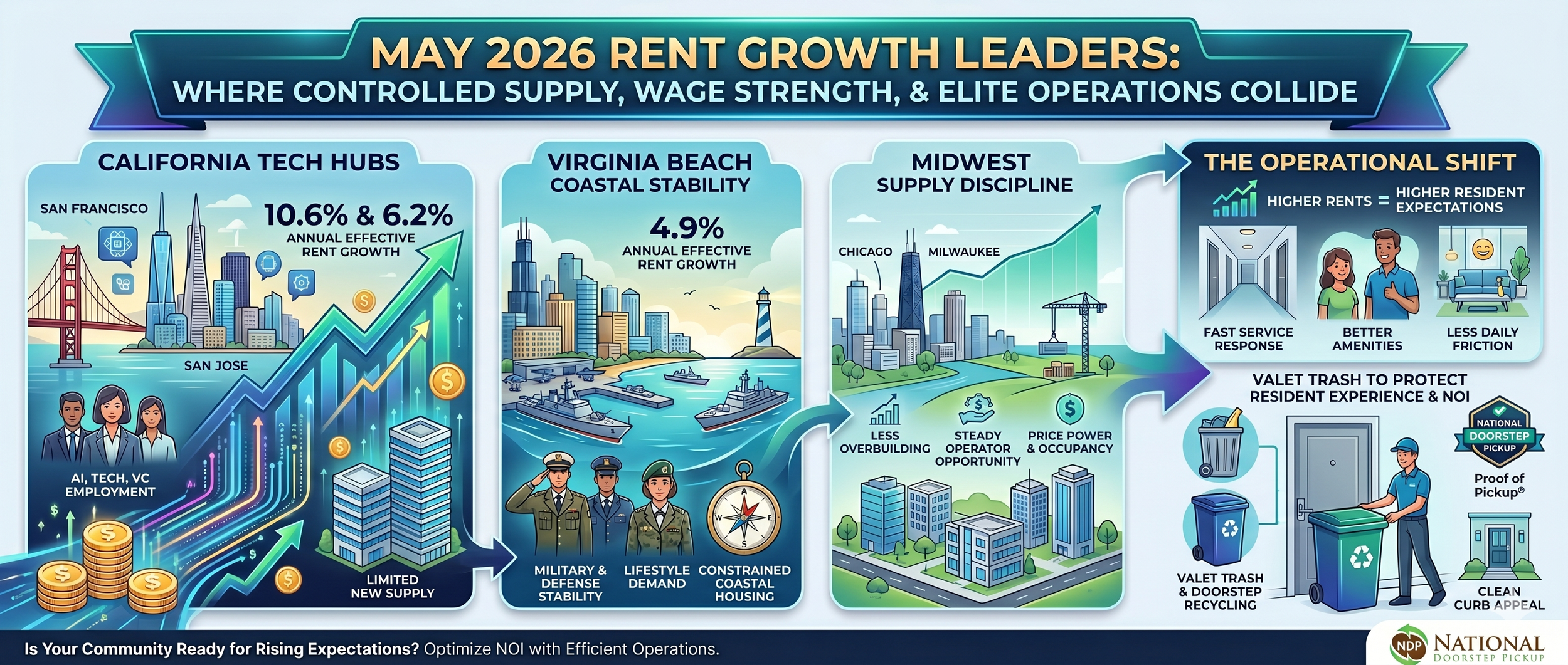
According to RealPage Market Analytics, the strongest apartment rent growth markets for the year ending May 2026 were concentrated in high-wage tech hubs, select coastal markets, and supply-disciplined Midwest metros. The standout leader was San Francisco, where annual effective rent growth reached 10.6%. San Jose followed at 6.2%, while Virginia Beach posted a strong 4.9% increase.
That ranking matters because rent growth is more than a pricing story. It is a signal of resident demand, supply discipline, operating confidence, and market-level leverage.
Apartment Rent Growth Leaders: Year Ending May 2026
Here are the top rent growth markets from RealPage’s May 2026 apartment market data:


The headline is simple: the best rent growth is showing up where supply is controlled, employment is resilient, and residents still have enough income strength to absorb higher housing costs.
Why San Francisco and San Jose Are Back on Top
San Francisco and San Jose are not just leading the chart. They are separating from the rest of the country.
San Francisco’s 10.6% annual effective rent growth was nearly double San Jose’s 6.2% increase. That kind of spread points to a market where demand has recovered faster than new apartment supply can respond.
The reason is not complicated. Tech-oriented coastal markets are benefiting from limited new supply and high-wage employment tied to artificial intelligence, software, venture capital, and related professional services. When high-income renters return to expensive urban markets, the rent ceiling moves.
For owners, that creates opportunity. For property managers, it creates pressure.
Higher rents invite higher expectations. Residents paying premium pricing expect cleaner corridors, faster service response, better amenity execution, and fewer daily friction points. That includes the simple things: trash removal, recycling access, pet waste control, and community appearance.
Virginia Beach Is the Sleeper Market in the Top Three
Virginia Beach ranking third is one of the most important takeaways from the May 2026 chart.
This is not a traditional “AI boomtown” story. Virginia Beach’s 4.9% annual effective rent growth reflects a different kind of demand profile: constrained coastal housing, military and defense-related stability, lifestyle demand, and limited new apartment inventory compared with faster-building Sun Belt markets.
That makes Virginia Beach especially relevant for multifamily operators in Hampton Roads.
When a market grows rents without overwhelming supply growth, resident retention becomes a major NOI lever. Owners cannot afford to lose good residents because the community feels poorly maintained, trash areas are overflowing, or basic services feel inconsistent.
Midwest Markets Are Quietly Winning With Supply Discipline
That matters because many Midwest markets did not experience the same level of overbuilding seen in parts of Texas, Florida, Arizona, Tennessee, and the Carolinas. With less new inventory competing for residents, stabilized communities have more pricing power.
This is the “steady operator” opportunity.
In these markets, owners may not see explosive double-digit rent growth, but they can protect occupancy, reduce concessions, and improve renewal performance through operational consistency. That is where low-friction amenities can outperform flashy capital projects.
Residents do not always need another unused lounge. They do notice whether the property is clean, convenient, and professionally run.
The Real Lesson: Rent Growth Raises the Bar for Operations
Strong rent growth is good news, but it is not a blank check.
When rents rise, residents become more sensitive to value. They ask sharper questions:
Is this community worth the premium?
Are services dependable?
Does the property feel clean and controlled?
Are common areas maintained?
Is management making daily life easier?
This is why apartment operators in rent growth markets should treat operations as a revenue protection strategy.
A well-run valet trash and doorstep recycling program helps communities protect the resident experience while supporting staff efficiency. It reduces trash room pressure, limits overflow issues, helps control curb appeal, and gives residents a convenience they interact with several nights per week.
How Valet Trash Supports NOI in Rent Growth Markets
For apartment owners in markets like San Francisco, San Jose, Virginia Beach, Milwaukee, Chicago, New York, Pittsburgh, St. Louis, Minneapolis, Detroit, Philadelphia, and Kansas City, valet trash is not just a convenience amenity.
It is a defensive operating tool.
A professionally managed doorstep waste and recycling program can help communities:
Improve curb appeal during tours
Reduce trash room and dumpster-area complaints
Support renewal conversations with visible daily convenience
Give residents a practical amenity they actually use
Help site teams document service quality with photo verification
Create a cleaner resident experience in mid-rise, garden-style, and high-density communities
Strengthen compliance with recycling and waste-handling expectations
At National Doorstep, our Proof of Pickup® process gives property teams better visibility into nightly service performance. With route tracking, photo verification, and local operating expertise, communities can turn a basic trash program into a cleaner, more accountable resident amenity.
August 2026 Update: RealPage’s July Rent Growth Leaders Strengthen the Recovery Story
Updated August 17, 2026: Two months after the May 2026 data analyzed above, the apartment rent-growth picture has become even more pronounced.
RealPage’s latest U.S. apartment market update shows that same-store effective asking rents increased 0.4% year over year in July 2026, marking the first return to positive annual rent growth since July 2025. Rents also increased 0.3% during July itself, extending the industry's streak to seven consecutive months of monthly rent increases in 2026.
That national number is modest. The market-level numbers are not.
San Francisco and San Jose Are Accelerating
San Francisco remains the clear apartment rent-growth leader among major U.S. markets. Annual rent growth reached 13.5% in the year ending July 2026, up substantially from the 10.6% recorded in May.
San Jose followed at 8.0% annual rent growth, compared with 6.2% in May. RealPage continues to associate the strength of these technology-oriented coastal markets with constrained new apartment supply and expansion in high-paying technology employment.
The important takeaway for multifamily owners is that the May results were not simply a temporary spike. Rent growth in the two leading Bay Area markets accelerated as 2026 progressed.
Virginia Beach Has Become a National Rent-Growth Standout
Virginia Beach has also strengthened considerably.
The original May analysis identified Virginia Beach as one of the most important markets to watch. RealPage now reports 6.3% annual apartment rent growth in the year ending July 2026, placing the market ahead of New York, where annual rent growth is now closer to 4%.
Virginia Beach therefore deserves to be viewed as more than an emerging rent-growth market. It has become one of the strongest major apartment markets in the country.
For owners and operators across Virginia Beach and the broader Hampton Roads multifamily market, that kind of pricing performance increases the importance of resident retention, property appearance, service consistency and amenity execution.
Oakland and Milwaukee Add Another Dimension to the Leaderboard
The new RealPage numbers also demonstrate that rent growth is broader than San Francisco and San Jose.
Oakland posted 4.8% annual rent growth, giving the Bay Area three markets with significant positive pricing momentum. Milwaukee reached 4.1%, strengthening the case that supply-disciplined Midwest markets can continue generating rent gains even without the technology-sector dynamics driving Northern California.
Chicago remained positive at 2.7%, while Minneapolis recorded 2.1% and Detroit 1.7% annual rent growth.
This is an increasingly important distinction for apartment investors: rent growth in 2026 is not simply a coastal recovery. It is a market-by-market supply-and-demand story.
The National Apartment Market Has Crossed an Important Threshold
Perhaps the most important change since the May article is what has happened nationally.
In May, U.S. effective asking rents were still 0.2% below their year-earlier level despite five consecutive months of increases. By July, annual rent growth had moved to positive 0.4%.
Occupancy stood at 95.5% in July, while approximately 340,200 apartments were delivered during the year ending second-quarter 2026. Annual supply has now declined for six consecutive quarters after deliveries peaked near 588,000 units in late 2024.
That combination matters.
Demand is meeting a construction pipeline that is finally cooling.
If deliveries continue moderating, properties in markets with resilient employment and limited new competition could gain additional pricing leverage.
But the Multifamily Recovery Is Still Highly Uneven
The new leaderboard should not be interpreted as evidence that every apartment market has recovered.
RealPage reports that the South remains the only U.S. region experiencing annual rent declines, with elevated apartment supply continuing to pressure many Sun Belt markets.
San Antonio remained among the weakest major markets with annual rent declines approaching 5%, while rents were down roughly 3% in Tampa, Phoenix, Austin and Charlotte.
This creates a striking 2026 multifamily divide:
San Francisco: +13.5%
San Jose: +8.0%
Virginia Beach: +6.3%
Oakland: +4.8%
Milwaukee: +4.1%
New York: approximately +4%
Chicago: +2.7%
Minneapolis: +2.1%
Detroit: +1.7%
San Antonio: approximately -5%, with Tampa, Phoenix, Austin and Charlotte around -3%
National averages increasingly hide what is happening at the individual-market level.
What the July Leaders Mean for Multifamily Owners
The July RealPage data reinforces the central argument of this article: strong rent growth increases the value of operational execution.
When a property has greater pricing power, residents are also being asked to pay more. That puts increased scrutiny on the daily experience the community delivers.
Clean common areas, reliable waste collection, convenient recycling, responsive property teams, controlled dumpster and compactor areas, and amenities residents actually use become part of the value equation supporting renewals.
For multifamily owners, the objective should not simply be to capture higher market rents.
It should be to protect the resident experience that allows those rents to remain sustainable.
That is particularly important in markets such as San Francisco, San Jose, Virginia Beach, Oakland and Milwaukee, where the latest RealPage results suggest owners currently have substantially more pricing momentum than the national average.
Updated Bottom Line
The May 2026 leaderboard showed that an apartment-market recovery was beginning to separate winners from laggards.
The July 2026 numbers make that separation much clearer.
National rent growth is positive again. San Francisco and San Jose have accelerated. Virginia Beach has emerged as a major national outperformer. Oakland and Milwaukee demonstrate that strong rent growth extends beyond the two leading technology hubs.
At the same time, several high-supply Sun Belt markets continue to experience rent declines.
For apartment owners and property managers, 2026 is increasingly becoming a year in which local supply, local demand and property-level execution matter more than the national headline.
Source: RealPage Market Analytics, July 2026 U.S. Data Update, published August 7, 2026.
What Property Managers Should Do Next
If your apartment community is in one of the May 2026 rent growth leader markets, now is the time to tighten operations before resident expectations move even higher.
Start with these questions:
Are trash rooms, compactors, and dumpster areas helping or hurting curb appeal?
Are residents consistently following collection rules?
Are service issues documented with photos and timestamps?
Is recycling easy enough for residents to actually use?
Does your amenity package justify the rent increases your market now supports?
Rent growth gives owners room to improve NOI. But operational execution is what protects it.
Final Takeaway
The May 2026 rent growth leaders show a multifamily market that is recovering unevenly. Tech hubs are surging. Virginia Beach is outperforming. Midwest markets are quietly gaining ground. High-supply markets are still under pressure.
For apartment owners and property managers, the winning strategy is not just to chase rent growth. It is to protect the resident experience that makes higher rents sustainable.
Request a Free Valet Trash & Recycling Proposal from National Doorstep
Turn daily waste collection into a cleaner, more accountable resident amenity for your apartment community.