By Les Leith, CEO & COO at National Doorstep Pickup
Mid-rise apartment communities offer the best of urban living: walkable neighborhoods, elevator access, central corridors, premium amenities, and a lifestyle residents are willing to pay for.
But behind the polished leasing photos and rooftop amenity decks, property managers know the truth:
Trash logistics can get complicated fast.
Unlike garden-style communities where porters can move quickly between exterior doors, mid-rise apartments are built around interior corridors, elevators, trash rooms, controlled-access points, loading zones, and tight collection routes.
That creates a very different operational challenge.
One leaking bag can leave a drip trail through a hallway. One overloaded trash room can create odor complaints. One poorly planned elevator route can slow down service across multiple floors.
If valet trash is not planned correctly, mid-rise communities can experience hallway violations, elevator delays, missed pickups, overflowing trash rooms, resident complaints, and city compliance issues.
At National Doorstep, we specialize in navigating the tight spaces and high-density service demands of urban mid-rise buildings. Our local teams understand how to keep corridors clean, collection routes efficient, and residents satisfied while helping properties stay aligned with city waste and recycling requirements.
Why Mid-Rise Apartments Need a Different Valet Trash Strategy
Architects design mid-rise apartments with units positioned along central interior corridors, often connected by elevators and shared amenity areas. These communities are common in fast-growing urban markets like Nashville, Houston, Dallas, Tampa, Charlotte, Atlanta, and Austin, where density, convenience, and resident experience all matter.
But that same design creates operational pressure.
A missed bag in a garden-style community may sit outside one door. A missed bag in a mid-rise building can impact an entire corridor.
A poorly planned route in a low-density property may cost a few extra minutes. A poorly planned route in a mid-rise can disrupt elevator flow, create resident complaints, and overwhelm trash rooms before morning.
That is why successful valet trash service in mid-rise apartments requires more than “doorstep pickup.”
It requires a system.
Best Practice #1: Build Routes Around Elevators, Not Just Unit Counts
One of the biggest mistakes property teams make is assuming valet trash routes should be based only on the number of apartment homes.
In mid-rise buildings, the real operational bottleneck is often the elevator.
Porters must move through controlled-access doors, hallways, elevator banks, stairwells, trash rooms, loading areas, and disposal zones. If the route is not designed around building flow, service can slow down quickly.
A strong mid-rise valet trash route should account for:
Elevator location and wait time
Number of floors served
Corridor length
Trash room placement
Service access points
Resident traffic patterns
Loading dock or dumpster location
Local noise and service-hour restrictions
At National Doorstep, we design valet trash routes around the actual building layout, not just the door count. That helps reduce missed pickups, improve service consistency, and prevent unnecessary disruptions in high-density properties.
Best Practice #2: Protect the Resident Experience in Interior Corridors
Interior corridors are one of the biggest differences between mid-rise and garden-style communities.
Residents expect these hallways to feel clean, quiet, upscale, and odor-free. When bags are left out too early, placed incorrectly, leaking, or missed after service, the resident experience suffers immediately.
That is why clear trash placement rules matter.
Mid-rise communities should communicate:
Approved set-out times
Bag tie requirements
Maximum bag weight
Prohibited items
Recycling instructions
Container placement rules
Bulk item procedures
Holiday service changes
The goal is simple: keep hallways looking like part of a premium apartment community, not a temporary trash holding area.
National Doorstep helps communities reinforce these standards with professional service procedures, resident education support, and photo-based accountability through our Proof of Pickup® system.
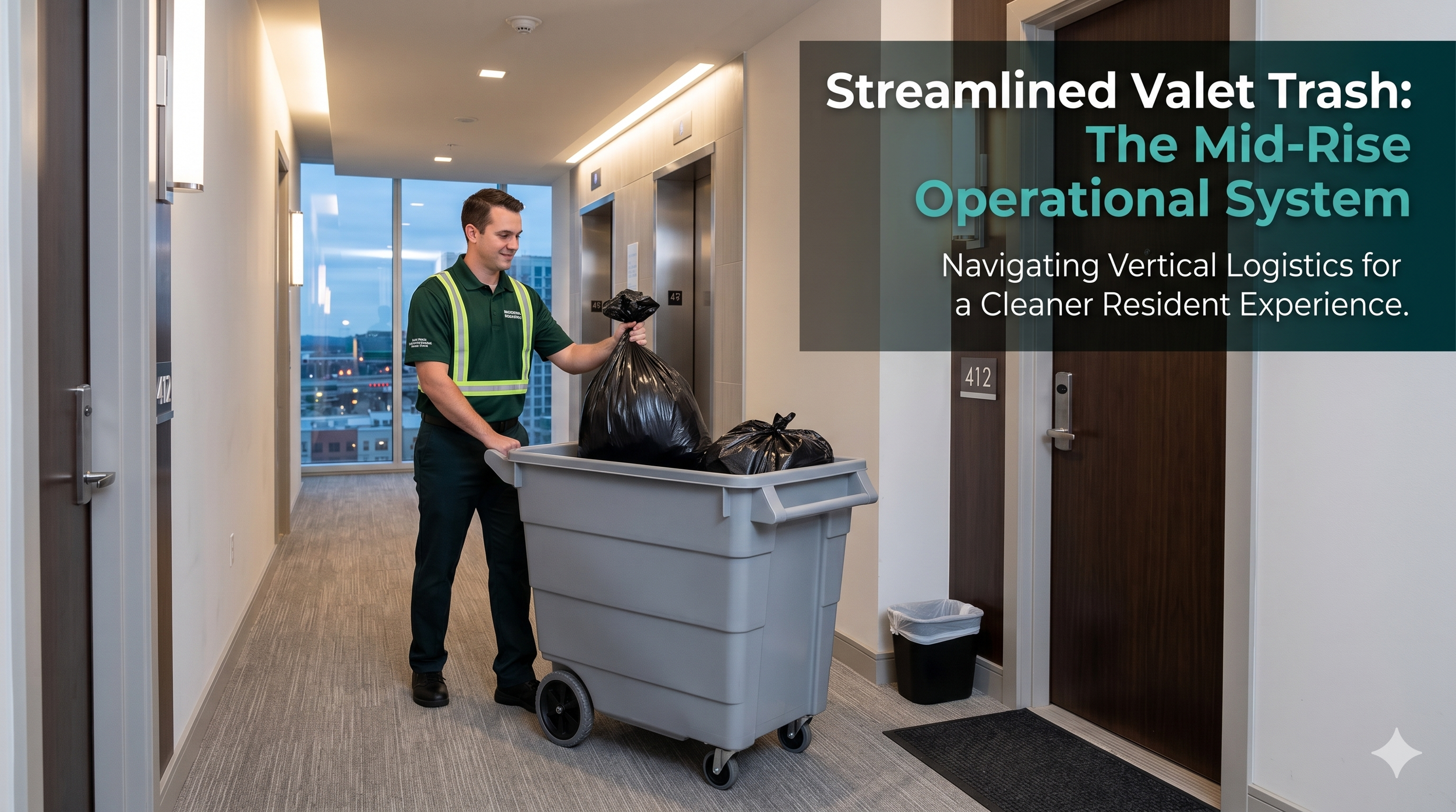
Best Practice #3: Use Trash Carts or Tilt Trucks to Prevent Indoor Drips
In mid-rise apartments, trash does not move across open sidewalks first. It often moves through interior corridors, elevator banks, trash rooms, parking garages, service hallways, and loading areas.
That means one leaking bag can create a visible trail through the building.
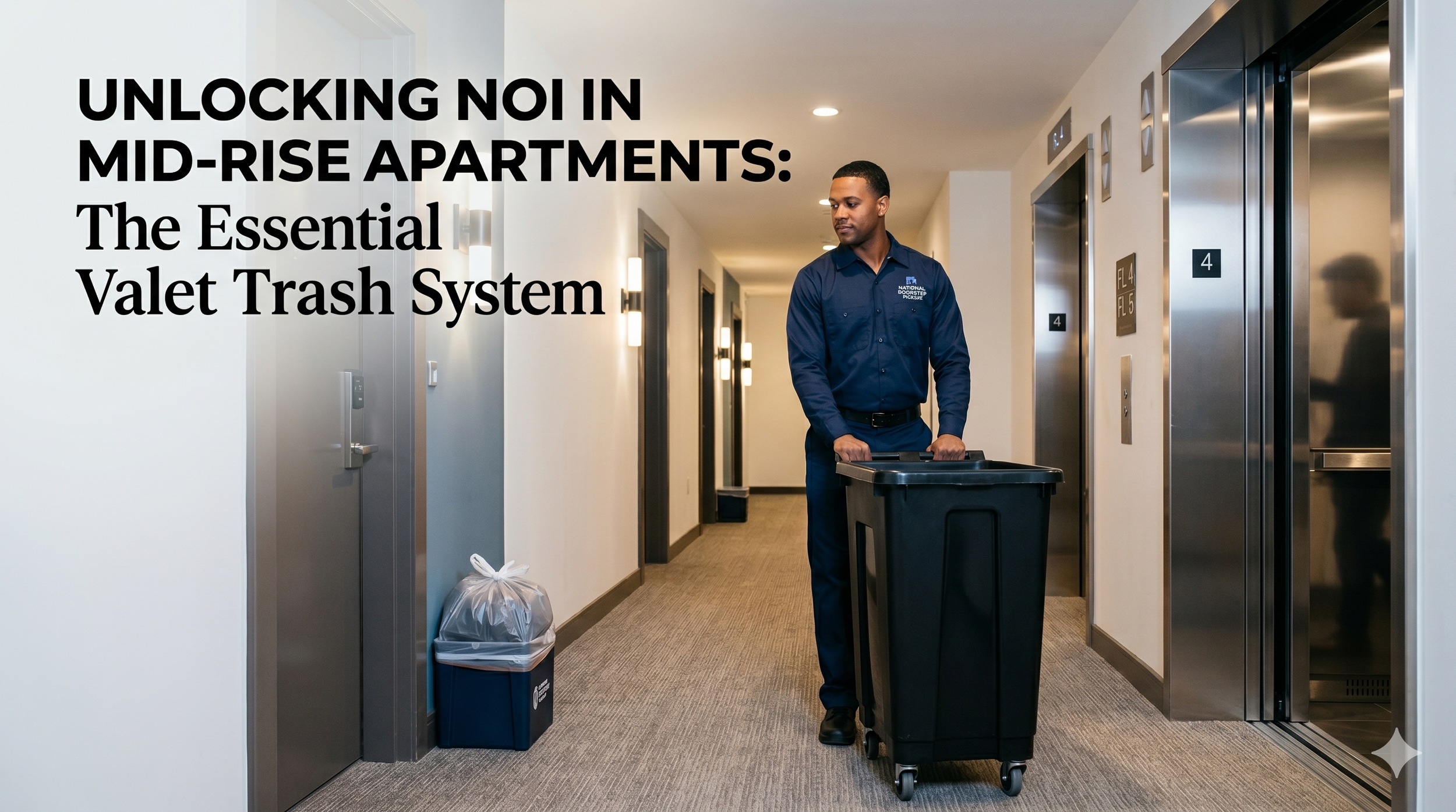
To protect interior finishes and reduce odor complaints, mid-rise valet trash routes should use trash carts, rolling collection bins, or tilt trucks whenever possible. These tools help porters consolidate bags safely while keeping liquids contained during transport.
This is especially important in buildings with:
Carpeted corridors
Polished concrete floors
Elevator access
Long interior hallways
Shared trash rooms
Parking garage disposal areas
High resident traffic
Food waste or pet waste concerns
Using the right collection equipment helps prevent:
Drips in hallways
Odors in elevators
Floor staining
Slip hazards
Resident complaints
Extra janitorial labor
Damage to the property’s upscale appearance
At National Doorstep, we plan mid-rise service routes with the right equipment for the building layout. Our teams use carts, tilt trucks, and controlled collection methods to move trash cleanly from resident doors to final disposal areas without turning interior corridors into a waste trail.
For urban mid-rise communities, this is not a minor detail. It is one of the difference-makers between a basic pickup service and a professionally managed valet trash program.
Best Practice #4: Use Photo Verification to Reduce Disputes
In dense mid-rise properties, trash issues can become difficult to track without documentation.
Was the bag placed out late?
Was the item oversized?
Did the porter miss the unit?
Was the hallway blocked?
Was the trash room already overflowing?
Without proof, every complaint becomes a guessing game.
Photo verification changes that.
With National Doorstep’s Proof of Pickup® technology, property managers get more visibility into service performance, route completion, and exception reporting. That gives onsite teams a better way to resolve complaints, identify recurring resident issues, and maintain accountability across every floor.
For mid-rise buildings, this is especially important because one missed section of a route can affect dozens of residents in the same corridor.
Best Practice #5: Coordinate Valet Trash With Recycling Compliance
Urban mid-rise properties are often located in cities with stricter waste, recycling, and solid waste ordinances. Requirements can vary by city, county, franchise zone, property type, number of units, and service provider rules.
That makes compliance a major part of the valet trash conversation.
A well-run mid-rise waste program should clarify:
Whether recycling service is required
Which materials are accepted
Whether cardboard must be broken down
Where recycling is staged
How contamination is handled
Whether residents need education
Whether the property must provide access to recycling
How bulk waste and prohibited items are managed
National Doorstep helps apartment communities build waste and recycling programs that work in the real world. We understand the operational side of compliance, including how city rules translate into daily resident behavior, collection routes, and property-level execution.
Best Practice #6: Control Odor Before It Becomes a Complaint
Odor can come from:
Leaking bags
Food waste
Pet waste
Overflowing trash rooms
Delayed pickup
Poor ventilation
Residents setting trash out too early
Trash sitting near elevators or corridor turns
The best solution is prevention.
That means using consistent pickup windows, enforcing bag standards, using proper collection carts, keeping collection routes tight, and making sure trash reaches the final disposal area quickly and cleanly.
National Doorstep trains local valet trash teams to work efficiently in high-density communities where odors, leaks, and missed bags can damage the resident experience fast.
Best Practice #7: Plan for Bulk Trash Separately
Bulk trash should never be treated like standard valet trash.
Mid-rise apartments often face challenges with residents leaving mattresses, furniture, boxes, electronics, and move-out debris near trash rooms, loading docks, elevators, or garage areas.
This creates safety concerns, fire risks, blocked access, and poor curb appeal.
A better approach is to separate standard doorstep collection from bulk item procedures.
Communities should define:
What qualifies as bulk trash
Whether pickup must be scheduled
Where items may be placed
Whether fees apply
How move-outs are handled
What items are prohibited
How residents submit requests
National Doorstep can help properties structure bulk removal procedures so large items do not overwhelm the regular valet trash route or create visual problems near common areas.
Best Practice #8: Match the Service Window to the Building’s Rhythm
Mid-rise buildings often have more predictable resident movement patterns than garden-style communities.
Residents may return from work, visit amenities, receive food deliveries, walk pets, or use elevators heavily during certain evening hours. A poorly timed trash route can create unnecessary congestion.
The right service window should account for:
Peak elevator use
Amenity traffic
Quiet hours
Resident set-out behavior
Loading dock access
Security procedures
Property staffing schedules
National Doorstep’s standard evening service model helps communities maintain consistency while reducing daytime trash visibility. The result is a cleaner building, a smoother resident experience, and fewer next-morning complaints for onsite teams.
Best Practice #9: Make Resident Instructions Simple
The more complicated the trash rules, the less likely residents are to follow them.
Mid-rise communities need simple, repeatable instructions that residents can understand immediately.
Strong resident messaging should answer:
What time can I place trash outside?
What time will it be picked up?
Where should I place the bag?
Do I need to tie the bag?
What items are not allowed?
What do I do with cardboard?
What do I do with bulk items?
Who do I contact with questions?
National Doorstep helps property teams reduce confusion by supporting clear communication around service expectations, recycling procedures, and resident responsibilities.
Best Practice #10: Keep Trash Rooms From Becoming the Problem
In many mid-rise apartments, trash rooms are the pressure point.
Even with doorstep collection, residents may still use trash chutes, compactor rooms, recycling rooms, or centralized disposal areas. If those spaces are not monitored, they can quickly become a source of odors, overflow, pests, and resident complaints.
A strong valet trash program should support, not replace, trash room management.
Property teams should regularly monitor:
Cardboard accumulation
Recycling contamination
Odor issues
Blocked access
Illegal dumping
Move-out debris
Compactor or dumpster capacity
National Doorstep’s service teams help create cleaner waste flow from resident doors to final disposal areas, reducing pressure on shared waste spaces and improving overall property presentation.
Best Practice #11: Choose a Valet Trash Partner With Mid-Rise Experience
Not every valet trash provider is built for mid-rise service.
A provider that performs well in suburban garden-style communities may struggle with urban mid-rise logistics if they do not understand elevators, interior corridors, controlled access, tight loading areas, city rules, and high-density resident expectations.
The right valet trash partner should offer:
Route planning by building layout
Trained porters
Trash carts, rolling bins, or tilt truck procedures
Photo verification
Clear exception reporting
Recycling support
Bulk trash procedures
Local market knowledge
Consistent communication
Scalable service for high-density communities
At National Doorstep, we specialize in valet trash and doorstep recycling for apartment communities of all types, including urban mid-rise buildings where logistics matter. Our teams understand how to work inside tight building footprints while protecting the clean, upscale environment residents expect.
The Bottom Line: Mid-Rise Valet Trash Needs Precision
Mid-rise apartment communities are built for convenience, density, and lifestyle. But without the right waste management system, trash can quickly become one of the most visible operational problems on the property.
The best valet trash programs for mid-rise apartments are built around:
Smart elevator-based route planning
Clean interior corridor standards
Trash cart or tilt truck use to prevent indoor drips
Resident education
Photo verification
Recycling compliance
Odor prevention
Bulk trash control
Local ordinance awareness
Professional porter execution
When done correctly, valet trash becomes more than a convenience. It becomes a cleaner, safer, more resident-friendly amenity that supports retention, curb appeal, and property value.
Request a Mid-Rise Valet Trash Proposal
If your community is located in a high-density urban market like Nashville, Houston, Dallas, Tampa, Charlotte, Atlanta, or Austin, National Doorstep can help you build a valet trash program designed for your building layout, resident expectations, and local compliance needs.
Request a proposal today and see how National Doorstep keeps mid-rise apartment communities clean, compliant, and resident-ready — every door, every night.