2027 Multifamily Outlook: Falling Apartment Supply Meets Rising Renter Purchasing Power
By Les Leith, CEO & COO at National Doorstep Pickup
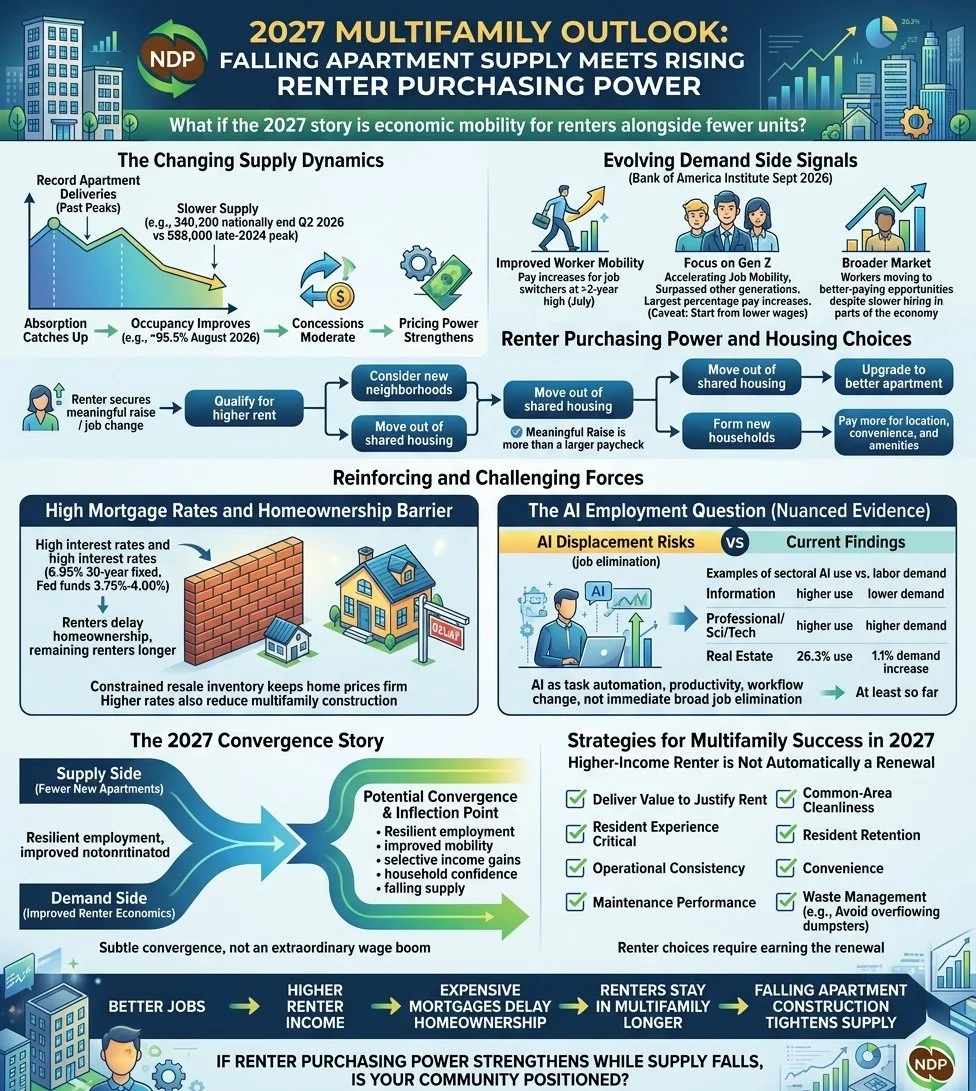
What if the 2027 apartment story isn’t just that we’re building fewer units—but that we’re building fewer units precisely as some renters start moving up economically again?
That possibility deserves more attention.
For the past several years, the multifamily conversation has been dominated by one force:
Supply.
Record apartment deliveries created aggressive lease-ups, heavy concessions and intense competition for renters.
But that equation is changing.
The sequence increasingly looks like this:
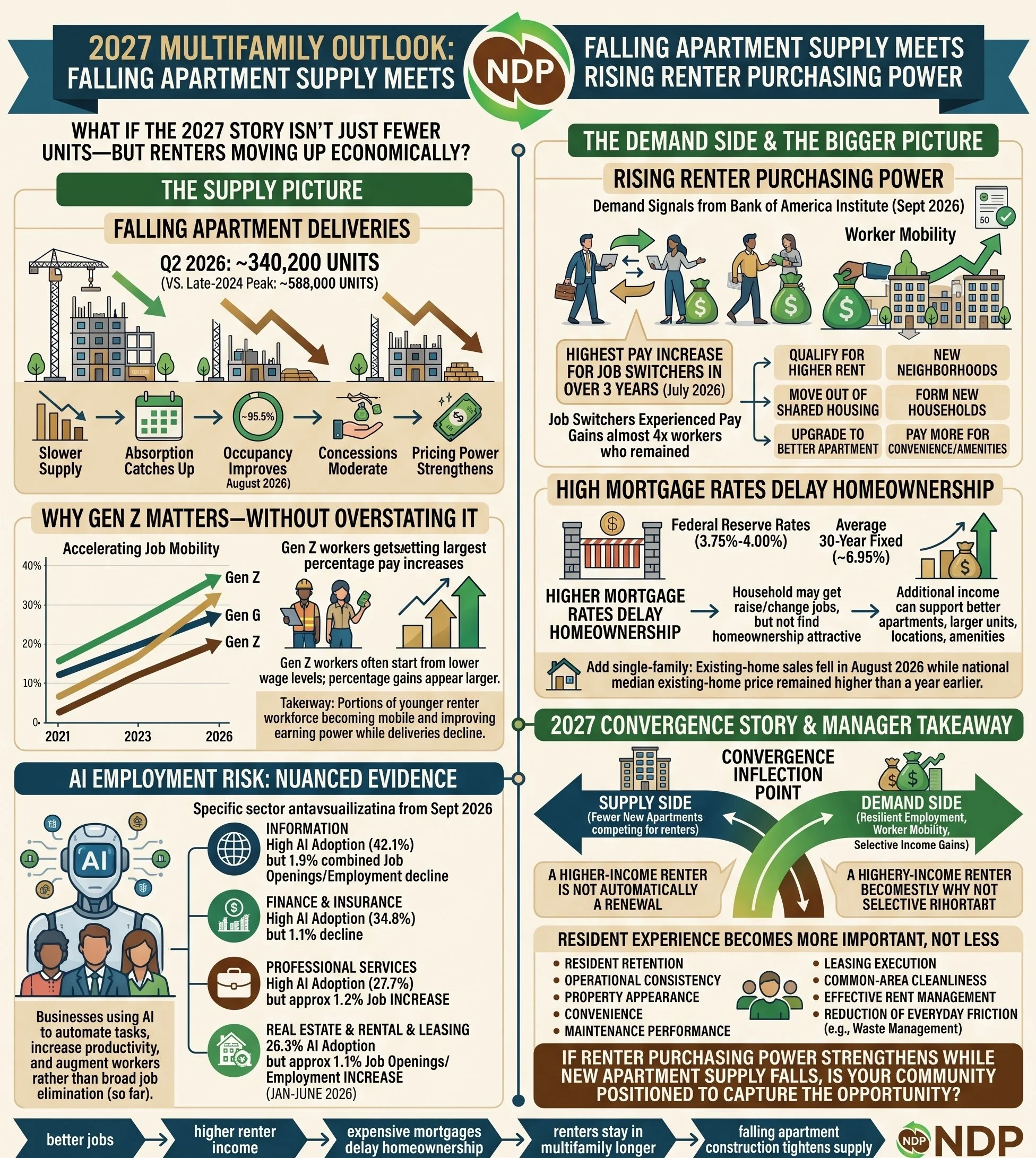
Slower supply → absorption catches up → occupancy improves → concessions moderate → pricing power strengthens.
But falling supply alone does not create apartment demand.
Renters still need jobs.
They need income.
And they need enough financial confidence to form households, relocate, move out of shared housing or upgrade into better apartments.
That is where new labor-market data from Bank of America Institute becomes particularly important.
The Demand Side May Be Improving Too
Bank of America Institute’s September 2026 analysis identified an emerging change in worker mobility.
The pay increase associated with switching jobs reached its highest level in more than three years in July.
That matters because headline wage-growth statistics can obscure what is happening inside individual households.
A renter who changes jobs and receives a meaningful raise does not simply have a larger paycheck.
Their housing choices may change too.
They may qualify for a higher rent.
They may consider neighborhoods previously outside their budget.
They may move out of shared housing.
They may form a new household.
They may upgrade to a better apartment.
Or they may become willing to pay more for location, convenience and amenities.
Bank of America does not directly measure those housing outcomes, so this should not be interpreted as proof of stronger apartment demand.
But it is an increasingly relevant demand-side signal at exactly the moment apartment supply growth is slowing.
Why Gen Z Matters—Without Overstating It
One portion of the Bank of America data is especially relevant to multifamily.
Gen Z job mobility is accelerating.
Gen Z workers also continue to receive the largest percentage pay increases from changing jobs.
For apartment operators, that deserves attention because younger adults represent a significant renter demographic and are often still moving through important housing transitions.
But the conclusion needs to stay disciplined.
Gen Z workers frequently begin from lower wage levels, which can make percentage increases appear larger than those received by older, higher-paid workers.
So the takeaway is not:
“Gen Z suddenly has dramatically more money for rent.”
It is more measured:
A portion of the younger renter workforce appears to be becoming more mobile and improving its earning power at the same time apartment deliveries are declining.
That combination could support apartment demand—but it does not guarantee it.
The Bigger Bank of America Signal
The Gen Z finding is important, but the broader Bank of America report may matter even more.
Worker mobility appears to be improving despite slower hiring in parts of the economy.
That means the labor market cannot be understood simply through the number of jobs created each month.
There is another question:
Are workers able to move into better-paying opportunities?
If the answer increasingly becomes yes, some households may gain purchasing power even without extraordinary economy-wide wage growth.
That creates a different multifamily environment.
The industry may be moving from a period characterized by:
Rapid apartment construction + intense leasing competition
toward one increasingly characterized by:
Lower apartment deliveries + stronger occupancy + selective improvements in renter earning power.
That is a much more interesting setup heading into 2027.
Higher Mortgage Rates Could Keep Renters in Apartments Longer
There is another factor that could reinforce apartment demand heading into 2027: the cost of becoming a homeowner.
In September 2026, the Federal Reserve raised its target federal funds rate by 25 basis points to 3.75%–4.00%. At roughly the same time, the average 30-year fixed mortgage rate climbed to approximately 6.95%.
Mortgage rates do not move directly with the federal funds rate, but elevated borrowing costs continue to make the transition from renting to owning significantly more expensive.
That creates an important dynamic for multifamily.
Higher mortgage rates do not simply reduce home sales—they can slow the rate at which apartment renters become homeowners.
A household may receive a raise, change jobs and improve its purchasing power without finding homeownership economically attractive.
Instead, that additional income may support a better apartment, a larger unit, a more desirable location or additional amenities.
That makes the relationship particularly relevant to Bank of America Institute’s recent findings on job switching.
If portions of the renter workforce are becoming more mobile and securing larger pay increases while mortgage rates remain elevated, multifamily could experience an unusual combination:
Improving renter purchasing power without an equivalent acceleration in renter-to-homeowner conversions.
That does not mean higher interest rates are universally positive for apartments.
Higher rates also increase multifamily borrowing costs, complicate refinancing and make new apartment development more difficult to finance.
But those same financing constraints can reduce future apartment construction, placing additional downward pressure on new supply.
For apartment fundamentals, the resulting equation could become increasingly important:
Higher mortgage rates → reduced home-buying affordability → renters remain renters longer.
At the same time:
Higher development costs → fewer new apartment projects → slower future supply growth.
Both forces can support apartment occupancy.
The single-family market does not necessarily respond through sharply lower prices, however.
Higher rates typically hit transaction volume before home values.
That pattern is already visible. Existing-home sales fell in August 2026 while the national median existing-home price remained higher than a year earlier.
The reason is simple: many existing homeowners still hold mortgages far below prevailing rates and have little incentive to sell.
That constrains resale inventory and can keep home prices relatively firm even when buyer affordability deteriorates.
A meaningful national decline in single-family values would therefore likely require more than high mortgage rates alone.
It would more likely require some combination of higher inventory, weaker employment, declining household income or increased forced selling.
For multifamily operators, however, the near-term implication is clearer:
The financial hurdle separating renting from homeownership remains unusually high.
And if renter incomes improve before that hurdle comes down, apartments may retain economically stronger residents for longer than they would in a lower-rate housing cycle. This connects labor mobility, renter purchasing power, housing affordability and multifamily supply rather than treating them as separate trends.
Now Add the AI Employment Question
There is another major risk to the apartment-demand thesis:
AI-driven labor displacement.
If artificial intelligence begins eliminating large numbers of jobs, falling apartment construction alone will not protect multifamily fundamentals.
Renters without stable employment cannot support sustained rent growth.
But so far, the evidence is more nuanced than the headlines suggest.
Bank of America Institute’s September 2026 analysis found no clear economy-wide relationship between higher AI adoption and weaker labor demand.
Its analysis compared reported AI usage by industry with changes in employment and job openings between January and June 2026.
The results varied considerably by sector.
Information showed 42.1% AI usage alongside a 1.9% decline in combined job openings and employment.
Finance and insurance showed 34.8% AI usage and a 1.1% decline.
But professional, scientific and technical services showed 37.7% AI usage while labor demand increased approximately 1.2%.
And particularly relevant to multifamily, real estate and rental & leasing reported 26.3% AI usage while the combination of employment and job openings increased approximately 1.1% from January through June 2026.
That is an important distinction.
AI adoption is not the same thing as job elimination.
At least so far.
Businesses may be using AI to automate individual tasks, increase employee productivity, change workflows or augment existing workers rather than simply eliminate positions.
That could change.
But as of September 2026, the evidence remains mixed.
Why That Matters for Apartment Demand
The AI question matters because the 2027 multifamily recovery requires more than declining construction.
It requires a functioning labor market.
And currently, several pieces of evidence are moving in a comparatively constructive direction.
Apartment deliveries are falling.
Occupancy has improved.
Rent growth has become steadier.
Employment remains comparatively resilient.
Worker mobility is showing signs of improvement.
Some job switchers are securing materially larger pay increases.
And despite rapid AI adoption, there is not yet clear evidence of broad economy-wide labor displacement.
None of those signals guarantees stronger apartment rents.
Together, however, they produce a stronger demand-and-supply thesis than apartment construction data alone.
Three Very Different Multifamily Environments
Consider how quickly the equation has changed.
2023–2025
Huge apartment supply + aggressive lease-ups + concessions + weak pricing power + reduced worker mobility.
2026
Falling deliveries + improving occupancy + steadier rent growth + early improvement in worker mobility.
Potential 2027
Lower apartment supply + resilient employment + improving worker mobility + selective income gains.
That is considerably more compelling than simply saying:
“Construction is slowing, therefore rents will rise.”
Construction is only one side of the equation.
The renter is the other.
The 2027 Thesis Is Becoming a Convergence Story
The apartment industry has spent years waiting for the supply pipeline to normalize.
That process is now underway.
But the emerging question is whether the demand side could begin improving at approximately the same time.
Not through another extraordinary post-pandemic wage boom.
Not through another Great Resignation.
And certainly not because every renter suddenly becomes wealthier.
The more plausible scenario is subtler.
Some workers regain mobility.
Some change jobs.
Some capture better wages.
Employment remains sufficiently resilient.
Household purchasing power gradually improves.
Meanwhile, substantially fewer apartments enter the market.
That creates a potential convergence:
Supply-side: fewer new apartments competing for renters.
Demand-side: resilient employment, improving worker mobility and selective income gains.
That is the potential 2027 inflection point.
There Is Still No Guarantee of a Rent Breakout
The Bank of America findings should not be interpreted as confirmation of a 2027 apartment boom.
Job-switching pay premiums remain below pre-pandemic levels.
AI-related displacement could accelerate.
Economic growth could weaken.
Unemployment could rise.
Consumer confidence could deteriorate.
And markets with substantial remaining apartment pipelines could continue experiencing very different conditions from lower-supply markets.
That is why the most defensible interpretation is not:
“A rent boom is coming.”
It is:
The conditions necessary for stronger multifamily fundamentals are becoming more aligned.
That is an important difference.
A Higher-Income Renter Is Not Automatically a Renewal
There is another implication property managers should not overlook.
When residents gain purchasing power, the existing property does not automatically capture it.
More income can mean more housing options.
A resident receiving a raise may:
Upgrade within the community.
Move to a competing property.
Choose a better neighborhood.
Move closer to work.
Pay more for convenience.
Or eventually transition into homeownership.
So improving renter economics creates both revenue opportunity and competitive risk.
Higher purchasing power can increase a resident’s ability to pay.
It can also increase their ability to leave.
That means operators still have to earn the renewal.
Resident Experience Becomes More Important, Not Less
If 2027 brings a healthier balance between apartment supply and renter demand, the most successful communities may not simply be those that raise rents fastest.
They may be those that deliver enough value to justify the rent.
That puts additional weight on:
Resident retention.
Operational consistency.
Property appearance.
Convenience.
Maintenance performance.
Leasing execution.
Common-area cleanliness.
Effective rent management.
And the reduction of everyday friction.
Waste management is one example.
Overflowing dumpsters, inconvenient disposal, unreliable service or poorly maintained waste areas may seem operational.
But they directly affect resident experience and leasing-tour presentation.
A renter with improving purchasing power may become more willing to pay for convenience.
They may also become less tolerant of poor execution.
That is why operational quality increasingly becomes part of revenue strategy.
The Question Property Managers Should Be Asking
The most important 2027 question may not be:
“How much can we raise rents?”
It may be:
“If renters gain more housing choices, have we built a community experience worth paying more for?”
Multifamily operators cannot control interest rates.
They cannot control national employment.
They cannot control where competitors build.
And they cannot determine how quickly artificial intelligence changes the workforce.
But they can control much of what residents experience after they walk through the door.
That becomes increasingly valuable when supply and demand begin moving back toward equilibrium.
The 2027 Inflection Point Worth Watching
The emerging multifamily story is therefore bigger than apartment construction.
It is the possibility that two economic forces begin improving simultaneously.
Fewer new apartments entering the market.
And portions of the renter workforce becoming more economically mobile.
Neither one guarantees rent growth.
But when declining supply meets resilient employment, improving labor mobility and selective wage gains, the operating environment begins to look very different.
That brings us back to the central question:
What if the 2027 apartment story isn’t just that we’re building fewer units—but that we’re building fewer units precisely as some renters start moving up economically again?
For property managers, regional managers and multifamily asset managers, there is an even more important question:
If renter purchasing power strengthens while new apartment supply falls, is your community positioned to capture the opportunity?
That is the inflection point worth watching.
better jobs → higher renter income → expensive mortgages delay homeownership → renters stay in multifamily longer → falling apartment construction tightens supply