By Les Leith, CEO & COO at National Doorstep Pickup
The rent-versus-buy math has flipped hard.
Golden handcuffs are largely real with isolated exceptions.
For years, apartment operators in fast-growth markets heard the same concern: “Won’t renters eventually buy homes and move out?”
In 2026, the better question is: can they afford to?
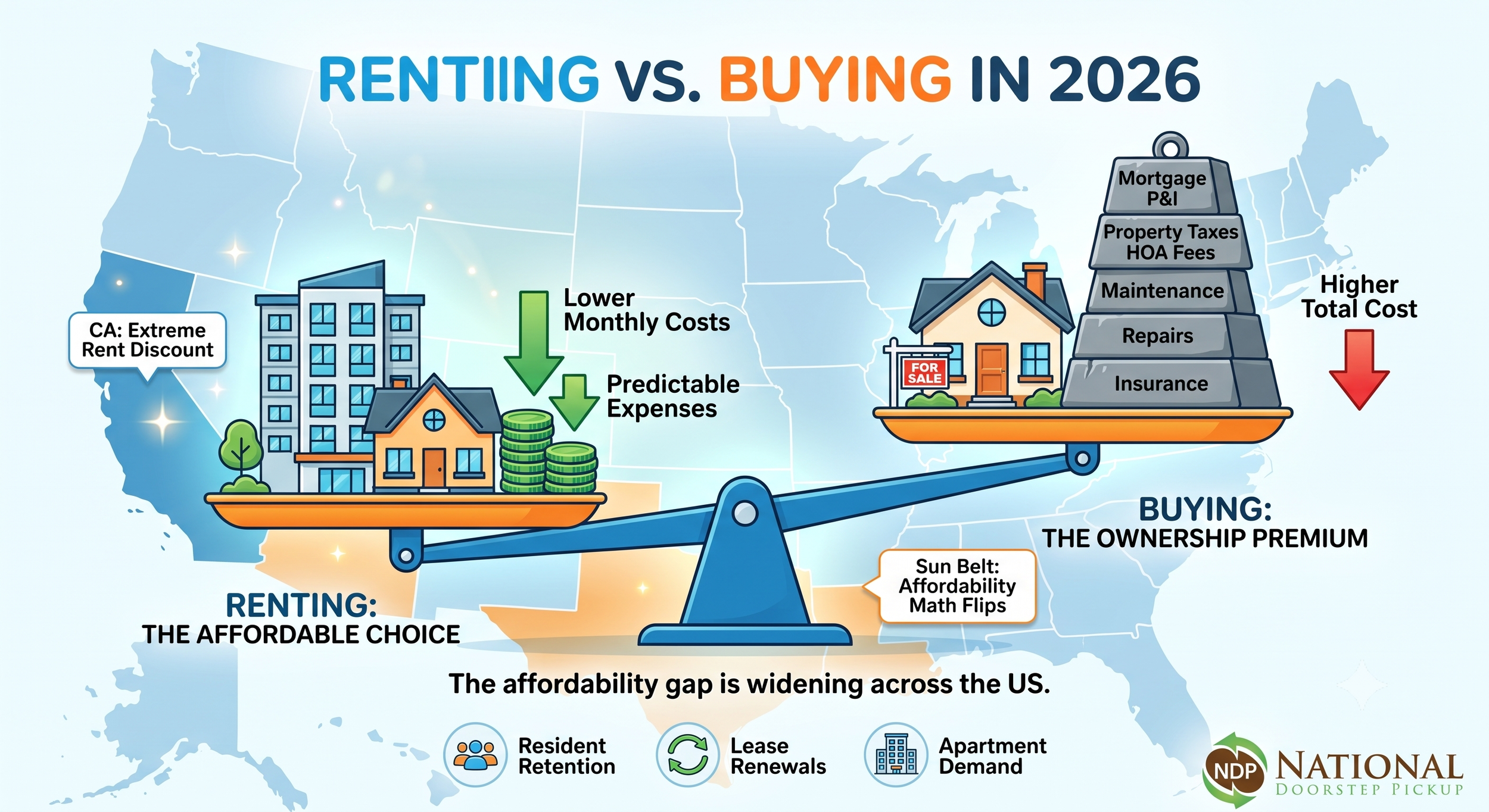
Across much of the country, renting is not just slightly cheaper than buying. It is dramatically cheaper. And the gap is no longer limited to San Francisco, San Jose, Los Angeles, New York, or other high-cost coastal cities.
The affordability advantage now shows up in two major ways:
First, it is much cheaper in many metros to rent an apartment than to own a newly purchased house.
Second, it is also cheaper in many metros to rent a single-family house than to buy a single-family house.
Those two comparisons matter for different reasons. Together, they tell a powerful story for multifamily owners, property managers, and rental housing operators.
The move from renting to owning has become expensive. In some markets, it has become financially unrealistic for a large share of renters.
That may keep residents renting longer. But it will not automatically keep them renewing at the same property.
The Big Picture: Renting Is Still Winning the Monthly Payment Battle
According to Realtor.com’s March 2026 rent report, buying a starter home in the top 50 U.S. metros cost an average of $920 more per month than renting, or 55.1% more. Realtor.com also found that renting was more affordable than buying in all 50 of the largest metros it analyzed.
That is the headline.
But the deeper multifamily story is regional.
California shows the most extreme rent discount. The Sun Belt shows the biggest shift from historical expectations. The Midwest shows narrower gaps, but often stronger stability. And single-family rentals show that even when renters want more space, they may still stay in the rental ecosystem instead of buying.
This is not just a housing affordability story.
It is a resident retention story.
It is a lease renewal story.
It is an apartment demand story.
And for property managers, it is an operations story.
Comparison #1: Renting an Apartment vs. Owning a House
The first comparison is the one apartment owners should watch most closely:
How much cheaper is it to rent an apartment than to own a newly purchased house?
The answer: in many metros, a lot cheaper.
For many households, moving from an apartment into a purchased home no longer means taking on a slightly higher monthly payment. It can mean taking on a housing cost that is 50%, 75%, or even 100%+ higher once the full ownership stack is included.
That ownership stack includes more than principal and interest.
It includes:
Mortgage payment.
Property taxes.
Homeowners insurance.
Maintenance.
Repairs.
Utilities.
HOA fees in some communities.
Lawn care.
The opportunity cost of a down payment.
And the financial risk of surprise expenses.
Freddie Mac reported that the 30-year fixed-rate mortgage averaged 6.49% as of July 4th, 2026, compared with 6.77% one year earlier. Even with some improvement from prior peaks, rates remain high enough to keep monthly ownership costs elevated for new buyers.
Bankrate’s 2025 Hidden Costs of Homeownership Study estimated that hidden homeownership expenses averaged more than $21,000 per year nationally, including insurance, taxes, utilities, internet/cable, and maintenance.
That is why the rent-vs-buy gap matters so much.
Rent may feel expensive. But ownership creates a much larger financial exposure.
California: The Apartment Rent Discount Is Massive
California remains the clearest example of the rent-vs-buy gap.
No surprise there.
In the Bay Area, Southern California, Orange County, Los Angeles, San Diego, San Francisco, and San Jose, the monthly cost to own a newly purchased home can be dramatically higher than the average apartment rent.
The monthly discount to rent an apartment instead of owning reportedly tops $8,000 per month in San Francisco and San Jose. In Los Angeles and San Diego, the monthly discount is close to $4,000 per month.
For California apartment owners, this is not a small detail.
It is a core demand driver.
Even when California rents are high, ownership can be so much more expensive that renting remains the practical financial choice for many households.
That does not mean every renter wants to rent forever. It means the monthly payment shock of buying can delay the move-out decision.
In high-cost California metros, the apartment is not competing against a slightly higher mortgage payment. It is competing against a completely different household budget.
The Sun Belt Has Changed
The bigger surprise is the Sun Belt.
Historically, many investors viewed Sun Belt homeownership affordability as a potential headwind for apartments.
The old logic was simple: if a renter in Texas, Arizona, Tennessee, North Carolina, or Florida could buy a house for a manageable monthly premium, apartment demand might face pressure as residents aged, married, had children, or wanted more space.
That assumption is weaker today.
The discount to rent an apartment versus buy a home now tops the national average in several major Sun Belt and growth markets, including:
Austin.
Denver.
Dallas.
Raleigh.
Las Vegas.
Fort Worth.
Houston.
San Antonio.
Phoenix.
Nashville.
In those metros, renting an apartment is 50%+ cheaper than owning.
That is a major shift.
It means a renter moving out of an apartment to buy a home in many of these markets may not be taking on a modest step-up in housing cost. They may be taking on a monthly housing payment that more than doubles.
Nominally, that can mean close to $2,000 more per month in some markets.
For apartment owners, this changes the renewal conversation.
Residents may still want a house. They may want a garage, a yard, a home office, or more space. But when buying means adding hundreds or thousands of dollars to the monthly budget, many households will pause.
That pause can keep them renting longer.
The Midwest: Narrower Gaps, But Not a Weak Story
The Midwest and near-Midwest tell a different story.
In many Midwest metros, the discount to rent an apartment versus own a home is more modest.
The monthly discount to rent an apartment versus own a house is about:
7% in Pittsburgh, or roughly $107 per month.
20% in St. Louis.
Less than 30% in Memphis, Cleveland, and Chicago.
At first glance, that might look like a weaker apartment story.
But that interpretation is too simplistic.
A narrower rent-vs-buy gap does not automatically create a headwind for Midwest apartments. In many of these markets, the story is not extreme affordability pressure. It is relative stability.
Midwest markets often benefit from steadier household budgets, less dramatic boom-bust volatility, moderate supply pressure, and consistent renter demand.
The Midwest is not necessarily a massive “rent discount” story.
It is a stability story.
And stability still supports multifamily fundamentals.
Comparison #2: Renting a Single-Family House vs. Buying One
The second comparison deserves its own section because it answers a different question:
How much cheaper is it to rent a single-family house than to buy a single-family house?
This matters because many apartment residents do not move directly from an apartment into homeownership.
Some move into single-family rentals first.
They want more space.
They want a yard.
They want a garage.
They want a suburban location.
They want a school district.
They want the feel of a house without the financial commitment of buying one.
When renting a single-family house is also cheaper than buying one, the entire rental ecosystem benefits.
That includes apartments.
Because if the ownership step is too expensive, renters may remain renters longer — whether they stay in an apartment, move to another apartment, or rent a single-family house.
Only a Few Markets Favor Buying Over Renting a House
Single-family rent-vs-buy comparison referenced in the notes, buying a house is cheaper than renting one in only 7 of the top 100 MSAs.
Those markets are:
Pittsburgh.
St. Louis.
Detroit.
New Orleans.
Cleveland.
Columbia.
Akron.
That is a narrow list.
It is also concentrated mostly in Midwest, near-Midwest, and slower-growth markets.
Most everywhere else, the ownership premium remains meaningful.
This reinforces the broader rental housing thesis: the path from renting to owning has become more expensive in most major markets.
High-Cost Markets: The Ownership Premium Can Be Absurd
In high-cost coastal and tech-heavy markets, the single-family rent-vs-buy gap can become extreme.
It can cost roughly $12,000 more per month to own a house in San Francisco and San Jose than to rent one. That represents an ownership premium of about 60%.
Buying is also reportedly more than 40% pricier than renting in several other high-cost markets, including:
Orange County.
Oakland.
Seattle.
New York.
Salt Lake City.
This is important because these markets are often misunderstood.
Some people blame institutional buyers or “Wall Street” for the ownership gap. But in many high-cost markets, institutional ownership of single-family homes is relatively limited compared with the size of the housing market.
The bigger issue is the math.
High home prices, elevated mortgage rates, taxes, insurance, and maintenance combine to create a monthly ownership burden that many households cannot justify.
The Sun Belt Single-Family Gap Is Widening Too
The single-family rent-vs-buy comparison also shows a major shift in the Sun Belt.
Traditionally, the Sun Belt was viewed as more affordable and more ownership-friendly than the coasts.
But that is not as true today.
The premium to buy versus rent a single-family house reaches 30%+ in markets including:
Austin.
Orlando.
Phoenix.
Raleigh.
Dallas.
Nashville.
Charlotte.
That is a major budget difference.
For a household thinking about leaving an apartment for more space, renting a single-family house may become the compromise. They get the space without taking on the full cost and risk of ownership.
For apartment operators, this creates two important takeaways.
First, not every apartment move-out becomes a home purchase. Some residents who leave may remain renters inside the single-family rental market.
Second, many residents may delay both buying and moving if their apartment community still meets their needs.
That puts more importance on service quality, convenience, cleanliness, and resident experience.
Why the Rent-vs-Buy Gap Looks Sticky
For the rent-vs-buy gap to close quickly, one of two things likely needs to happen:
Home prices would need to decline sharply.
Mortgage rates would need to decline sharply.
Neither outcome is guaranteed.
CBRE’s 2026 U.S. Multifamily Outlook says barriers to homeownership will continue to support multifamily demand, citing a 105% monthly premium to buy versus rent, elevated home prices, high mortgage rates, a shortage of single-family homes, and mortgage lock-in among existing homeowners.
Mortgage lock-in matters.
Many existing homeowners still have mortgages below current market rates. CBRE notes that more than half of outstanding U.S. mortgage debt is financed at rates below 4%, making many homeowners less willing to sell and take on a new loan at today’s higher rate environment.
That limits resale inventory.
Limited inventory supports home prices.
Elevated home prices keep ownership expensive.
And that keeps many would-be buyers renting longer.
What This Means for Multifamily Owners and Property Managers
The affordability gap is a tailwind for apartments.
But it is not a free renewal.
That distinction matters.
The rent-vs-buy gap may keep residents in the rental market longer, but residents still have choices. They can renew. They can move to a newer property. They can move to a less expensive apartment. They can rent a single-family house. They can relocate to a different submarket.
Apartment communities still have to earn the renewal.
That means operators should treat the rent-vs-buy gap as a retention window, not a guarantee.
The market may be giving renters a financial reason to stay. Property managers need to give residents an operational reason to stay at their specific community.
Why Resident Experience Matters More When Renters Stay Longer
When residents rent longer, daily quality-of-life issues become more important.
A renter may tolerate friction for one lease term.
They are less likely to tolerate it for three.
Small operational problems become bigger renewal risks over time:
Overflowing dumpsters.
Trash rooms that smell.
Missed pickups.
Messy breezeways.
Poor recycling access.
Pet waste issues.
Unclear communication.
Slow maintenance response.
Weak curb appeal.
Inconsistent amenity service.
These are not small details.
They are renewal friction points.
And in a market where affordability keeps people renting longer, property operations become a major differentiator.
Trash, Recycling, and the Renewal Experience
Waste management is one of the most visible parts of apartment operations.
Residents see it every day.
Prospects notice it during tours.
Regional managers hear about it when complaints pile up.
Trash issues can quickly make a community feel poorly managed, even when the rest of the property is performing well.
That is why professionally managed doorstep trash and recycling programs have become more than convenience amenities. They are part of the resident retention strategy.
A well-run valet trash and doorstep recycling program can help apartment communities:
Reduce dumpster overflow.
Improve curb appeal.
Limit hallway, breezeway, and trash-room friction.
Improve the resident experience.
Support cleaner recycling behavior.
Reduce onsite team headaches.
Create better accountability through service verification.
At National Doorstep Pickup, our Proof of Pickup® platform helps provide route, time, and photo verification so property managers have better visibility into service performance.
That matters because residents do not just want amenities.
They want amenities that work.
The NOI Angle: Retention Is Revenue Protection
The rent-vs-buy gap supports apartment demand, but the NOI opportunity comes from execution.
When residents stay longer, communities can reduce turnover costs, protect occupancy, strengthen renewal performance, and improve the value of the amenity package.
Every avoided move-out matters.
Turnover can create vacancy loss, make-ready costs, leasing costs, concessions, maintenance labor, and operational disruption.
A cleaner, more convenient, better-run property gives residents fewer reasons to shop the competition.
That is why apartment amenities should not be judged only by whether they look good in a leasing brochure.
They should be judged by whether they help residents renew.
Doorstep trash and recycling is one of those amenities because it touches daily life. It makes the community easier to live in. It reduces friction. It helps the property feel cleaner and more professionally managed.
In a market where buying is expensive and renters may stay renters longer, the best operators will use that extra retention window wisely.
The Operator Takeaway
The rent-vs-buy gap is one of the strongest apartment demand supports in 2026.
But the story is bigger than apartments alone.
Renting an apartment is much cheaper than owning a house in many metros.
Renting a single-family house is also cheaper than buying one in many metros.
California shows the most extreme rent discounts.
The Sun Belt has shifted dramatically, with many growth markets now showing major ownership premiums.
The Midwest has narrower gaps, but continues to benefit from stability.
Single-family rentals show that even residents who want more space may remain renters instead of buyers.
The conclusion is clear:
The path out of renting has become more expensive.
That gives apartment communities a larger retention opportunity.
But affordability alone will not secure the renewal.
Residents still expect clean grounds, convenient services, strong communication, reliable amenities, and a property that feels professionally managed.
The rent-vs-buy gap may keep renters in the market.
Your operations determine whether they stay with you.
National Doorstep Pickup Helps Communities Turn Retention Into NOI
National Doorstep Pickup helps apartment communities improve the daily resident experience with professional valet trash, doorstep recycling, pet waste support, and Proof of Pickup® service verification.
When residents are renting longer, convenience matters.
Cleanliness matters.
Accountability matters.
A consistent doorstep waste and recycling program can help your property reduce complaints, improve curb appeal, strengthen the amenity package, and create a better renewal experience.
Request a proposal today and see how National Doorstep Pickup can help your community turn everyday operations into a resident-retention advantage.