By Les Leith, CEO & COO at National Doorstep Pickup
The apartment market may finally be doing something property managers have been waiting years to see: getting boring again.
And that could be very good news.
It's steadiness.
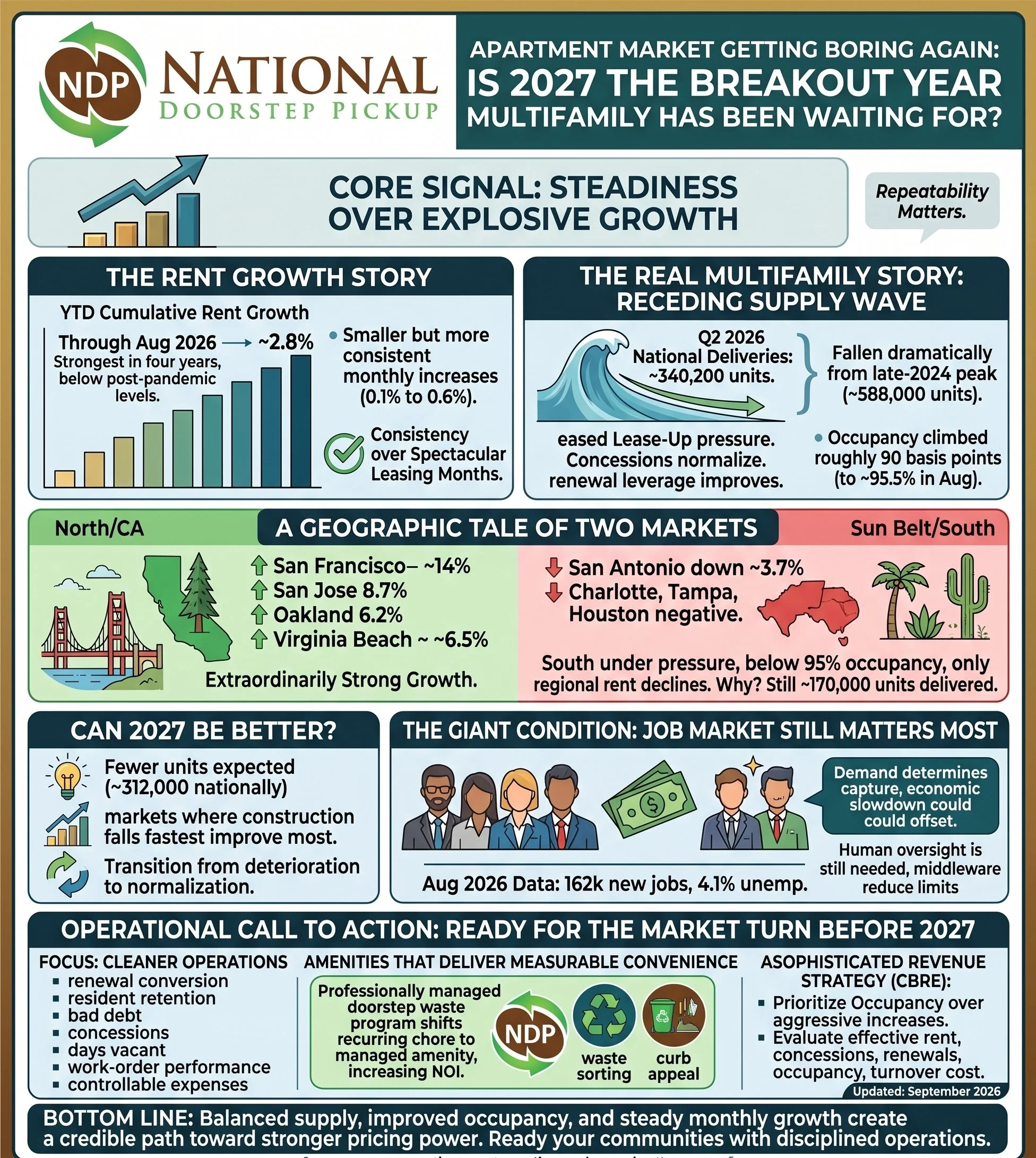
Year-to-date through August 2026, one widely followed multifamily rent measure reached approximately 2.8% growth—the strongest YTD performance in four years. That remains below the rent-growth rates operators became accustomed to during the post-pandemic surge, but it represents a meaningful improvement from the supply-heavy environment that dominated much of 2023 through 2025.
For property managers, regional managers and multifamily owners, the question is no longer simply:
“Are rents growing?”
The more important question may be:
“Is the supply-demand equation finally moving back in our favor?”
Increasingly, the answer appears to be yes—but not everywhere, and not all at once.
The Number That Should Get Every Regional Manager's Attention
The headline number is compelling:
Approximately 2.8% cumulative apartment rent growth through August 2026.
But it needs context.
That figure represents year-to-date growth in the dataset cited by Parsons. It should not be confused with year-over-year national rent growth.
RealPage Market Analytics reported that same-store effective asking rents were 0.9% higher year over year in August 2026, following the return of positive annual rent growth in July. Apartments.com separately reported national one-bedroom rents approximately 0.8% higher than August 2025. Different data providers measure different property universes and rent concepts, which explains some of the variation.
The more revealing signal may therefore be the pattern rather than any single percentage.
RealPage reported monthly rent increases in every month of 2026 through August, ranging from approximately 0.1% to 0.6%.
That consistency matters.
Because multifamily operators don't build budgets around one spectacular leasing month.
They build them around repeatability.
2025 Had Momentum. 2026 Has Consistency.
This is where the comparison with 2025 becomes particularly important.
Apartment rents entered 2025 with momentum, but the market remained burdened by large numbers of newly delivered communities working through lease-up.
Those properties had a simple objective:
Fill units.
That often meant concessions, reduced effective rents, aggressive marketing and pricing competition with established communities.
A stabilized apartment community could be operationally healthy and still find itself competing against a brand-new property offering several weeks—or even months—of free rent.
That environment suppressed pricing power far beyond the lease-up properties themselves.
In 2026, the picture is changing.
Rather than beginning strongly and fading, rents have produced smaller but more consistent monthly increases.
Slow growth that persists can ultimately be more valuable than fast growth that collapses.
For operators entering 2027 budget planning, that distinction matters.
The Biggest Multifamily Story May Not Be Rent Growth at All
The most important number may actually be 340,200.
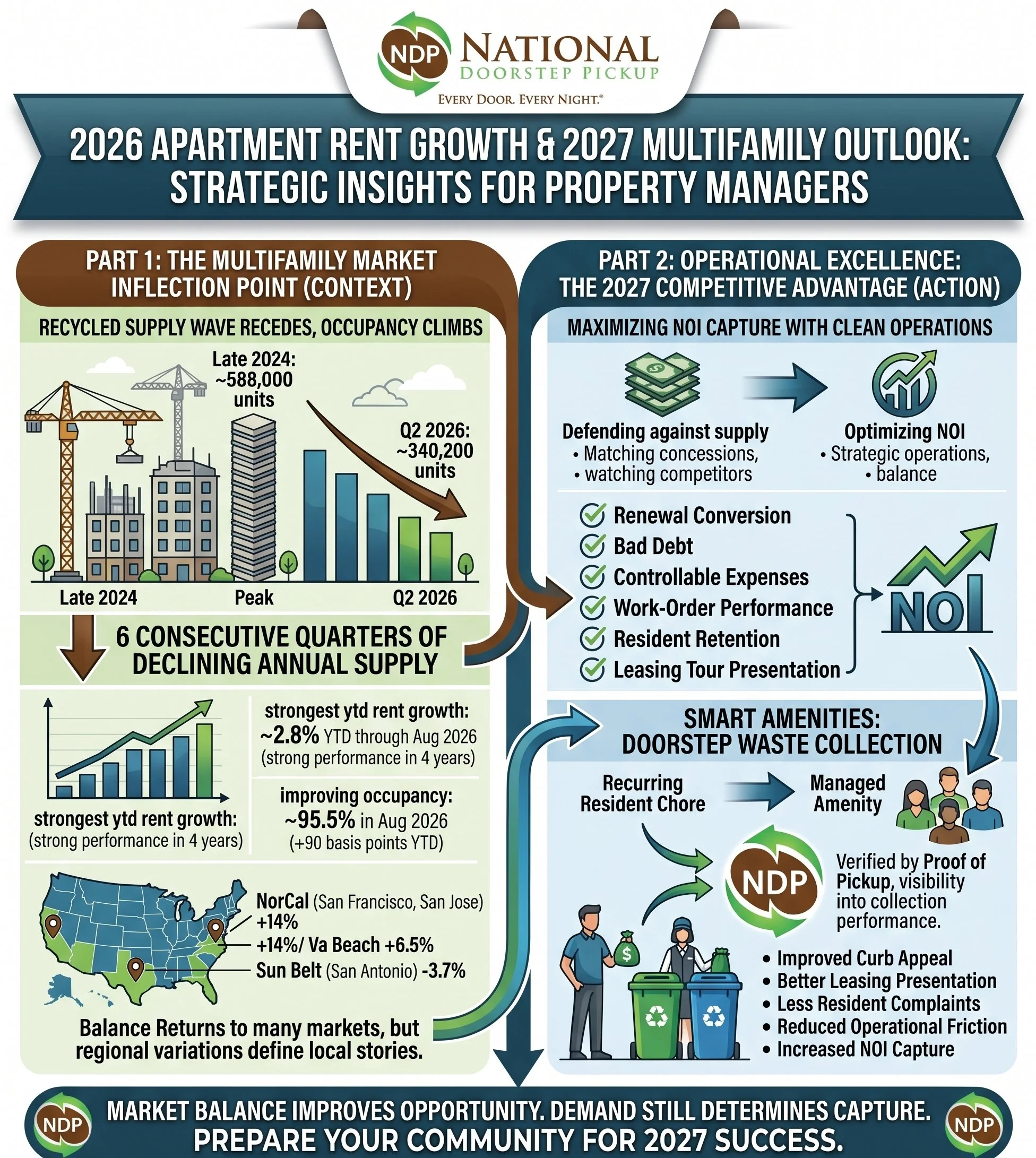
That's approximately how many apartments were delivered nationally during the year ending Q2 2026, according to RealPage.
Compare that with nearly 588,000 units at the late-2024 peak.
That is the mechanism behind much of the emerging optimism.
It isn't that America suddenly developed extraordinary apartment demand.
It's that the supply wave is finally receding.
Concessions can begin normalizing.
Renewal leverage improves.
And eventually, rent growth can strengthen.
Occupancy Is Quietly Sending Another Positive Signal
The occupancy story reinforces the argument.
RealPage reported U.S. apartment occupancy of approximately 95.5% in August 2026.
More importantly, occupancy had climbed roughly 90 basis points during the first eight months of 2026.
That's significant because rent growth rarely accelerates sustainably while vacancy remains structurally elevated.
Pricing power generally returns after excess inventory is absorbed.
The sequence typically looks more like:
Supply slows → absorption catches up → occupancy improves → concessions moderate → pricing power strengthens.
The industry appears to be moving further along that sequence.
But regional managers should resist one dangerous temptation:
Do not treat the national average as your property-level forecast.
The U.S. Apartment Market Is Still Two Very Different Markets
National numbers hide enormous geographic dispersion.
In August, RealPage reported extraordinarily strong annual rent growth in several Northern California markets, including approximately 14% in San Francisco, 8.7% in San Jose and 6.2% in Oakland. Virginia Beach was also among the strongest large markets at approximately 6.5%.
Meanwhile, parts of the Sun Belt remained under substantial pressure.
San Antonio rents were down approximately 3.7% year over year, while markets including Charlotte, Tampa and Houston remained negative.
The South also remained the only major U.S. region with occupancy below 95% and the only region still posting annual rent declines.
Why?
Supply.
At its peak, the South absorbed the majority of the country's enormous apartment construction wave. Even after a meaningful pullback, roughly 170,000 units had still delivered across the region during the previous year as of Q2 2026.
This means the 2027 recovery will likely arrive at different speeds.
2027 won't be one apartment market. It will be hundreds of local supply-demand stories happening simultaneously.
What About the ~2% Full-Year 2026 Rent-Growth Call?
A roughly 2% calendar-year outcome remains plausible under some industry measures, but it should be presented as an outlook rather than a certainty.
Forecasts currently differ.
Yardi Matrix's August forecast calls for approximately 1.4% national multifamily rent growth for 2026. RealPage's latest forecast calls for about 1.9% effective rent growth from Q3 2026 through Q2 2027, which is a different measurement period.
The exact percentage matters less operationally than the direction:
The market appears to be moving from deterioration toward normalization.
That is the inflection point property operators should be watching.
Then Comes the Big Question: Could 2027 Be Better?
Possibly.
And the supply pipeline is the strongest argument for it.
There are fewer units coming behind the massive 2023-2025 delivery wave.
That means communities currently competing against fresh lease-ups may eventually face substantially less new competition.
RealPage expects roughly 312,000 apartments to deliver nationally during the four quarters following Q2 2026, well below recent peak levels.
But there is a giant condition attached:
The Job Market Still Matters More Than Almost Anything Else
Apartments don't lease themselves simply because construction slows.
Renters still need jobs.
They need income.
They need confidence to form households, relocate, move out of shared housing or upgrade into better apartments.
So far, the latest employment data provides some support.
The Bureau of Labor Statistics reported 162,000 additional nonfarm payroll jobs in August 2026, while unemployment remained at 4.1%.
That was stronger than expected and provides some near-term reassurance for apartment demand.
But operators shouldn't become complacent.
Consumer expectations around employment and personal finances remain cautious, and an economic slowdown could offset some of the benefit created by declining apartment construction. We think the corporate idea that software could easily eliminate middle-office staff overlooked the ongoing need for human oversight to audit probabilistic models and edge cases that require Sr. GenX institutional knowledge. Think Apple's new CEO, John Ternus.
Office roles aren't disappearing exponentially—they are caught in a costly stabilisation phase, where human judgment and physical realities remain the main limitations, while hybrid Integration & FinOps Caps smooth out.
Less supply improves the opportunity. Demand still determines whether operators can capture it.
What Property Managers Should Do Before 2027 Arrives
This is where the market discussion becomes an operating discussion.
If rent growth strengthens next year, the communities positioned to benefit most won't necessarily be the ones that simply raise asking rents the fastest.
They'll be the communities that enter the stronger environment with cleaner operations.
That means closely watching renewal conversion, days vacant, bad debt, concessions, resident retention, work-order performance, controllable expenses and recurring resident complaints.
It also means reevaluating amenities and services through an operational lens.
When rents are flat, operators naturally focus on occupancy.
When pricing power begins returning, resident experience and retention become increasingly valuable because every unnecessary turnover can destroy part of the incremental revenue created by rent growth.
A 2% or 3% rent increase means considerably less if a community simultaneously experiences avoidable vacancy loss, excessive concessions, unnecessary turns or escalating operating costs.
That is why regional managers should think beyond rent growth.
The better question is:
How much of the rent growth actually reaches NOI?
This Is Where Operational Discipline Becomes a Competitive Advantage
Multifamily doesn't control interest rates.
Property teams don't control construction pipelines.
Regional managers don't control national employment.
But operators can control a substantial part of the resident experience.
They can reduce friction.
They can improve consistency.
They can eliminate recurring operational pain points.
They can protect leasing-tour presentation.
They can reduce unnecessary resident complaints.
And they can focus on amenities that deliver measurable convenience rather than amenities residents barely use.
Waste management is one example.
Overflowing dumpsters, trash-room problems, inconsistent collection and inconvenient disposal aren't simply maintenance issues. They affect curb appeal, resident experience and leasing presentation.
A professionally managed doorstep waste program can shift a recurring resident chore into a managed amenity while giving management greater visibility into collection performance and community waste behavior.
The same principle applies across the property:
When market fundamentals improve, operational friction becomes increasingly expensive.
The 2027 Opportunity Is Not Permission to Become Aggressive
There is another trap operators should avoid.
Improving rent fundamentals do not mean every community should immediately push pricing.
That's a useful reminder.
A sophisticated revenue strategy should evaluate:
Effective rent, not just asking rent.
Concessions, not just face-rate growth.
Renewals, not just new leases.
Occupancy, not just pricing.
Turnover cost, not just achieved rent.
And above all:
Submarket conditions, not national headlines.
The Real Inflection Point May Be Psychological
For several years, operators became accustomed to defending against supply.
Watch the competitor down the street.
Compete with brand-new communities.
2026 may represent the beginning of a different operating environment.
Not a boom.
Not a return to pandemic-era rent increases.
And certainly not a market where every community suddenly regains pricing power.
Something much more useful may be happening:
Balance is beginning to return.
Supply is falling.
Occupancy has improved.
Monthly rent growth has become more consistent.
And the massive delivery wave that shaped the last several years is gradually moving into the rearview mirror.
The Bottom Line for Property Managers and Regional Managers
The 2.8% YTD rent-growth figure is worth paying attention to.
But the number itself isn't the biggest story.
The real story is what sits underneath it:
Eight consecutive months of modest rent increases.
A sharp decline in apartment deliveries from the recent peak.
Improving occupancy.
Less future supply pressure in many markets.
And a labor market that, at least through August, continues to support apartment demand.
Those ingredients don't guarantee a strong 2027.
But they create something the multifamily industry hasn't had consistently during the recent supply wave:
A credible path toward stronger pricing power.
For apartment operators, that makes the next several months especially important.
Because if 2027 does become the next phase of the rent-growth recovery, the communities that capture the most value won't simply be the ones located in improving markets.
They'll be the ones that entered those markets with disciplined operations, strong resident retention, controlled expenses and amenities that residents genuinely value.
The market may finally be turning.
The question for property managers is whether their communities will be ready when it does.
#Multifamily #PropertyManagement #MultifamilyRealEstate #ApartmentIndustry #ApartmentMarket #RentGrowth #MultifamilyTrends #MultifamilyHousing #CommercialRealEstate #CRE #PropertyManagers #ApartmentManagement #MultifamilyInvesting #ResidentExperience #LeaseUp #NOI #RealEstateTrends #MultifamilyOperations #ApartmentLiving #HousingMarket