By Les Leith, CEO & COO at National Doorstep Pickup
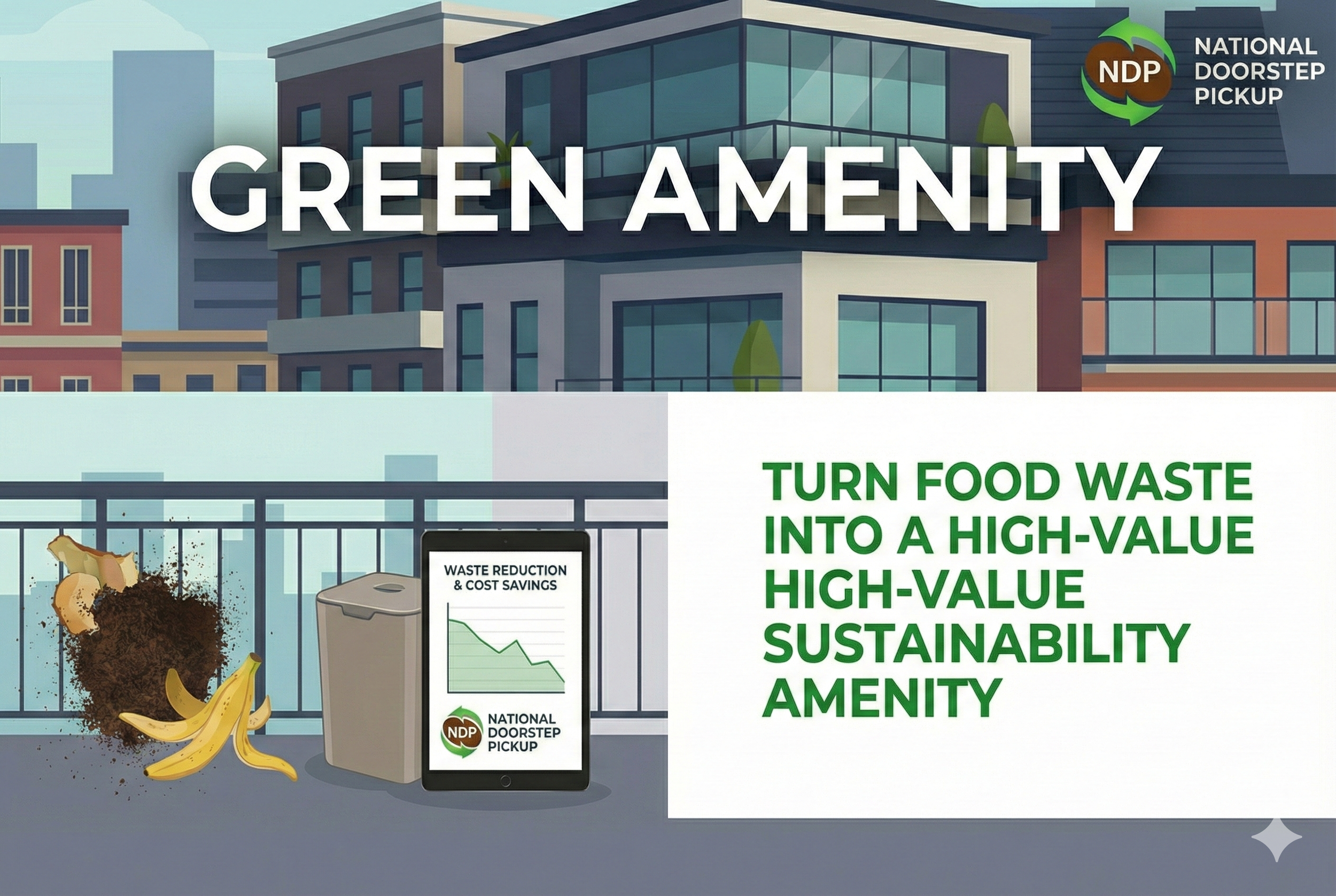
Urban multifamily communities face growing pressure to operate sustainably while maintaining clean, efficient, and resident-friendly properties. Composting—once thought impractical for apartments—is now emerging as a powerful, achievable solution that reduces waste costs, supports environmental goals, and strengthens resident engagement. When implemented correctly, composting becomes less of an operational burden and more of a strategic amenity that differentiates your community.
Below is a practical, property-management-focused guide to understanding composting in urban apartments, the challenges involved, and how modern solutions make it work at scale.
Why Composting Matters for Multifamily Properties
Composting transforms organic waste—food scraps, coffee grounds, and compostable paper—into nutrient-rich material rather than sending it to landfills. For urban multifamily properties, this delivers measurable operational and reputational benefits.
Key advantages for property management include:
Waste reduction: Organic waste makes up a significant portion of the apartment waste stream. Composting reduces landfill volume and hauling costs.
Environmental impact: Diverting food waste prevents methane emissions associated with landfills, supporting ESG and sustainability benchmarks.
Stronger sustainability positioning: Composting signals environmental leadership, which resonates with today’s eco-conscious residents.
Healthier landscaping: Finished compost can be reused on-site, reducing fertilizer expenses and improving curb appeal.
Resident engagement: Composting programs encourage shared responsibility and community participation.
The Urban Challenge: Limited Space (and How to Solve It)
Space constraints are often the first objection property management raises—and rightly so. Urban properties rarely have excess room for traditional compost piles. Fortunately, modern systems are designed specifically for dense environments.
Proven space-efficient solutions include:
Vertical and compact systems: Countertop units and slim-profile bins maximize limited indoor or utility room space.
Bokashi composting: A sealed, anaerobic process that ferments food waste indoors with minimal odor and footprint.
Community composting zones: Rooftops, courtyards, or unused corners can support shared composting areas without disrupting amenities.
Stackable bins and trays: Ideal for balconies, patios, or back-of-house locations.
Centralized indoor setups: Clearly labeled systems in trash rooms streamline participation while keeping operations orderly.
The takeaway: lack of space no longer disqualifies a property from composting.
Resident Participation: The Real Success Factor
Even the best system fails without resident buy-in. High-performing composting programs prioritize education, simplicity, and communication.
Effective engagement strategies include:
Education and outreach: Workshops, quick-start guides, signage, and visual infographics remove uncertainty.
Clear instructions: Residents are far more likely to participate when bins are intuitive, and rules are simple.
Incentives and events: Sustainability-themed community events or small rewards drive early adoption.
Ongoing communication: Regular updates build trust and reinforce correct usage.
When residents understand the “why” and the “how,” contamination drops and participation rises.
Odor and Pest Control: Managing the Biggest Concern
Odors and pests are manageable—not inevitable—when composting is done correctly.
Best practices include:
Maintaining the right carbon-to-nitrogen balance (browns vs. greens).
Using enclosed, lidded systems to contain smells and deter pests.
Avoiding meat and dairy in traditional composting setups.
Monitoring moisture levels and ensuring regular maintenance.
Leveraging Bokashi or vermicomposting, both of which are well-suited for indoor, low-odor environments.
There are other natural tips and tricks that we can share after service starts that eliminate smells and odors.
Proper system selection and routine oversight keep composting clean and resident-friendly.
Building a Community-Led Composting Program
For larger properties, community-led composting creates shared ownership and long-term success.
A proven rollout framework:
Educate residents and gauge interest.
Select a secure, accessible location.
Establish clear, simple guidelines.
Choose the right system for your property size.
Assign resident champions or coordinators.
Monitor performance and address issues quickly.
Share results—waste diverted, environmental impact, and community wins.
Transparency and feedback keep momentum strong.
How National Doorstep® Helps Property Management Succeed
Composting works best when paired with professional support. National Doorstep®™ simplifies composting for multifamily communities by integrating it into a broader doorstep valet trash and recycling solution. Property management gains a turnkey system that reduces operational friction, improves compliance, and elevates the resident experience—all without adding staff burden.
By partnering with National Doorstep®, properties can implement composting confidently, knowing education, logistics, and consistency are handled professionally.
Request a quote today to see how National Doorstep®™ can help your community turn organic waste into a cleaner, greener, and more valuable amenity.
Frequently Asked Questions
What composting systems work best for apartments?
Vermicomposting, Bokashi fermentation, and compact bin systems are all effective for multifamily properties, especially those with limited space.
Is composting cost-effective?
Yes. Diverting organic waste can reduce hauling fees, lower landfill pulls, and offset landscaping costs through compost reuse.
What can residents compost?
Common items include fruit and vegetable scraps, coffee grounds, tea bags, eggshells, and non-glossy paper products.
Does composting attract pests?
Not when managed correctly. Sealed bins, proper material balance, and excluding meat and dairy minimize risk.
How long does composting take?
Depending on the method, finished compost typically develops within a few months to a year, with regular monitoring accelerating results.
Composting in urban multifamily properties is no longer a niche experiment—it is a scalable, resident-approved strategy that supports sustainability goals and operational efficiency when executed properly.