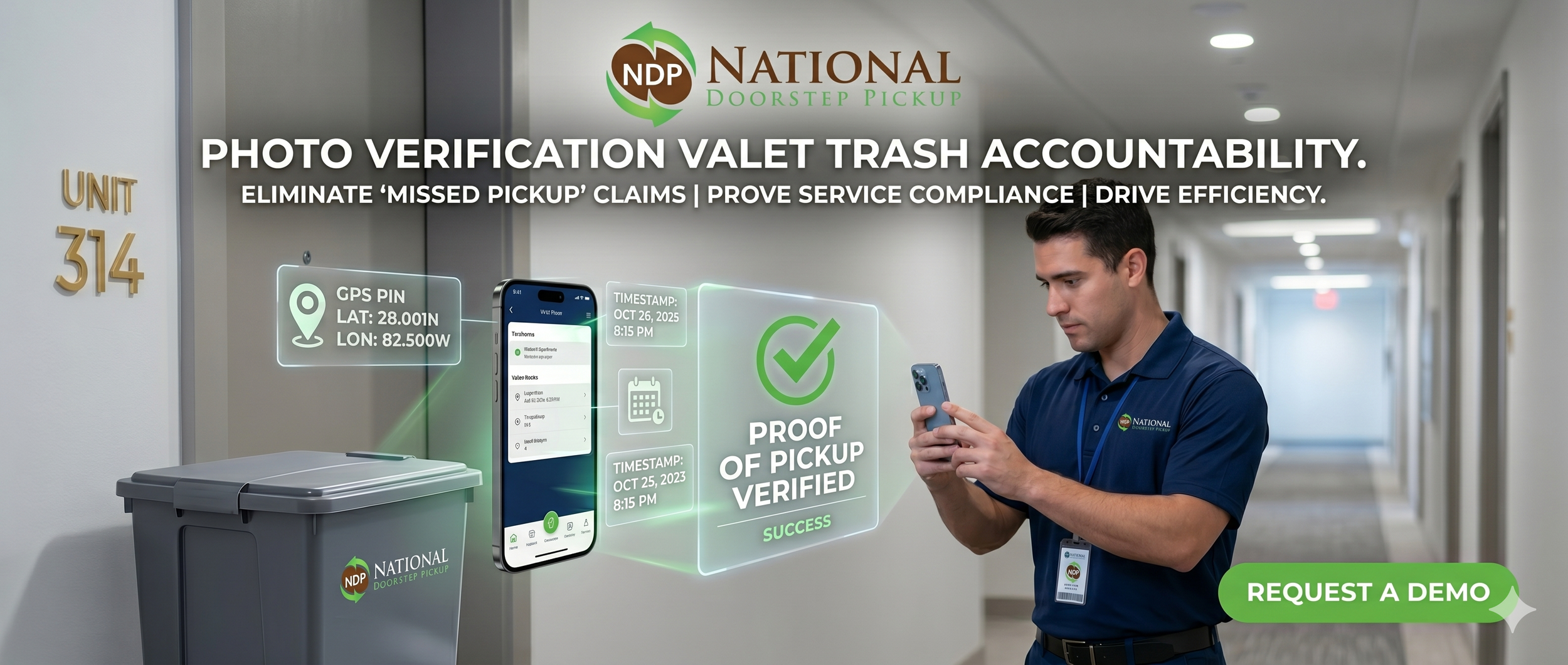
How to Use Photo Verification to Improve Valet Trash Accountability
By Les Leith, CEO & COO at National Doorstep Pickup
Missed pickup complaints are not just a trash problem.
They are a trust problem.
When a resident says, “My trash was never picked up,” the property team is immediately pulled into a familiar cycle: check the breezeway, text the porter, call the vendor, review the resident’s complaint, and hope someone remembers what happened last night.
That is not accountability. That is ‘he said, she said’ guesswork.
At 300 doors with 20 pickups per month, that is a lot of simultaneous events to document at scale.
Modern valet trash service needs the same standard residents already expect from package delivery, rideshare apps, and food delivery: proof that the service happened, when it happened, and what condition was documented at the door.
That is where photo verification changes the game.
National Doorstep’s Porter Software uses Proof of Pickup®, digital validation, real-time reporting, and photo-PDF documentation to give property managers visibility into nightly valet trash performance. The system is designed to support operational accountability, recycling workflows, waste containment, and resident communication across multifamily properties.
Why Valet Trash Accountability Breaks Down Without Photos
Traditional valet trash programs often rely on three weak forms of evidence:
The resident’s complaint.
The porter’s memory.
The property manager’s assumption.
That may work when service volume is low. It does not work when a community has hundreds of doors, multiple buildings, controlled access points, varied resident behavior, recycling requirements, cardboard overflow, and nightly service expectations.
Without photo verification, property managers are left asking:
Was the bag outside during the pickup window?
Was it tied properly?
Was it leaking?
Was the container blocked?
Was the porter actually at the door?
Was the trash non-compliant?
Was the issue a missed pickup or a resident set-out violation?
Photo verification turns those questions into documented answers.
The Big Shift: From “Trust Me” to “Show Me”
Valet trash accountability improves when every service event becomes visible.
A strong photo verification process should document the condition of the pickup, the timing of the service, and the reason for any exception. National Doorstep’s page describes field crews using smartphones to send reports after pickup, with Porter Software providing Proof of Pickup® and “Amazon®-level Verification” for accountability.
That matters because property managers do not need more vendor promises.
They need proof.
Photo verification gives the site team a record they can use to resolve complaints, coach residents, monitor vendor performance, and protect the value of the amenity.
What Photo Verification Should Capture
A good valet trash photo verification system should capture more than a random picture of a bag.
It should create a useful operating record.
At minimum, the documentation should support:
Pickup confirmation: proof that the porter serviced the door or area.
Set-out condition: whether the bag was properly tied, placed correctly, and available during the pickup window.
Non-compliance evidence: visible documentation of loose trash, leaking bags, oversized bulk items, cardboard overflow, contaminated recycling, or blocked access.
Route-level visibility: confirmation that buildings, floors, corridors, and collection points were completed.
Property communication: a clean record the management team can use when responding to resident complaints.
National Doorstep’s system emphasizes real-time situational awareness, digital validation, reporting, and property manager access to Valet Porter Tour data and Proof of Pickup® validation on demand.
How Photo Verification Reduces Missed Pickup Disputes
Most missed pickup disputes fall into one of three categories.
First, the porter missed the door.
Second, the resident set the trash out late or incorrectly.
Third, the service happened, but the resident did not see the result until after another issue occurred.
Photo verification separates those categories fast.
Instead of debating what happened, the property manager can review the documentation and respond with confidence. That makes the conversation less emotional and more operational.
A resident complaint becomes:
“We reviewed the service documentation from last night. The porter completed your building at 8:47 PM, and the photo shows no bag outside the door at the time of service.”
Or:
“We confirmed your trash was out and should have been collected. We are addressing this with the porter team and will correct it.”
Both responses are better than silence, guessing, or finger-pointing.
Photo Verification Also Protects the Property Team
Property managers are already overloaded.
Every unresolved trash complaint creates additional administrative drag: emails, calls, resident portal messages, vendor follow-up, courtesy credits, negative reviews, and staff frustration.
Photo verification reduces that burden because the evidence is already collected.
The best valet trash programs do not make the property team investigate every issue from scratch. They give the team a searchable, visual record that supports faster decisions.
That is especially important for communities with:
Garden-style layouts
Mid-rise buildings
High-rise communities
Student housing
Senior living communities
Mixed-use properties
Large multifamily assets with multiple waste streams
National Doorstep specifically notes that automated routing and gate code management help support smooth nightly workflows across Garden-Style, Mid-Rise, and High-Rise communities. (Doorstep Valet Trash)
How Photo Verification Improves Porter Performance
Accountability is not only about catching mistakes.
It is about creating a performance feedback loop.
A manager can identify:
Which building has repeated set-out issues
Which doors generate the most complaints
Which route segment takes too long
Where cardboard piles up
Where recycling contamination occurs
Where access problems delay service
Which resident education reminders are needed
That turns valet trash from a nightly labor task into a managed operating system.
National Doorstep’s page states that operational KPIs are kept top of mind and references better than 99.75% pickup success across 300,000+ doors served, connecting reliability with digital validation and operational accountability.
Why Photo Verification Matters for Recycling and Cardboard Compliance
Valet trash is no longer only about bags at the door.
More cities are increasing expectations around recycling access, cardboard control, resident education, contamination prevention, and multifamily waste diversion. That means property managers need documentation, not just service.
Photo verification helps show whether recycling workflows are actually being followed.
It can document:
Cardboard overflow
Improperly sorted materials
Contaminated recycling
Resident participation issues
Container placement problems
Missed education opportunities
Recurring problem areas
National Doorstep positions its technology as part of GreenPlus™ and Compliance Shield, using digital validation to support recycling participation, resident education, contamination prevention, and mandate-aligned service.
For multifamily owners, that matters because compliance risk and service quality are now tied together. A community that cannot prove what is happening at the door may struggle to prove what is happening across the waste stream.
The Accountability Formula: Photo + Time + Route + Report
A photo by itself is helpful.
A photo connected to time, route data, porter activity, and reporting is much more powerful.
The strongest valet trash accountability model looks like this:
Photo verification shows the condition at the door.
Timestamped reporting shows when the service event occurred.
Route data shows where the porter was during the tour.
Exception reporting explains why an item was not collected.
Manager access gives the property team the record when they need it.
This creates a documented service loop from door to dumpster, resident to manager, and porter to property.
That is the difference between a basic valet trash vendor and a technology-enabled service partner.
How Property Managers Can Use Photo Verification Day to Day
Photo verification should not sit unused in a dashboard.
It should become part of the operating rhythm.
Use it to review recurring complaints before renewal season. Use it to identify buildings where residents need better set-out reminders. Use it to support lease addendum enforcement. Use it to confirm service quality before a small issue becomes a review-site problem.
Property teams can also use photo verification to improve communication.
Instead of sending vague reminders like “Please follow trash rules,” managers can send targeted resident education:
“Trash must be bagged, tied, and placed inside the approved container between 6 PM and 8 PM.”
“Loose trash, leaking bags, bulk items, and cardboard are not part of standard nightly pickup unless scheduled separately.”
“Late set-outs may not be collected after the porter has completed the route.”
That level of clarity reduces conflict because expectations are specific.
Photo Verification Protects NOI
Valet trash is an amenity, but poor execution can turn it into a resident complaint engine.
When accountability is weak, the property pays in staff time, resident dissatisfaction, vendor disputes, lower amenity perception, and potential renewal friction.
When accountability is strong, valet trash becomes easier to defend as a paid amenity.
Photo verification helps protect NOI by:
Reducing avoidable service credits
Reducing staff investigation time
Improving resident trust
Supporting amenity fee justification
Documenting service consistency
Improving recycling and cardboard workflows
Reducing contamination and overflow problems
Strengthening vendor accountability
National Doorstep’s Porter Software page directly connects digital validation, documentation, and verified sustainability data with NOI optimization and asset appreciation reporting. (Doorstep Valet Trash)
What to Ask Before Choosing a Valet Trash Provider
Before hiring or renewing a valet trash vendor, property managers should ask:
Do you provide photo verification?
Can management access Proof of Pickup® records on demand?
Are porter reports generated after each pickup?
Can your system document non-compliant set-outs?
Can it support recycling, cardboard, and contamination workflows?
Can it help identify recurring resident behavior issues?
Does your reporting help reduce missed pickup disputes?
Can your team support Garden-Style, Mid-Rise, and High-Rise routing?
Do you provide a clear communication loop between porter, vendor, property team, and resident?
A provider that cannot answer those questions is asking the property to operate on trust alone.
That is not enough anymore.
The Bottom Line: Better Proof Creates Better Service
Photo verification improves valet trash accountability because it replaces uncertainty with evidence.
It helps property managers know what happened, when it happened, where it happened, and why an exception occurred.
It protects the resident experience.
It protects the property team’s time.
It protects the amenity value.
It protects the asset.
National Doorstep’s Proof of Pickup® and Porter Software platform gives property managers the operational visibility needed to keep valet trash service levels high, manage recycling workflows, reduce disputes, and document performance across the community.
When the service is visible, the accountability is real, although it takes more time to capture and document nightly!
When the accountability is real, the amenity becomes easier to trust, easier to manage, and easier to monetize.
Call to Action
Ready to bring photo-verified accountability to your community?
Request a Proposal from National Doorstep Pickup and see how Proof of Pickup®, Porter Software, and Every Door. Every Night.® service can help your property reduce missed pickup disputes, improve resident communication, and protect the value of your valet trash amenity.