By Les Leith, CEO & COO at National Doorstep Pickup
Hundreds of residents moving out. Hundreds more moving in. Furniture piling up. Dumpsters overflowing. Maintenance crews racing the clock.
Welcome to student housing Turn Season—when a property’s waste-management strategy can become just as important as its make-ready schedule.
For conventional multifamily properties, move-outs are generally staggered throughout the year.
Student housing operates differently.
The result?
A predictable waste surge that can overwhelm even well-managed communities.
Sofas, mattresses, shelving, appliances, household trash, discarded electronics, packing material, and mountains of cardboard can arrive at disposal areas almost simultaneously.
But the biggest operational problem isn’t necessarily the volume of trash.
It’s what happens when that trash interferes with everything else.
Maintenance technicians lose access to disposal areas. Hauling equipment cannot reach dumpsters. Bulk furniture obstructs circulation. Vendors compete for parking and loading zones. And management teams begin spending time on waste problems instead of preparing apartments for the next residents.
The solution isn’t simply asking the valet trash company to pick up more.
Turn Season requires its own waste-management plan, clearly defined vendor responsibilities, and separately contracted services wherever the existing agreements do not cover the additional work.
Here’s how student housing operators can prevent waste-related gridlock before the next lease-turn surge.
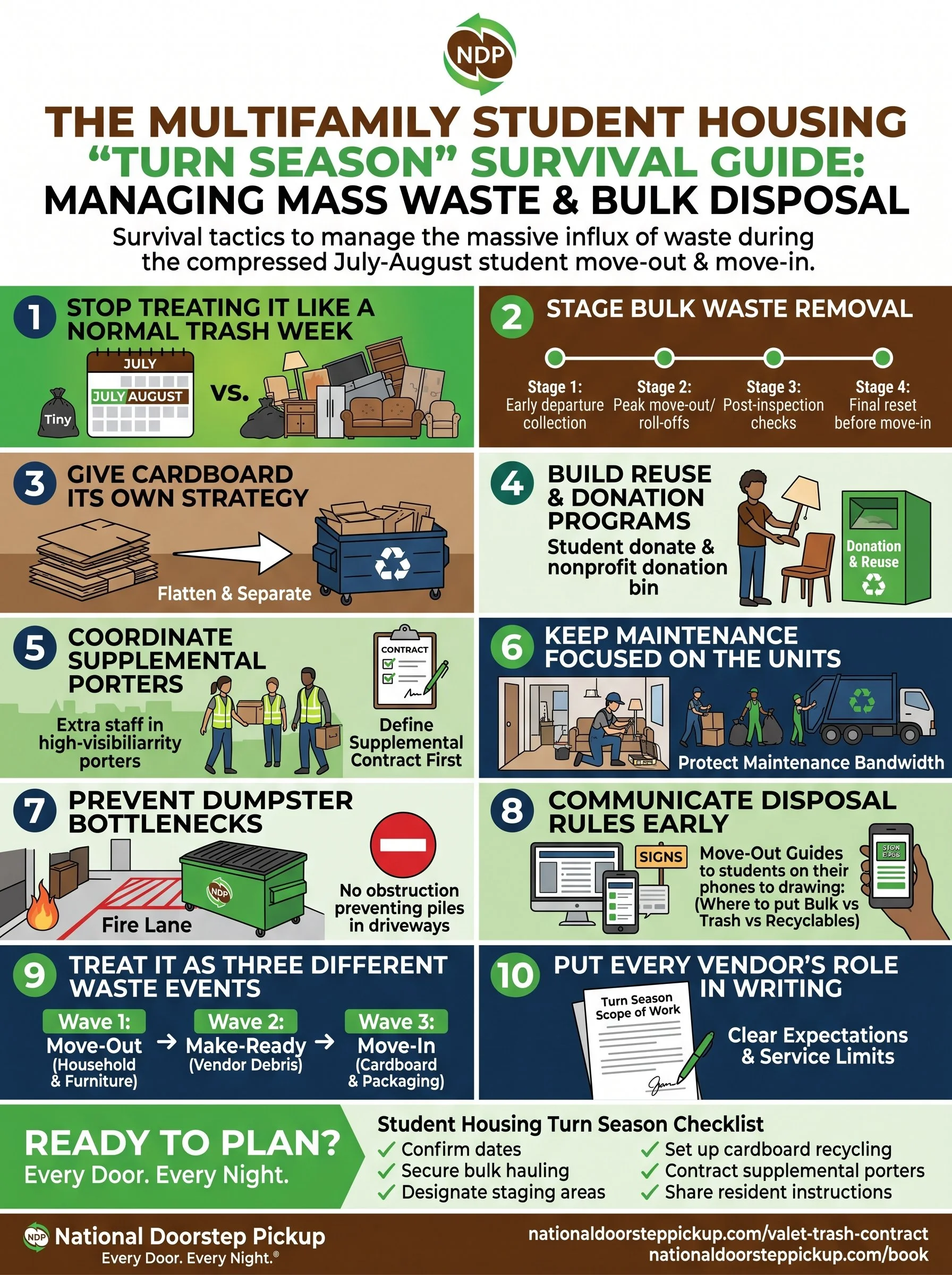
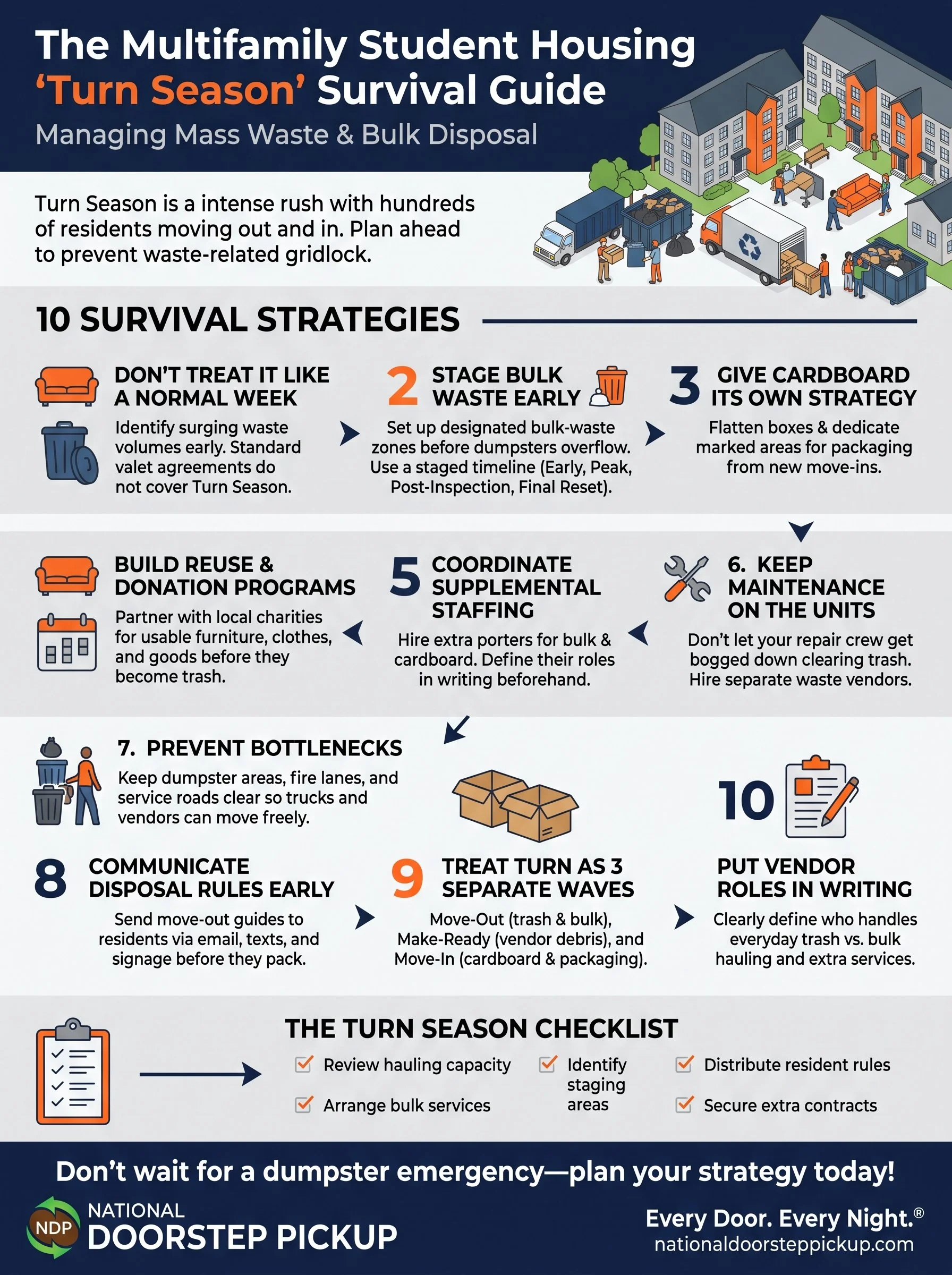
1. Stop Treating Turn Season Like a Normal Trash Week
A student housing community operating smoothly in February may experience completely different waste conditions during peak July and August move-outs.
Consider a hypothetical 700-bed community with a compressed lease-turn schedule.
Hundreds of residents may dispose of unwanted belongings over just a few days.
Unlike ordinary household waste, this material can include bulky furniture, oversized packaging, abandoned possessions, household chemicals, and electronics requiring special disposal.
The standard trash infrastructure may not be designed for that concentrated volume.
And importantly, neither is a standard doorstep valet trash agreement.
Routine valet trash service generally addresses the collection of eligible, properly bagged household waste according to the contracted service schedule, limits, and set-out rules.
It should not be assumed to include abandoned furniture, mattresses, bulk removal, unit cleanouts, extraordinary cardboard volumes, or special Turn Season staffing.
Before move-out begins, property management should establish a separate operating plan identifying the anticipated waste volume, hauling capacity, collection locations, supplemental labor requirements, and responsibilities of every participating contractor.
The first rule of Turn Season: Plan for the surge before the surge arrives.
2. Stage Bulk Waste Removal Before Dumpsters Overflow
One of the most common Turn Season problems is allowing oversized items to consume the space intended for regular household trash.
A sofa can occupy a substantial portion of a dumpster.
Add mattresses, desks, chairs, shelving, and miscellaneous furniture, and disposal capacity can disappear quickly.
Instead of allowing bulk waste to accumulate throughout the property, establish designated collection areas where permitted and arrange separate bulk hauling.
A practical staged removal program may look like this:
Stage One: Early Move-Out Collection
Schedule initial bulk removal around early departures. Capture furniture and other oversized items before the primary move-out rush.
Stage Two: Peak Move-Out Collection
Increase bulk disposal capacity around the community’s primary vacancy deadline. Where necessary, arrange roll-off containers or additional hauling.
Stage Three: Post-Inspection Removal
After units are vacated, identify abandoned items that require disposal. Coordinate removal separately from normal household waste collection and in accordance with applicable abandoned-property rules.
Stage Four: Final Property Reset
Complete the remaining bulk disposal and clean designated waste areas before the primary move-in window.
The University of Georgia’s student-housing move-out guidance illustrates this separation by directing bulky trash to open-top dumpsters while directing bagged household waste to regular dumpsters or compactors.
The lesson for private student housing operators is straightforward:
Protect everyday dumpster capacity by keeping bulky waste in its own disposal workflow.
3. Give Cardboard Its Own Move-In Strategy
Move-out creates unwanted belongings.
Move-in creates packaging.
As residents arrive, properties experience another waste surge driven by furniture deliveries, electronics, online orders, shipping cartons, and household purchases.
Without a dedicated plan, cardboard can consume ordinary dumpster capacity at extraordinary speed.
A cardboard strategy should begin before move-in day.
Designate clearly marked cardboard collection areas. Require residents to flatten boxes. Ensure collection infrastructure is large enough for the anticipated demand. Arrange recycling service with the appropriate provider.
The EPA recommends flattening cardboard before placing it into recycling containers and emphasizes that local recycling programs determine accepted materials.
That distinction matters.
Recycling requirements and accepted materials can vary by municipality, hauler, and property.
A recycling program only works when the material is accepted, properly separated, and collected through an authorized channel.
Property management should confirm local requirements rather than assuming all cardboard or packaging materials belong in the same container.
The operational benefit extends beyond waste diversion.
Removing flattened cardboard from the ordinary trash stream helps preserve general disposal capacity for material that cannot be recycled.
4. Build a Reuse and Donation Program Before Everything Becomes Waste
Not every item a student leaves behind is trash.
Desks, chairs, shelving, clothing, kitchenware, lamps, and small household goods may still be usable.
A donation strategy can reduce disposal pressure by separating reusable belongings before they enter the waste stream.
Student housing operators can establish temporary donation locations, coordinate with local nonprofit organizations, and communicate accepted items ahead of move-out.
University housing programs already demonstrate the value of this approach.
UC Davis, for example, operates student move-out donation drives that collect reusable household goods and nonperishable food for community partners.
For private student housing properties, the same basic principle applies:
Reuse what can be reused. Recycle what can be recycled. Dispose of the remainder responsibly.
Donation programs should be separately coordinated with appropriate organizations rather than assumed to be part of the property’s regular waste collection contract.
5. Coordinate Supplemental Porter Staffing—But Define the Contract First
Extra labor can be valuable during Turn Season.
However, additional labor should never be assumed to be included in the property’s existing valet trash rate.
This is an important distinction for student housing operations directors.
Standard doorstep valet trash service and supplemental Turn Season waste management are different service scopes.
Routine doorstep collection generally involves eligible bagged household waste collected during designated service periods.
Turn Season may require additional personnel for tasks such as moving approved bulk items, supporting temporary collection zones, performing common-area waste sweeps, or handling specially arranged cardboard collection.
These are supplemental services that must be expressly covered by the existing agreement or separately contracted.
Before scheduling additional personnel, management should determine:
Which specific tasks require supplemental labor?
How many staff members are needed?
Which dates and time windows require coverage?
Who supplies equipment and transportation?
Who is responsible for disposal and hauling fees?
What material is prohibited or requires specialized handling?
How will completed work be documented?
A porter assigned to routine doorstep collection is not automatically a bulk-disposal crew.
Clearly defined responsibilities protect both property management and service providers from unexpected obligations, scheduling conflicts, and avoidable disputes.
6. Keep Maintenance Focused on the Units—Not the Dumpsters
Student housing Turn Season creates an unusual operational challenge.
Large numbers of apartments must be inspected, repaired, cleaned, and made ready for new residents within a tightly defined deadline.
Maintenance technicians may already be managing plumbing repairs, appliance replacements, drywall work, unit inspections, painting, and vendor coordination.
Now add furniture stacked near dumpsters.
Suddenly, maintenance personnel are being pulled away from unit turns to relocate discarded items and restore disposal access.
That creates an unnecessary competition for labor.
A better approach is to assign waste-management responsibilities through a separate operational workflow.
Management should coordinate bulk haulers, specialty removal contractors, maintenance personnel, and any separately contracted supplemental porter services before the turn begins.
The goal is not to remove maintenance from every waste-related task.
It is to prevent predictable waste surges from repeatedly disrupting critical make-ready work.
Every hour spent clearing preventable waste obstructions is an hour unavailable for preparing apartments.
During an accelerated lease turn, protecting maintenance bandwidth is essential.
7. Prevent Dumpster Areas From Becoming Property Bottlenecks
Dumpster overflow is not merely a housekeeping concern during Turn Season.
It can become a property-circulation issue.
When normal containers fill, residents may leave furniture and trash beside enclosures.
Additional waste can accumulate until collection vehicles struggle to reach containers.
Poorly placed disposal areas may also interfere with loading zones, sidewalks, service roads, parking areas, and emergency access.
Preventing this requires more than increasing collection frequency.
Property management should identify approved staging areas, confirm hauling access, designate overflow procedures, and establish a clear escalation process when containers approach capacity.
Bulk staging must not block fire lanes, required exits, accessible routes, or emergency access.
The objective is to prevent waste from becoming a physical obstacle to property operations.
8. Communicate Disposal Rules Before Residents Start Moving
Move-out instructions delivered after the dumpsters overflow are too late.
Residents need clear direction before they begin discarding belongings.
Student housing managers should communicate waste procedures through resident emails, text messages, portals, move-out notices, signage, and other approved communication channels.
Instructions should explain where to place ordinary household trash, how to dispose of furniture, where to bring donations, how to separate cardboard, and which materials require specialized disposal.
Residents should also understand that restricted items such as certain electronics, batteries, hazardous chemicals, and appliances may require separate handling.
The instructions should identify prohibited dumping areas and explain any property-enforced violations or charges established under applicable lease terms and law.
For a high-turnover property, clear instructions reduce confusion and the labor associated with correcting improper disposal.
If the resident has to guess where an item belongs, the waste plan is already losing efficiency.
9. Treat Move-Out, Make-Ready, and Move-In as Three Different Waste Events
One reason student housing waste planning becomes difficult is that Turn Season is often treated as a single cleanup period.
In reality, the property may encounter three separate waste surges.
Wave One: Move-Out
Outgoing residents generate household trash, abandoned furniture, unwanted belongings, and bulk waste.
Wave Two: Make-Ready
Maintenance technicians and contractors generate packaging, discarded replacement materials, and renovation-related debris.
Wave Three: Move-In
Incoming residents produce cardboard, packaging, household trash, and other materials associated with furnishing new apartments.
Each wave can require a different handling strategy, collection schedule, disposal method, and contractor.
Construction or renovation debris, for example, should not be placed into ordinary household waste containers unless the responsible hauler and applicable rules permit it.
By distinguishing the three waves, operators can allocate equipment and labor more effectively.
The goal is continuous waste movement—not allowing one wave to overwhelm the next.
10. Put Every Vendor’s Responsibility in Writing
This may be the single most important Turn Season recommendation.
Do not assume an existing vendor agreement includes extraordinary waste services simply because the vendor already operates at the community.
A comprehensive Turn Season plan should identify who is responsible for routine doorstep waste collection, bulk hauling, temporary containers, cardboard recycling, donations, abandoned-property handling, supplemental porter services, and final disposal.
Any additional services should be explicitly contracted before work begins.
The agreement or authorized scope of work should establish service dates, material limitations, staffing, equipment, pricing, access requirements, and documentation expectations.
This helps prevent the most avoidable Turn Season problem:
Everyone assumes someone else is handling the waste.
The Student Housing Turn Season Readiness Checklist
Before the next July or August lease turn, property management should confirm:
Expected move-out and move-in dates are documented.
Waste-hauling capacity has been reviewed against anticipated volumes.
Additional bulk disposal services are separately arranged.
Approved bulk staging locations are identified.
Cardboard recycling capacity is coordinated.
Donation and reuse partnerships are confirmed where applicable.
Supplemental porter services are separately contracted if required.
Existing valet trash contract limits and exclusions are understood.
Maintenance and vendor access routes remain unobstructed.
Resident disposal instructions are distributed.
Special waste-handling requirements are addressed.
Waste-removal responsibilities are assigned to specific parties.
Final property cleanup and inspection are scheduled before move-in.
A written checklist creates accountability before the highest-volume days arrive.
The Real Cost of a Poorly Managed Turn Season
The direct cost of disposing of waste is only part of the equation.
An overflowing dumpster can create additional labor.
Abandoned furniture can interrupt normal service routes.
Improperly placed materials can restrict vendor access.
Cardboard contamination can complicate recycling.
Unplanned bulk disposal can create unexpected expenses.
And pulling maintenance workers away from make-ready work can jeopardize an already compressed schedule.
These are operational consequences—not simply cosmetic concerns.
Student housing directors should evaluate waste planning in the context of overall property readiness.
The central question is not:
How quickly can we empty the dumpsters?
It is:
How do we keep waste from interfering with our ability to deliver move-in-ready apartments?
National Doorstep Pickup: Standard Valet Trash vs. Separately Contracted Turn Season Services
National Doorstep Pickup is a technology-enabled multifamily doorstep waste collection and recycling company serving apartment communities and student housing properties across the lower 48 states.
Our routine services are governed by the applicable service agreement, including approved materials, collection schedules, service limits, and property-specific requirements.
Turn Season bulk disposal, abandoned furniture removal, unit cleanouts, extraordinary cardboard collection, and additional porter staffing are not automatically included in a standard valet trash agreement.
These activities require an express contractual provision or a separately approved scope of work.
Where separately contracted and operationally available, supplemental waste-management services may be coordinated to address specific property requirements.
National Doorstep Pickup’s Proof of Pickup® technology provides route, time, and photo verification for applicable doorstep collection services, supporting documented service execution and accountability.
Property management remains responsible for coordinating its broader Turn Season waste plan, including bulk hauling, disposal capacity, approved staging locations, supplemental vendor contracting, and applicable regulatory requirements.
The Bottom Line: Contract for Turn Season Before It Arrives
Student housing operators should not expect ordinary valet trash service to absorb extraordinary lease-turn waste volumes.
They should plan ahead, separate waste streams, coordinate haulers, protect maintenance capacity, and contract additional services when needed.
Because when hundreds of leases turn at once, the property needs a waste strategy—not a dumpster emergency.
National Doorstep Pickup
Every Door. Every Night.®
Planning your next student housing service agreement or evaluating your property’s routine doorstep trash and recycling program?
For service planning or a consultation:
Schedule a 30-Minute Meeting →https://www.nationaldoorsteppickup.com/book