By Les Leith, CEO & COO at National Doorstep Pickup
For institutional multifamily owners, recycling is no longer just a resident amenity. When collection, diversion and downstream disposition are measurable, the waste stream becomes an asset-level ESG data source.
A recycling bin does not improve a GRESB score simply because it exists.
A sustainability policy does not earn LEED points simply because it mentions waste diversion.
And a property cannot credibly report what it cannot measure.
That distinction matters as institutional investors, asset managers and sustainability teams move from broad ESG commitments toward asset-level, auditable performance data.
For multifamily portfolios, doorstep recycling can help close one of the most persistent reporting gaps: what actually happens between the resident's front door and the final waste or recycling destination.
The opportunity is bigger than recycling participation.
It is turning a recurring building operation into defensible ESG data.
GRESB Is Increasingly an Asset-Level Data Exercise
For waste, the reporting architecture is particularly relevant to multifamily.
The 2026 GRESB guidance requires waste generation to be reported at the asset level, including absolute hazardous and non-hazardous waste quantities and data coverage. GRESB's data-coverage calculation measures the floor area for which waste information is available against the maximum floor area for which waste could have been collected.
That changes the sustainability conversation.
The question is no longer simply:
“Do our communities offer recycling?”
It becomes:
“Across how much of the portfolio can we actually document waste generation and diversion?”
That is a much more institutional question.
And it exposes the weakness of recycling programs that operate without a reliable data trail.
GRESB Rewards Both Coverage and Waste Management Performance
GRESB also explicitly recognizes operational waste-management measures.
Its 2026 framework identifies measures including recycling, composting, waste-stream audits and ongoing waste performance monitoring. GRESB defines ongoing monitoring as tracking waste volumes at least quarterly by weight or volume and conducting at least an annual performance review.
That makes the operational infrastructure surrounding recycling important.
A multifamily owner with 100 properties does not just need 100 recycling programs.
It needs a repeatable system capable of answering questions such as:
How much waste was generated? How much was diverted? Which properties have complete data? Which communities are underperforming? Did service actually occur? Where are contamination or participation problems appearing? Can reported results be reconciled with hauler, recycler or processing-facility records?
That is where doorstep recycling plus digital service verification becomes materially different from placing another collection container near the dumpster.
The Missing Layer: Proof Between the Apartment Door and the Dumpster
Traditional multifamily waste reporting often begins too late.
The hauler knows what leaves the property.
The sustainability department may know the annual tonnage.
But what happened upstream?
Was recycling collected consistently from residents?
Which buildings participated?
Was a scheduled collection actually completed?
Did operational failures suppress diversion?
Were recycling streams being presented correctly?
These questions matter because portfolio-level ESG reporting ultimately depends on thousands or millions of individual operating events occurring correctly at the asset level.
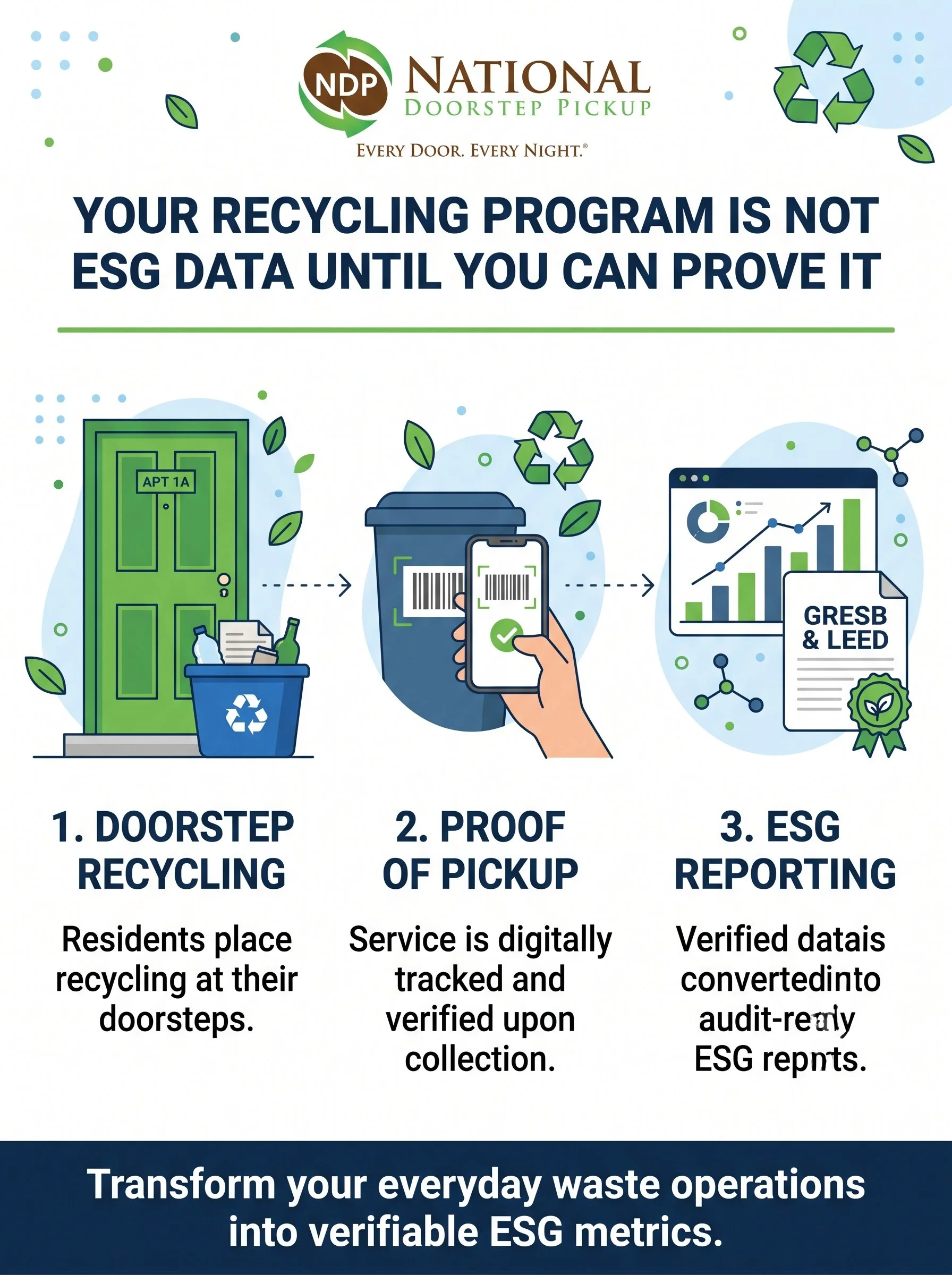
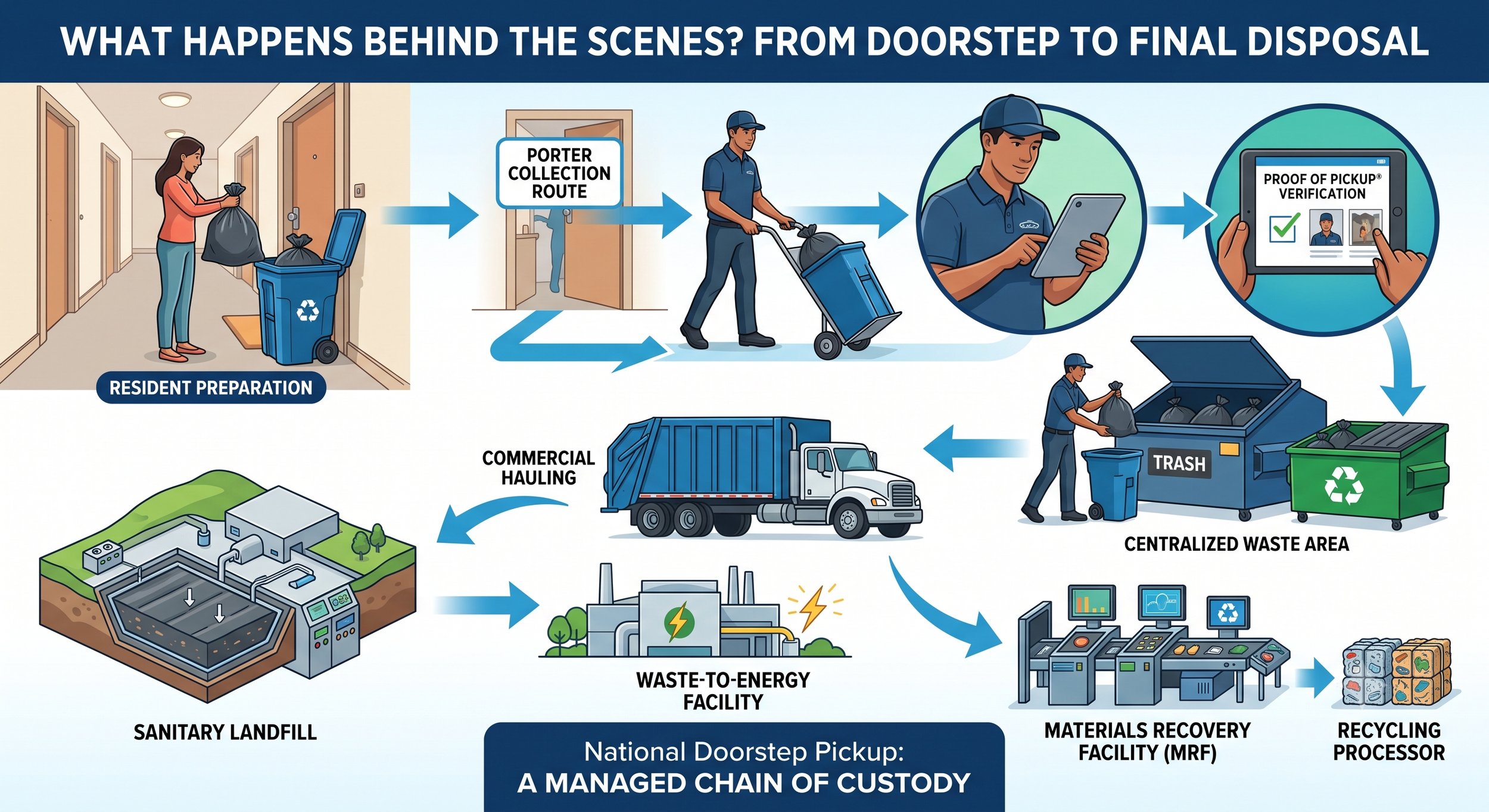
National Doorstep Pickup's Proof of Pickup® technology is designed to document the service-execution layer through route, time and photo verification.
That creates something institutional owners increasingly need:
an auditable operational trail.
Instead of treating recycling as an invisible service, management can establish evidence that scheduled collection activity occurred.
And that evidence can become part of a larger ESG data architecture.
But Proof of Pickup® Is Not the Same as a Certified Diversion Weight
This distinction is critical.
A photo showing that recycling was collected is operational evidence.
It is not automatically a measurement of pounds or tons diverted from landfill.
Accordingly, a strong institutional reporting process should connect several layers of information:
Collection verification: Proof of Pickup® route, time and photo records establish that doorstep service occurred.
Property-level program data: participating buildings, units, service frequency, recycling configuration and applicable waste streams define the operational denominator.
Downstream quantitative data: hauler tickets, recycler reports, scale weights, MRF data or documented conversion methodologies establish reportable material quantities.
Disposition data: recycling, reuse, composting, landfill and other destinations establish the ultimate diversion pathway.
Portfolio reporting: standardized asset-level information can then be normalized and mapped into the owner's GRESB, LEED or broader ESG reporting workflow.
That is much more defensible than assuming that providing recycling automatically equals measurable diversion.
LEED v5 Makes Waste Performance Highly Visible
The connection becomes even more significant under LEED v5 Operations + Maintenance.
LEED v5 O+M allocates 13 possible points to Materials and Resources. Twelve of those points are associated with Waste Reduction Performance, with another point available for Waste Reduction Strategies.
The Waste Reduction Performance credit is explicitly performance based.
The February 2026 LEED v5 O+M framework awards points according to documented waste diversion:
6% diversion can earn 1 point.
30% can earn 5 points.
60% can earn 10 points.
And 80% diversion can earn the full 12 points available under the credit. U.S. Green Building Council
That is not a symbolic recycling credit.
It is a measurable operational-performance pathway.
LEED Wants the Math, Not Just the Recycling Program
The rating system calls for tracking material generation monthly for at least three consecutive months within the 12-month reporting period, including material type and weight. Where quantities must be estimated, the methodology or source used for those calculations must be documented.
That creates a clear institutional lesson:
Better recycling infrastructure is valuable. Better recycling infrastructure with measurable outcomes is substantially more useful.
Doorstep recycling can improve the accessibility of recycling for apartment residents.
Proof of Pickup® can document whether the service infrastructure supporting that program is actually functioning.
Hauler and processor data can quantify the resulting material stream.
Combined correctly, those layers can give sustainability teams a much stronger evidence chain for ESG reporting.
LEED v5 Also Recognizes Waste Collection Management and Education
There is another important connection.
LEED v5 O+M's Waste Reduction Strategies credit includes a pathway for Waste Collection Management and Education.
That aligns closely with a persistent challenge in multifamily recycling:
The recycling program can only perform as well as the resident-facing collection system.
If participation is inconvenient, contamination is confusing or collection is inconsistent, the downstream ESG metric suffers.
Doorstep recycling moves part of that infrastructure directly to the resident.
Instead of asking hundreds of households to independently transport recyclable material to a centralized location, the property can create a standardized collection process closer to the point of generation.
For an institutional portfolio, that can make recycling less dependent on resident friction and more integrated into normal property operations.
From ESG Narrative to ESG Evidence
There is a fundamental difference between these two statements:
“Our portfolio supports recycling.”
and
“Our portfolio tracks recycling participation, collection execution, waste generation, diversion and downstream disposition at the asset level.”
The second statement is far more valuable to an institutional sustainability team because it can be interrogated.
It can be compared.
It can be benchmarked.
It can reveal underperforming assets.
And it can support the kind of standardized sustainability reporting investors increasingly expect.
The Portfolio-Level Advantage
This becomes especially important when a multifamily owner moves from one property to 50, 100 or 500.
At one community, a sustainability manager can manually investigate a questionable recycling number.
Across a national portfolio, that approach does not scale.
Institutional ESG programs require standardized operating procedures and standardized data structures.
A consistent doorstep recycling program can provide the operational layer.
Proof of Pickup® can provide service-verification data.
Waste and recycling vendors can provide downstream quantitative records.
Portfolio ESG systems can aggregate those inputs into reporting datasets.
Now the organization is not merely asking whether an apartment community recycles.
It can begin asking:
Which assets are producing measurable diversion, where is data coverage incomplete, and where should management intervene?
That is the transition from sustainability initiative to portfolio intelligence.
Better Waste Data Can Also Expose Operational Risk
The value of better reporting is not limited to presenting positive results.
It can reveal problems.
A sudden decline in recycling collection activity could indicate a service issue.
Persistent contamination could indicate inadequate resident education.
Low diversion despite high participation could expose problems downstream.
Missing records from particular assets could identify ESG data-coverage gaps before annual reporting begins.
That matters because institutional sustainability teams should not have to discover reporting deficiencies during submission season.
A digitally documented waste program can move ESG management closer to continuous operational monitoring instead of annual data reconstruction.
GRESB and LEED Are Different—But the Data Discipline Is Similar
GRESB and LEED should not be conflated.
GRESB is an investor-driven sustainability benchmark for real-estate entities and portfolios.
LEED is a green-building certification system with specific prerequisites and credits at the project level.
A doorstep recycling program does not automatically increase a GRESB rating.
Proof of Pickup® does not automatically earn a LEED credit.
And neither framework should be represented that way.
But both illustrate the same broader shift:
Sustainability claims increasingly need measurable operating data behind them.
For multifamily waste, that means connecting the resident experience, the collection process and the final material disposition into one defensible reporting chain.
The Investment Case: Make Existing Operations More Measurable
For an asset manager, the objective is not to add technology simply to generate more dashboards.
Waste already exists.
Residents already generate recyclables.
Properties already pay for collection.
Sustainability teams already need portfolio data.
The opportunity is to connect those activities.
For owners participating in GRESB, pursuing LEED certification or recertification, or strengthening internal sustainability reporting, that data infrastructure can support better benchmarking, more complete reporting and more informed asset-management decisions.
And that is the bigger institutional opportunity:
Don't just provide recycling.
Build a recycling program that produces evidence.
The Bottom Line Stop settling for the narrative "Our portfolio supports recycling."
Transition to the evidence: "Our portfolio tracks recycling participation, collection execution, waste generation, diversion, and downstream disposition at the asset level."
Every Door. Every Night.® — With Data Behind the Service
National Doorstep Pickup combines multifamily doorstep waste collection, doorstep recycling and Proof of Pickup® service verification to help property owners create cleaner, more accountable waste operations.
For institutional owners, sustainability officers and asset managers, the next step is not merely adding another recycling initiative.
It is building a waste-diversion program capable of supporting the asset-level data discipline increasingly expected by GRESB, LEED and institutional ESG reporting.
Better access. Better operational visibility. Better data. Better reporting.
National Doorstep Pickup — Every Door. Every Night.®