By Les Leith, CEO & COO at National Doorstep Pickup
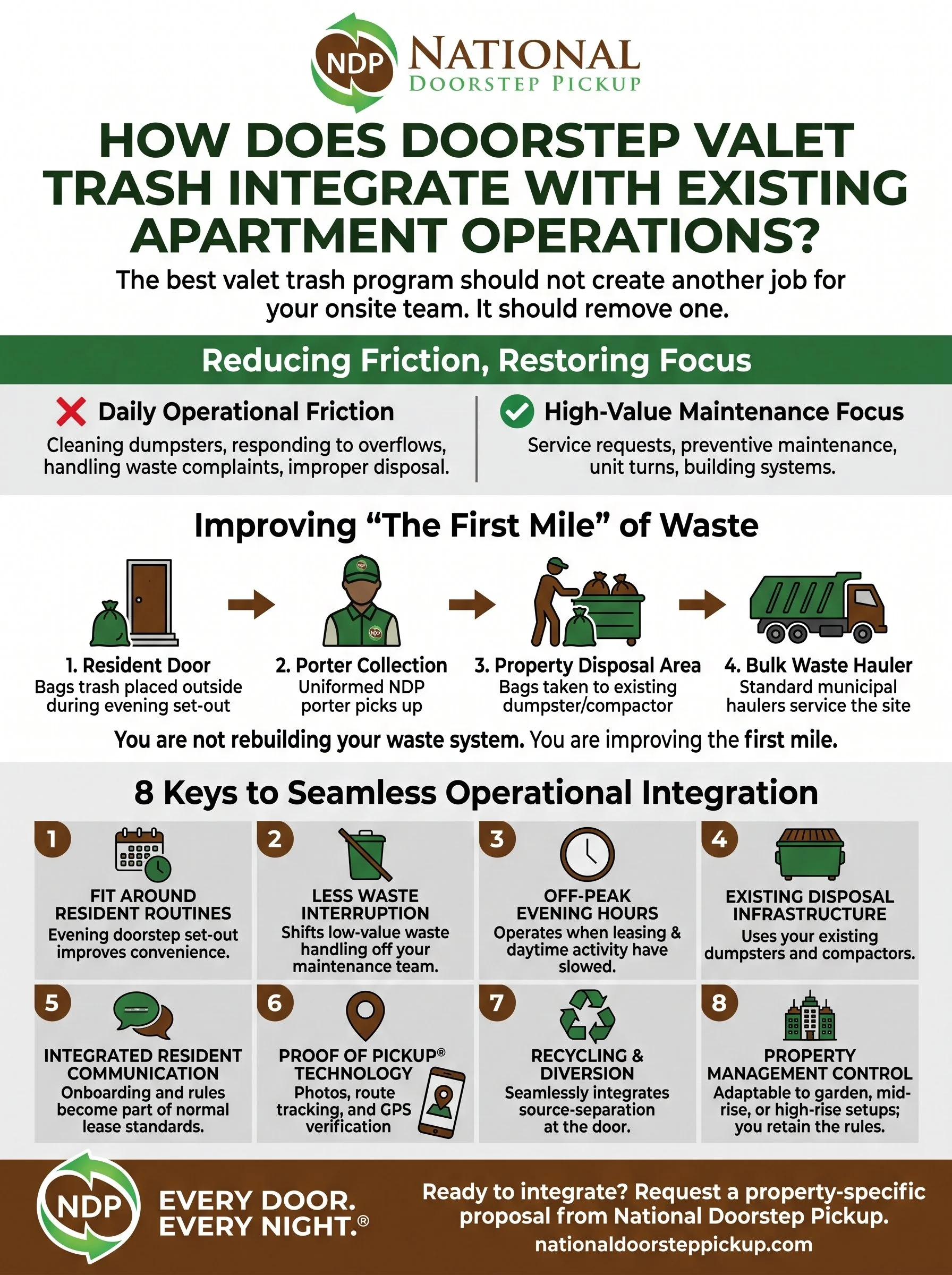
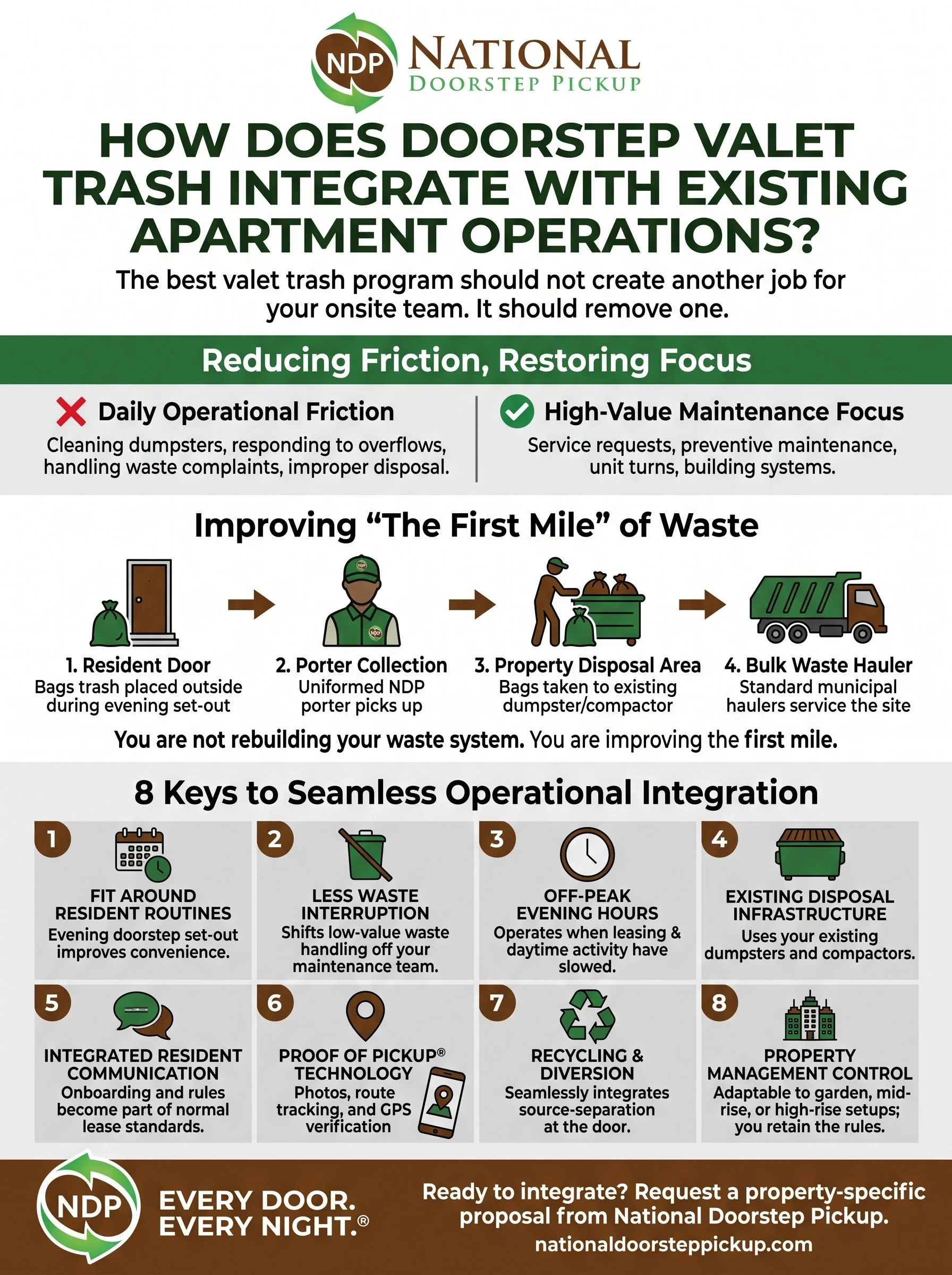
The best valet trash program should not create another job for your onsite team. It should remove one.
That is the real test of operational fit.
Apartment communities already manage leasing, maintenance, resident communication, vendor access, package volume, common-area cleanliness, waste hauling, turns, inspections, and after-hours issues.
A well-designed doorstep valet trash program integrates into those existing workflows without forcing property teams to rebuild their operating model around the vendor.
The Hook: Valet Trash Should Reduce Operational Friction—not Add to It
If maintenance teams are constantly cleaning around dumpsters, responding to overflowing trash rooms, handling resident waste complaints, or correcting improper disposal, the community is already spending labor on trash.
The question is not whether waste affects operations.
It already does.
The better question is:
Can doorstep collection move part of that workload away from the onsite team while creating a cleaner, more measurable process?
That is where operational integration matters.
1. Doorstep Collection Fits Around Existing Resident Routines
Residents already generate household waste every day.
Instead of requiring residents to carry bags across the property to a dumpster, compactor, or trash room, doorstep valet trash creates a scheduled set-out and collection process.
Residents place properly bagged household waste outside their door during the approved set-out window.
A uniformed porter then collects the material and transports it to the property's designated disposal location.
The physical waste stream does not disappear.
The collection point changes from the dumpster to the resident's doorstep.
That shift can improve convenience while reducing the amount of resident traffic around centralized waste areas.
2. Maintenance Teams Keep Their Existing Responsibilities—With Less Waste-Related Interruption
One of the strongest operational benefits of valet trash is its potential to reduce low-value waste handling by onsite personnel.
Maintenance teams should be focused on:
Service requests
Preventive maintenance
Unit turns
Building systems
Grounds and property conditions
Life-safety responsibilities
They should not routinely become the property's unofficial trash collection crew.
A properly managed doorstep collection program creates a defined division of responsibility.
Residents follow the set-out rules. The valet trash provider performs the collection. Property management oversees the community standard.
That structure can help maintenance stay focused on higher-value work.
3. Service Is Scheduled Around Community Operations
Doorstep collection is generally performed during evening hours, when leasing offices and most maintenance operations have slowed down.
That separation matters.
The goal is to prevent valet trash operations from competing with daytime property activity, leasing tours, contractor traffic, deliveries, maintenance workflows, and resident movement.
National Doorstep Pickup structures service around defined collection windows so property teams know when collection is expected to occur.
Predictability is what turns a vendor service into an operational system.
4. The Dumpster, Compactor, or Trash Room Still Works as the Final Disposal Point
Valet trash does not necessarily replace the property's existing waste-hauling infrastructure.
It integrates with it.
The typical flow looks like this:
Resident Door → Valet Trash Collection → Property Disposal Area → Waste Hauler
That means the community can continue using its existing dumpster, compactor, trash room, or approved disposal configuration while changing how waste gets from the apartment to that location.
For operators, this distinction is important.
You are not necessarily rebuilding the waste system.
You are improving the first mile of it.
5. Resident Communication Becomes Part of the Operating Model
Successful valet trash programs depend on clear resident expectations.
Management and the service provider should align on:
Approved service days
Set-out times
Bag limits
Properly tied bags
Cardboard procedures
Prohibited materials
Recycling separation
Where containers or mats may be placed
When items must be brought back inside
This allows valet trash rules to become part of normal resident communication alongside parking rules, package procedures, pet policies, amenity hours, and community standards.
Strong onboarding can reduce confusion before it becomes a complaint.
6. Proof of Service Adds Accountability
One of the biggest operational weaknesses of traditional service models is uncertainty.
A resident says trash was missed.
The provider says the route was completed.
Management is stuck in the middle.
Technology can change that.
National Doorstep Pickup uses Proof of Pickup® technology to support route, time, and photo verification.
Instead of:
“Was this building serviced?”
Management can work from documented route activity.
That is particularly valuable for regional managers and multi-property operators who cannot personally observe every service night.
7. Valet Trash Can Support Recycling and Waste-Diversion Programs
Doorstep service can also integrate with broader recycling and waste-diversion initiatives.
Where appropriate for the property and local requirements, residents may be provided with separate instructions for recyclable materials or other waste streams.
This creates an opportunity to align:
Convenience + Resident Education + Waste Separation + Compliance
Rather than treating recycling as an entirely separate operational initiative, communities can incorporate it into the same resident-facing waste program.
8. Property Management Retains Control
A professionally implemented valet trash program should adapt to the property—not the other way around.
Management still controls community policies, approved set-out locations, resident communications, access protocols, disposal areas, and property-specific requirements.
The provider's role is to integrate collection into that framework.
For garden-style, mid-rise, high-rise, student housing, senior living, military housing, condominium, and other multifamily configurations, the actual operating procedure may differ.
The operating principle should remain the same: fit the service to the building.
The Bigger Operational Question
Property managers sometimes ask:
“How much work will implementing valet trash create for my team?”
A better-designed program changes that question to:
“How much waste-related work can we remove from our team's plate?”
That is the difference between adding another vendor and adding an operational solution.
Doorstep valet trash works best when residents understand the rules, porters have clearly defined routes, management has visibility into service, and the existing hauling infrastructure continues doing what it was designed to do.
When those pieces align, the service becomes remarkably simple:
Residents set it out.
The porter picks it up.
Management can verify it.
The property keeps moving.
Every Door. Every Night.®
With Proof of Pickup® service documentation and programs designed around existing property operations, National Doorstep Pickup helps apartment operators improve resident convenience without turning waste collection into another daily responsibility for onsite teams.
Want to see how doorstep valet trash could integrate with your existing community operations?