By Les Leith, CEO & COO at National Doorstep Pickup
What if higher interest rates are doing two things at once—making it harder for apartment renters to buy homes while making it harder for developers to build the apartments that would compete for those renters?
That may be one of the most important multifamily questions heading into 2027.
The economic equation is becoming increasingly compelling:
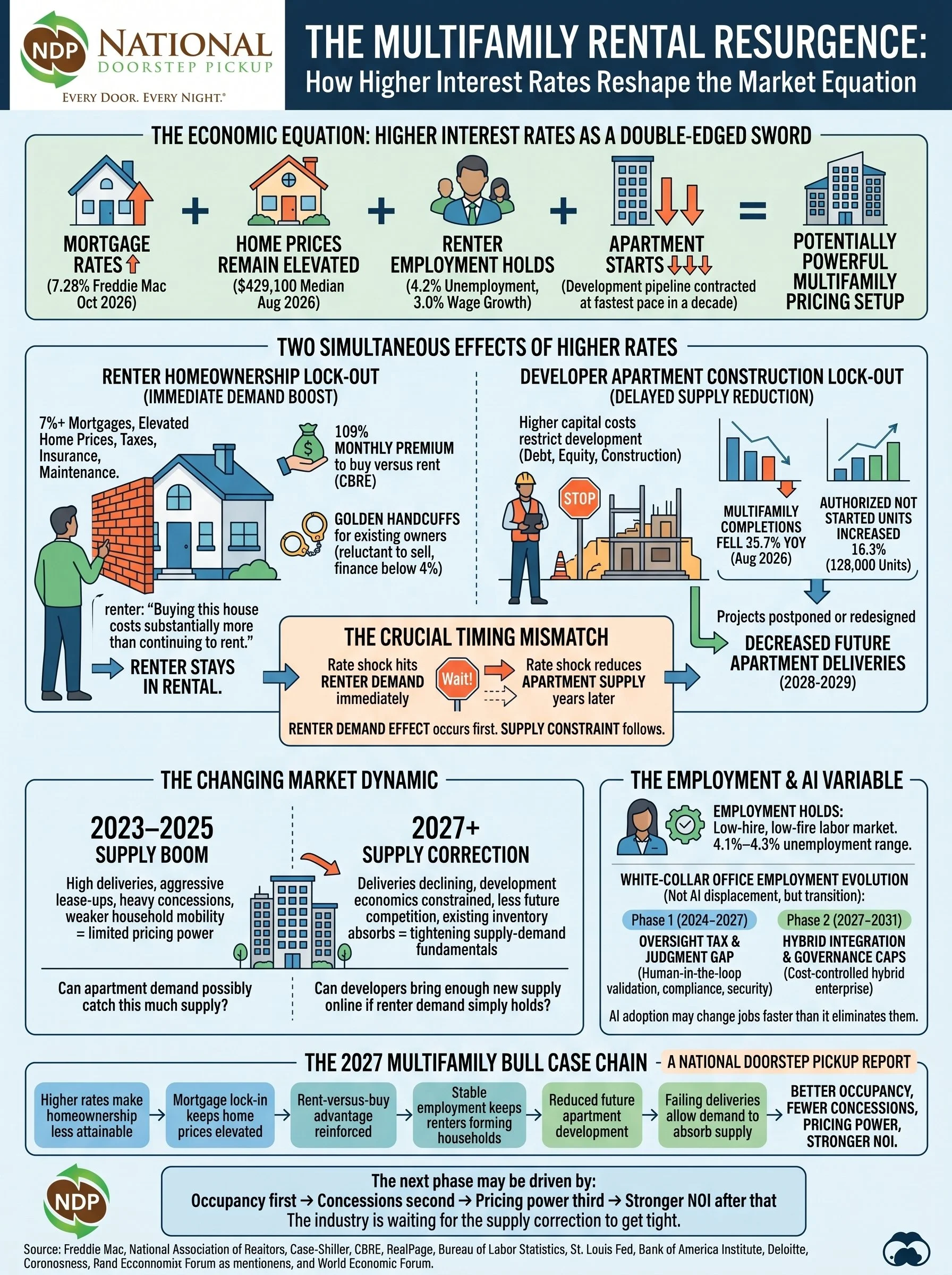
Mortgage rates ↑ + home prices remain elevated + renter employment holds + apartment starts ↓↓↓ = potentially powerful multifamily pricing setup
Not because high interest rates are inherently good for apartments.
They aren’t.
And not because every renter wants to become a homeowner.
They don’t.
The opportunity comes from the interaction between demand and supply.
Would-be homebuyers face a dramatically higher financial hurdle to leave rental housing.
Existing homeowners remain reluctant to sell because many are locked into mortgages far below current rates.
Home prices consequently have not fallen enough to offset today’s borrowing costs.
Meanwhile, the same higher-rate environment is making new apartment construction significantly harder to finance.
That creates a potentially unusual housing cycle:
The cost of capital is raising the barrier to leaving rental housing at almost the same time it is raising the barrier to creating more rental housing.
That is the setup worth watching.
And unlike the historic apartment supply wave of 2023 through 2025, the supply side of the equation is now moving rapidly in the other direction.
This Is the Next Chapter in the Rent-vs-Buy Story
In July, we examined why apartments and single-family rentals were increasingly winning the affordability comparison against homeownership.
The basic conclusion was straightforward:
High home prices, mortgage rates, taxes, insurance and maintenance had opened a substantial monthly gap between renting and buying.
CBRE subsequently quantified just how large that hurdle had become, estimating a roughly 105% monthly premium to buy versus rent nationally. CBRE also noted that more than half of America’s outstanding mortgage debt—about $7 trillion of approximately $13 trillion—is financed below 4%.
That matters because those existing homeowners have their own version of golden handcuffs.
Selling a home financed at 3% or 4% and purchasing another with a mortgage around 7% can radically increase the monthly payment even before accounting for today’s higher home prices.
So many owners stay.
Fewer homes turn over.
Resale inventory remains constrained relative to what would normally occur in a high-rate environment.
And home prices can remain surprisingly resistant to falling.
Our previous rent-versus-buy analysis argued that this dynamic creates a retention window for multifamily operators: renters may have compelling financial reasons to remain renters even as their incomes rise.
Since then, the math has become even more dramatic.
Mortgage Rates Just Changed the Equation Again
Freddie Mac reported that the average 30-year fixed mortgage reached 7.28% on October 1, 2026, up from 7.03% only one week earlier and as high as 7.57%.
That is not a small move.
For the marginal first-time homebuyer, another half-point or full point of mortgage cost can push a home from uncomfortable to financially impractical.
And home prices have not collapsed to compensate.
The National Association of Realtors reported that the median existing-home price was $429,100 in August 2026, still 1.6% higher than one year earlier, even as existing-home sales fell 2% during the month.
The Case-Shiller National Home Price Index told a similar story in July: national prices remained 1.9% higher year over year.
So consider what has happened to the renter evaluating homeownership.
Mortgage rate: higher.
Home price: still elevated.
Insurance: elevated in many markets.
Property taxes: higher following years of appreciation in many metros.
Maintenance responsibility: transferred entirely to the homeowner.
Down payment: still required.
The renter does not need to believe apartments are inexpensive.
The renter only needs to conclude:
“Buying this house costs substantially more than continuing to rent.”
That decision can keep an economically qualified household inside rental housing for another lease cycle—or several.
These Are Not Literally the Same “Golden Handcuffs”
It is useful to distinguish two related housing effects.
Homeowners have mortgage-rate lock-in.
They own homes financed at rates considerably below today’s market and may be reluctant to surrender that financing.
Renters have homeownership lock-out.
They may have sufficient income to rent comfortably but still face a monthly ownership payment that does not make financial sense.
The two conditions reinforce one another.
Existing owners staying put reduce housing turnover.
Reduced turnover can support home values.
Elevated home values keep ownership expensive.
Higher mortgage rates amplify the payment.
Would-be buyers remain renters.
And then something unusual happens on the apartment side.
Developers Are Getting Locked Out Too
This may ultimately become the bigger story.
Higher interest rates do not just affect the renter considering a mortgage.
They hit the apartment developer trying to finance a $50 million, $100 million or $150 million project.
RealPage describes the current capital-markets reset clearly.
Deals underwritten when agency debt could be obtained below 3% stopped penciling when borrowing costs reset sharply higher. Even after reductions in short-term rates, long-term financing conditions have remained substantially above the environment that financed the last construction boom.
That changes development math from the ground up.
Debt costs rise.
Required equity returns rise.
Construction costs remain elevated.
Exit-cap assumptions become more difficult.
Loan proceeds shrink.
Required equity increases.
Development yields become less attractive relative to risk.
Projects get postponed.
Projects get redesigned.
Some projects never break ground.
That is already appearing in the data.
RealPage reports that multifamily completions fell 35.7% year over year in August 2026, while the number of multifamily units authorized but not yet started increased 15.3% to 128,000 units.
That last number deserves attention.
An apartment community that has been authorized but has not started is not merely an abstract statistic.
It is potentially a building that developers want to build—but cannot yet make work economically.
Today’s Rate Shock Hits Demand Immediately—but Supply Years Later
This is where the 2027–2029 apartment story gets particularly interesting.
Housing demand reacts to mortgage rates quickly.
A renter can run a mortgage calculator tonight.
A household planning to buy a home next month can look at a 7.28% mortgage, calculate the payment and decide:
Not yet.
That household remains in rental housing.
The apartment-supply reaction works on an entirely different clock.
An apartment community not financed in October 2026 does not disappear from October 2026 supply.
It disappears from 2028 or 2029 supply.
Multifamily development takes years.
So today’s interest-rate environment can create:
Immediate pressure against renter-to-owner conversion
while simultaneously creating:
Delayed reductions in future apartment deliveries.
That lag matters enormously.
The renter-demand effect occurs first.
The supply constraint follows.
And if employment remains sufficiently intact during the transition, those two curves can begin moving in opposite directions.
Apartment Supply Has Already Turned
The apartment industry spent several years fighting the largest delivery wave in decades.
New projects competed aggressively for residents.
Lease-ups offered concessions.
Established properties had to respond.
Effective rents struggled even where underlying demand remained respectable.
RealPage Chief Economist Carl Whitaker has repeatedly emphasized this point: recent weakness in high-supply markets has been primarily a function of extraordinary construction overwhelming otherwise solid renter demand.
Quarterly deliveries have already moved dramatically below their recent peak.
Only about 77,700 apartments were completed during Q2 2026, far below the 100,000-plus quarterly delivery volumes that characterized much of the recent supply boom.
This changes the conversation.
For three years, the question was:
Can apartment demand possibly catch this much supply?
The next question may become:
Can developers bring enough new supply online if renter demand simply holds?
Those are two very different apartment markets.
Jay Parsons: Mortgage Rates Matter—But Supply Matters More
Rental-housing economist Jay Parsons recently addressed almost this exact issue.
His warning is important.
Higher mortgage rates by themselves do not guarantee higher apartment rents.
We just lived through the proof.
Mortgage rates rose dramatically during 2023–2025.
But apartment rents did not explode.
Why?
Because apartment supply exploded first.
Parsons argues that the enormous apartment and build-to-rent construction wave overwhelmed whatever benefit rental housing received from worsening homeownership affordability.
That distinction is critical.
The equation is not:
Mortgage rates ↑ = apartment rents ↑
It is:
Mortgage rates ↑ + renter retention ↑ + apartment supply ↓ + adequate employment = improving pricing conditions
Parsons estimates the rent-versus-own discount had already reached roughly $1,000 per month for single-family rentals and $1,500 per month for build-to-rent housing by June, with the gap widening as mortgage rates increased.
He also makes the crucial supply-side observation:
The high apartment supply that suppressed rents from 2023 through 2025 is now falling substantially.
As the recent lease-up wave stabilizes, supply itself can shift from a rent-growth headwind into a tailwind.
That is the 2027 difference.
The 2023–2025 Equation Was Working Against Owners
Think about what operators were fighting:
**High apartment deliveries
aggressive lease-ups
heavy concessions
weaker household mobility
= limited pricing power**
Homeownership becoming expensive could not overcome that amount of new inventory.
Now change the inputs.
Potential 2027 equation:
**7%+ mortgages
elevated home prices
existing-homeowner lock-in
renters delaying home purchases
apartment deliveries falling
fewer projects entering construction
employment remaining sufficiently stable
= tightening apartment supply-demand fundamentals**
Add in that some can not refinance or recap due to the interest rate explosion on a CRECLO, and it’s a completely different setup.
Employment Does Not Need to Boom. It Needs to Hold.
This is the demand-side variable that matters most.
Apartments cannot lease themselves because mortgage rates are high.
Residents need jobs.
They need income.
They need enough economic confidence to form households and sign leases.
The September employment report was softer than August, but it does not currently show a broad labor-market collapse.
The Bureau of Labor Statistics reported 29,000 additional payroll jobs in September, while unemployment moved only slightly to 4.2%. Importantly, unemployment has remained within a narrow 4.1%–4.3% range since March.
Wage growth has also continued: average hourly earnings were 3.0% higher than one year earlier in September.
This is not a booming labor market.
It is increasingly a low-hire, low-fire labor market.
For multifamily, that distinction matters.
The strongest apartment cycle does not necessarily require another Great Resignation.
It requires enough employed households to continue paying rent, forming households and absorbing the shrinking number of available new units.
Why We Remain More Constructive on Office Employment Than the Headlines Suggest
Artificial intelligence is the obvious challenge to that thesis.
If AI rapidly eliminated millions of white-collar jobs, the apartment demand equation would deteriorate.
But evidence available today does not establish that outcome.
A 2026 study summarized by the St. Louis Fed found no clear evidence that industry-level AI adoption was associated with employment gains or employment losses in either the United States or Europe, even though AI adoption was associated with productivity improvements.
Bank of America Institute analysis cited in our previous 2027 multifamily outlook reached a similar conclusion: industries with greater reported AI adoption were not consistently experiencing weaker labor demand.
And Deloitte’s 2026 enterprise AI research identifies another constraint: autonomous agents are being adopted faster than companies are developing governance systems around them. Only about one in five companies reported a mature governance model for autonomous AI agents. Deloitte also found that workforce adjustment has so far centered heavily on education and AI fluency rather than wholesale role redesign.
That supports a different near-term employment model than simple exponential replacement.
Our Readjusted Office Obsolescence Timeline
We believe the more realistic transition is a prolonged hybrid period.
Phase 1: Task Consolidation & the Oversight Tax — 2024–2027
AI increasingly handles standardized drafting, summarization, classification, research and repetitive workflow steps.
But execution still creates verification requirements.
We describe this using three operating concepts.
The 60/40 Judgment Gap
This is our framework—not a published labor statistic.
AI can handle an increasingly large portion of structured, predictable work.
The remaining work contains the exceptions:
Context.
Institutional memory.
Client nuance.
Compliance.
Conflicting instructions.
Physical-world conditions.
Ambiguous decisions.
Edge cases.
Those exceptions often carry disproportionate business risk.
Removing a human from a 90% automated workflow is difficult when the remaining 10% contains the decisions capable of creating 90% of the liability.
The Oversight Tax
The more work AI generates, the more important validation becomes.
Employees review outputs.
Managers audit exceptions.
Technical teams monitor agents.
Compliance teams establish controls.
Legal departments define acceptable use.
Finance departments monitor economics.
Cybersecurity teams police access.
The technology removes tasks while simultaneously creating an additional layer of governance around the tasks it performs.
The World Economic Forum’s employer research similarly expects the future workplace to contain significantly more human-machine collaboration, rather than work simply becoming entirely human or entirely automated.
The Token FinOps Wall
Autonomous workflows are not free.
Every prompt.
Every tool call.
Every retry.
Every background agent.
Every validation model.
Every large context window.
Every failed chain.
Every redundant inference cycle.
All of it consumes compute.
As enterprises move from AI chat tools into agentic workflows, CFOs increasingly have to ask the same TCO question they asked during the cloud-computing transition:
What is the marginal economic value of this workload?
That encourages organizations to route simpler tasks through smaller models, cap autonomous activity and reserve expensive inference for workflows where the economics make sense.
The logical endpoint is not necessarily a completely autonomous enterprise.
It may be a cost-controlled hybrid enterprise.
Phase 2: Hybrid Integration & FinOps Caps — 2027–2031
We believe this becomes the more durable enterprise architecture.
Large models handle complicated reasoning.
Smaller language models route predictable tasks.
Prompt caching limits redundant compute.
Agents operate within API and budget ceilings.
Humans remain responsible for exceptions, accountability and final judgment in higher-risk workflows.
Automation grows.
But so does the economic pressure to use humans and machines where each is most efficient.
That means many office jobs may change dramatically before they disappear.
The World Economic Forum’s Future of Jobs analysis illustrates the same tension: employers anticipate significant AI-driven displacement in some roles, but simultaneously project large-scale hiring, reskilling and redeployment, with human capabilities such as analytical thinking, leadership, resilience and collaboration remaining critical.
AI Watchdogs Could Actually Reinforce Human-in-the-Loop Work
AI governance is also becoming a larger issue.
Recent debate in Washington has included calls from across the political spectrum for stronger AI oversight, while independent researchers have increasingly scrutinized autonomous-agent behavior outside the companies developing the systems. No comprehensive federal regulatory system has been enacted, and significant disagreements remain over how much regulation is appropriate.
President Donald Trump and leaders of major artificial intelligence companies signed a voluntary White House Accord on Super Intelligence at the White House on September 29, 2026. The agreement relies on self-policing and non-binding guidelines rather than formal legislation or executive enforcement. Participating companies agree to implement internal and external safety measures. Criticisms and reactions are varied.
For the labor market, the important point is narrower.
More monitoring does not automatically mean more employment.
But requirements for:
validation, auditing, security review, compliance, model governance, red-teaming, incident response and human accountability
all create work that has to be performed somewhere.
That strengthens the case that AI adoption may change the composition of professional employment faster than it eliminates professional employment outright.
And that matters for apartments.
White-collar renters do not need AI to create another technology employment boom.
They simply need the transition to remain gradual enough for employment and incomes to support household formation.
Put All Four Variables Together
This is where the multifamily thesis becomes powerful.
Economic variable
What is happening
Multifamily implication
Mortgage rates
30-year fixed reached 7.28%. Harder for renters to buy homes
Home prices
Still positive nationally year over year
Rates are not being offset by a home-price crash
Employment
Slower hiring, but unemployment remains near 4.2%
Existing renter income base remains broadly intact
Apartment supply
Deliveries declining; development economics constrained
Less future competition for renter demand
None of these variables alone guarantees higher rents.
Together they create a very different market.
The Biggest Asymmetry May Be Time
This could ultimately be the most important point.
The renter feels a 7.28% mortgage rate today.
The apartment operator feels a cancelled 2026 construction project two or three years from now.
That means rental demand can respond faster than rental supply.
And real estate cycles are often created by exactly that kind of timing mismatch.
Developers stop building because conditions look unattractive.
Demand continues growing slowly.
Existing inventory absorbs.
Vacancies tighten.
Concessions decline.
Pricing power returns.
By the time rents justify development again, the industry cannot instantly manufacture another 400,000 apartments.
The entitlement process still takes time.
Financing still takes time.
Construction still takes time.
Lease-up still takes time.
That is how a supply correction can eventually become a supply shortage.
Migration Still Determines Where the Upside Appears First
This does not mean every metropolitan area enters the same rent cycle simultaneously.
Our previous analysis of Census and Bank of America mobility data remains important.
Markets with heavy new construction and weak population momentum can remain soft longer.
Markets with strong population growth but enormous supply can still struggle temporarily.
And markets with modest migration but extremely limited construction can experience surprisingly strong rent performance.
Carl Whitaker’s RealPage analysis of the South provides perhaps the clearest recent example.
The South absorbed substantial apartment demand, but its extraordinary construction pipeline overwhelmed that demand and suppressed rent growth. At the peak, more than 235,000 units were being delivered in the region. Even after the pullback, roughly 170,000 units delivered over the prior year represented more than half of total U.S. apartment supply.
That is why falling construction matters so much.
It changes the denominator.
The Multifamily Bull Case Is Not “Higher Rates Are Good”
That would be too simplistic.
The actual thesis is:
Higher mortgage rates make homeownership less attainable.
Mortgage lock-in helps keep home prices elevated.
Elevated home prices reinforce the rent-versus-buy advantage.
Stable employment allows renters to keep forming households and paying rent.
AI has not yet produced broad measurable labor displacement.
Human oversight may slow the office-employment adjustment.
Higher capital costs restrict apartment development.
Today’s falling starts become tomorrow’s falling deliveries.
Falling deliveries allow existing apartment demand to absorb the remaining supply.
Better absorption supports occupancy.
Higher occupancy reduces concessions.
Reduced concessions improve effective rents.
Effective rent growth improves NOI.
That is the chain.
The Apartment Industry May Be Waiting for the Wrong Rate Cut
For several years, multifamily owners have been asking:
When will interest rates finally fall?
Perhaps that is no longer the only question.
Because elevated rates are already changing the supply-demand equation.
They are preventing some renters from buying.
They are discouraging some existing homeowners from selling.
They are helping preserve home prices.
And they are making new multifamily development harder to finance.
The industry spent three years waiting for apartment demand to catch up to an enormous construction pipeline.
Heading into 2027, we may need to invert the question:
What happens if apartment supply starts falling faster than renter demand can weaken?
That is where the setup becomes particularly interesting.
2027 Could Be the Beginning—not the End—of the Supply Correction
We should not confuse a construction slowdown with an immediate national apartment shortage.
Large pipelines still remain in selected metros.
Some Sun Belt markets still need time to absorb recent deliveries.
Job growth is slower.
Migration remains uneven.
Consumers remain sensitive to affordability.
But real estate pricing turns at the margin.
It does not require every market to become undersupplied simultaneously.
It requires enough markets to move from:
oversupplied → balanced
and then from:
balanced → undersupplied.
The early pieces of that transition are increasingly visible.
Completions are falling.
Projects are being delayed.
Mortgage rates are above 7%.
Home prices remain elevated.
Renting remains dramatically less expensive than owning for many households.
Unemployment remains relatively low.
AI adoption has not yet translated into clear economy-wide employment losses.
And the enormous lease-up pipeline that suppressed apartment pricing is steadily being absorbed.
The Bottom Line for Multifamily Owners and Property Managers
Our September 2027 outlook showed why declining apartment supply could eventually restore pricing power.
Now those two stories are converging.
The strongest version of the 2027 thesis is no longer simply:
Fewer apartments are being built.
It is:
Mortgage rates ↑ + home prices remain elevated + renter employment holds + apartment starts ↓↓↓ = potentially powerful multifamily pricing setup
Higher mortgage rates alone did not create a rental boom in 2023.
Record apartment supply prevented it.
But 2027 is increasingly different.
Supply is falling.
The ownership hurdle is rising.
Employment remains sufficient to support a large renter base.
And today’s financing constraints are removing apartments from future delivery calendars.
That combination could turn what looked like a painful high-rate cycle into an increasingly favorable operating environment for existing multifamily communities.
The most important question may therefore no longer be:
When will rates come down?
It may be:
What if they stay high long enough for apartment supply to get genuinely tight?
If that happens while renter employment remains resilient, the next phase of the multifamily cycle could be driven by something the industry has not enjoyed consistently in several years:
Occupancy first.
Concessions second.
Pricing power third.
And stronger NOI after that.