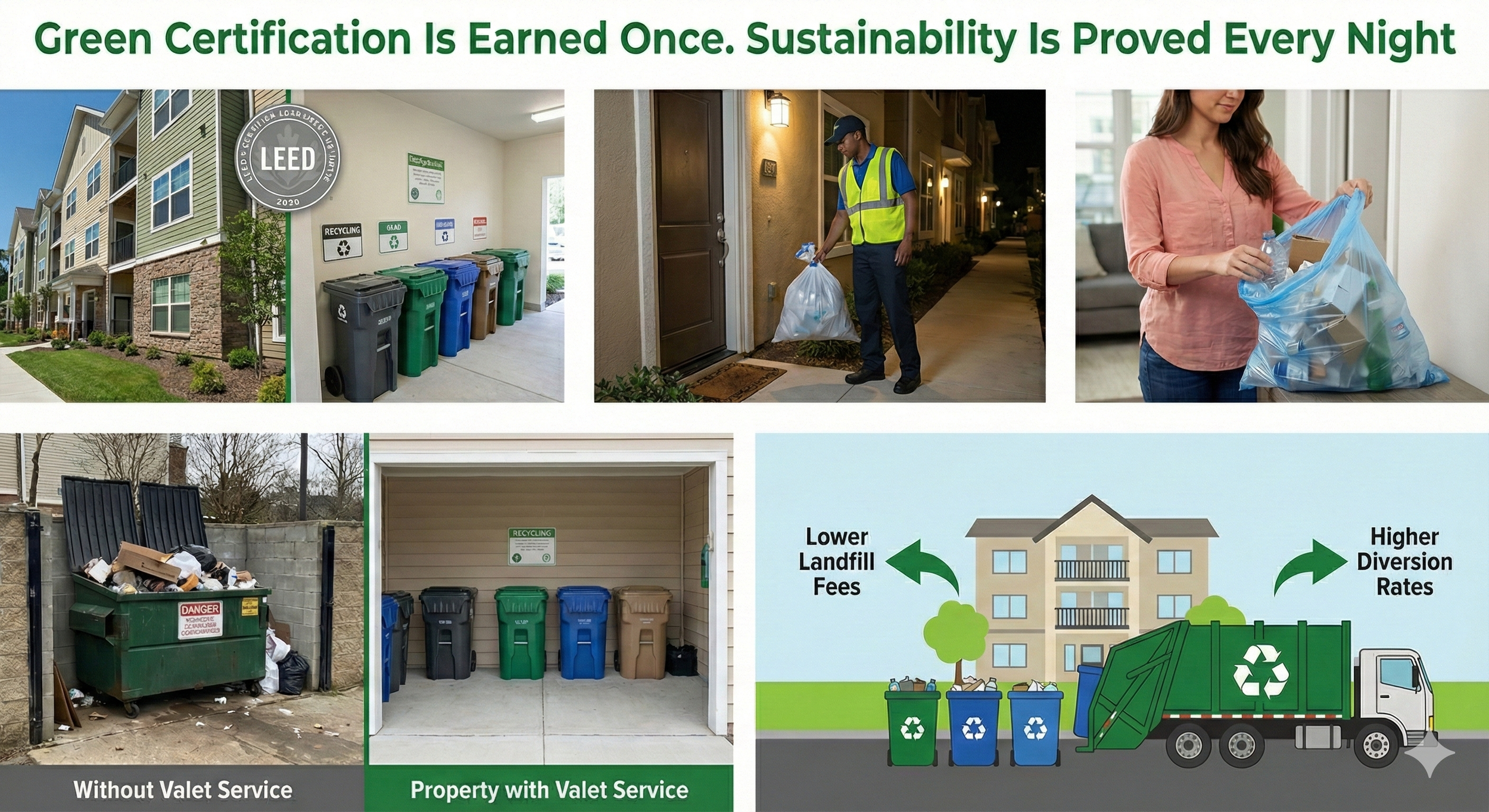
Green Certification Is Earned Once. Sustainability Is Proved Every Night.
Why Valet Recycling Has Become Non-Negotiable for Green-Certified Multifamily Communities
By Les Leith, CEO & COO at National Doorstep Pickup
Green certification is no longer a marketing badge—it is an operational promise.
Property management teams invest heavily in energy efficiency, water conservation, and sustainable materials to achieve green-certified status. Yet one of the fastest ways to erode those gains happens quietly, night after night, at the dumpster: contaminated recycling, low participation, overflow, and inconsistent waste handling.
This is where valet recycling shifts from “nice-to-have” to mission-critical.
For green-certified multifamily properties, valet recycling is not about convenience. It is about control, compliance, measurable diversion, and resident behavior alignment—all of which directly support certification requirements, operating efficiency, and long-term asset value.
Key Takeaways for Property Management
Valet recycling reinforces green certification compliance by reducing contamination and increasing diversion rates.
Doorstep collection dramatically increases resident participation, closing the gap between sustainability goals and daily behavior.
Structured recycling programs reduce landfill costs, protect certifications, and improve NOI through cleaner waste streams and fewer hauling inefficiencies.
Green Certification Is a System—Not a One-Time Achievement
Green certifications such as LEED, Green Globes, and regional sustainability programs evaluate how a community is operated, not just how it was designed.
While energy and water systems are largely automated, waste management depends almost entirely on human behavior. Without a structured system, even the best-designed green community will fail to perform at the waste stream level.
Overflowing recycling bins, contamination, and resident confusion are not cosmetic problems—they are compliance risks.
Why Waste Management Is Central to Green Building Standards
Waste diversion is one of the most heavily weighted and operationally fragile components of green certification.
Green standards consistently emphasize:
Waste reduction and diversion
Recycling participation rates
Contamination control
Resident education and engagement
Ongoing performance tracking
Traditional recycling rooms and centralized bins place the burden entirely on residents—resulting in low compliance and high contamination. Valet recycling reverses that dynamic.
What Valet Recycling Actually Solves (That Traditional Recycling Does Not)
1. Participation Is No Longer Optional
When recycling is collected at the doorstep, participation rates increase materially. Convenience eliminates friction, and consistency creates habit.
Valet recycling transforms recycling from an “extra task” into a standard part of daily living—aligning resident behavior with certification goals.
2. Contamination Drops—Immediately
Most recycling failures are not malicious; they are educational. Structured valet programs introduce clear guidelines, visual standards, and trained collection teams that identify issues early—before entire loads are rejected.
Cleaner recycling streams protect diversion metrics and reduce costly hauling penalties.
3. Waste Rooms Stay Functional and Audit-Ready
Overflowing bins, loose materials, and cross-contamination jeopardize both safety and certification audits. Doorstep collection reduces pressure on centralized waste areas and keeps common spaces compliant, orderly, and defensible.
Why Green-Certified Properties Are Adopting Valet Recycling First
For certified and certifiable communities, valet recycling directly supports:
Waste diversion thresholds required for certification
Ongoing compliance documentation
Resident sustainability engagement
Lower landfill dependency
Operational predictability
This is why leading green communities partner with providers like National Doorstep—not as a vendor, but as an operational extension of their sustainability strategy.
Best Practices for Implementing Valet Recycling Successfully
Educate Once. Reinforce Nightly.
Sustainability programs fail when education is front-loaded and forgotten. Valet recycling reinforces correct behavior nightly through consistent standards and real-time feedback.
Design for Real Behavior—not Ideal Behavior
Residents want to do the right thing—but only if it is simple. Doorstep collection removes confusion, distance, and inconsistency from the equation.
Track What Matters
Diversion rates, contamination incidents, overflow events, and hauling frequency should all improve under a structured valet recycling program. These metrics matter for both certification and cost control.
Addressing the Real Barriers to Multifamily Recycling
Low Participation
Doorstep pickup removes the single biggest barrier: inconvenience.
High Contamination
Clear guidelines and trained collection teams prevent one bad bag from ruining an entire load.
Space Constraints
Valet recycling reduces reliance on oversized recycling rooms and overflow-prone collection points.
Resident Turnover
Ongoing service and education ensure new residents immediately adopt correct recycling habits.
Sustainability That Shows Up on the P&L
Effective valet recycling is not just environmentally responsible—it is financially disciplined.
All of which contribute directly to NOI protection and long-term asset value.
Final Perspective for Property Management
Green certification is a promise to residents, municipalities, and investors that sustainability is embedded in daily operations—not just in marketing materials.
Valet recycling is how that promise is kept.
By integrating structured, documented, and behavior-driven recycling systems, property management teams protect certifications, reduce waste risk, and create communities where sustainability actually functions—night after night.
Frequently Asked Questions
What qualifies a property as green-certified?
Why is recycling performance so critical to certification?
Waste diversion is behavior-dependent. Poor participation or contamination can undermine certification requirements even when other systems perform well.
What materials are typically included in valet recycling?
How often is valet recycling collected?
Can valet recycling be customized by property type?
Yes. Programs are tailored based on unit count, certification goals, local regulations, and available recycling infrastructure.
Green certification is earned on paper.
Sustainability is proven at the doorstep.
National Doorstep GreenPlus™ Valet recycling ensures your community delivers on both.