By Les Leith, CEO & COO at National Doorstep Pickup
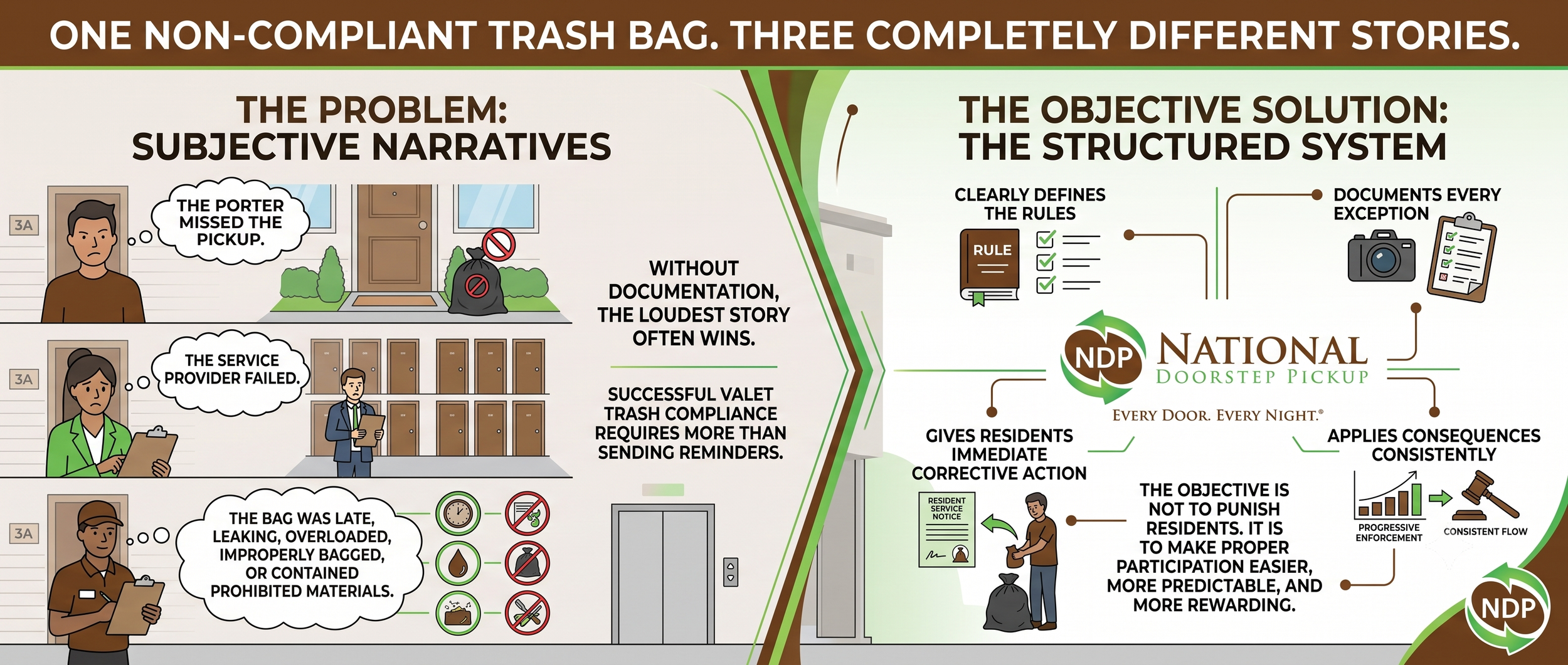
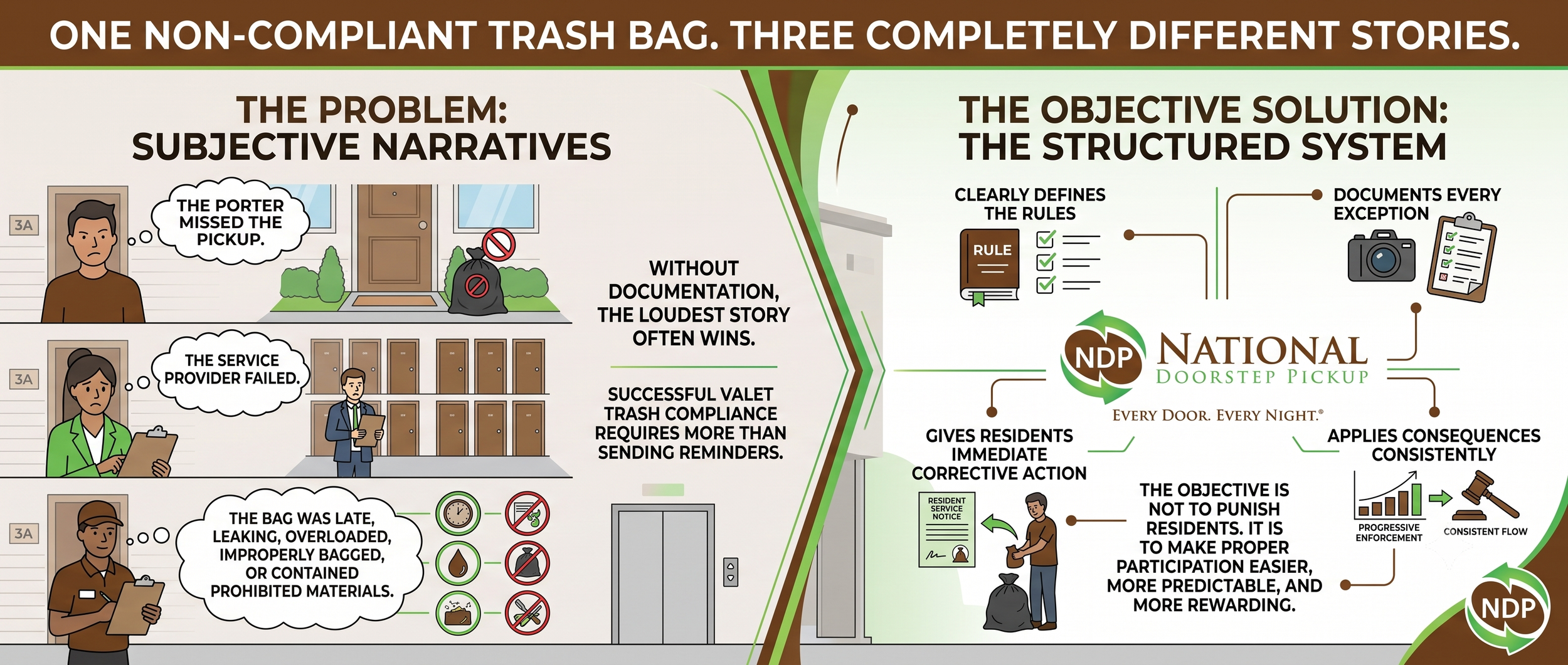
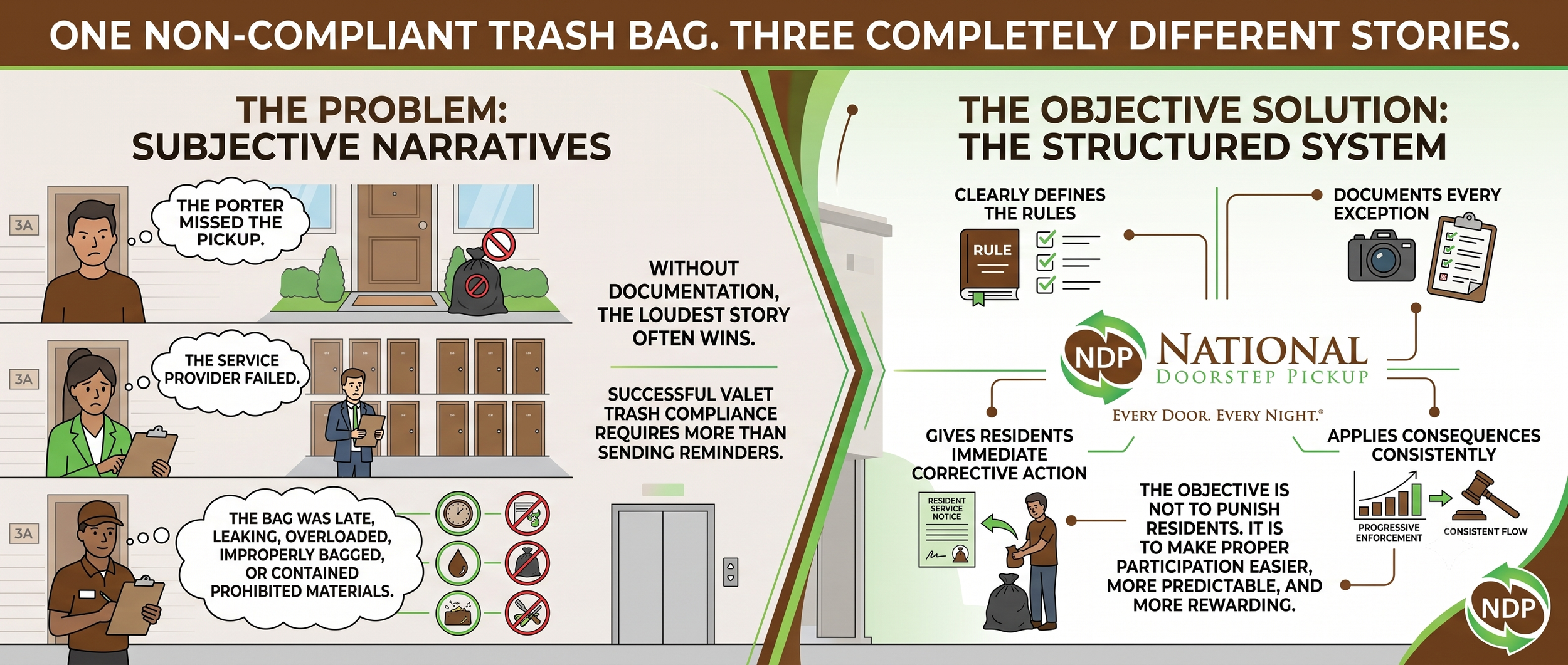
One non-compliant trash bag can create three completely different stories.
The resident believes the porter missed the pickup.
The property manager believes the service provider failed.
The porter knows the bag was placed outside late, leaking, overloaded, improperly bagged, or contained prohibited materials.
Without documentation, the loudest story often wins.
That is why successful valet trash compliance requires more than sending reminders. Property managers need a structured system that clearly defines the rules, documents every collection exception, gives residents an immediate corrective action, and applies consequences consistently.
The objective is not to punish residents.
The objective is to make proper participation easier, more predictable, and more rewarding than continued non-compliance.
Resident Non-Compliance Is Not Automatically a Service Failure
A bag left outside after collection does not necessarily mean the apartment was missed.
It may mean:
The resident placed the bag outside after the porter completed that section of the route.
The bag was untied, leaking, torn, overfilled, or unsafe to handle.
The resident exceeded the property’s bag limit.
Loose waste was placed inside or beside the container.
The resident used an undersized grocery bag.
The setout contained prohibited, hazardous, or oversized materials.
The empty container was left outside after the required retrieval time.
Recycling was placed in the wrong bag or contained unacceptable materials.
National Doorstep Pickup’s role is to collect compliant household waste during the scheduled collection window.
It is not an on-demand cleanup or housekeeping service.
When a setout does not meet the property’s rules, National Doorstep Pickup documents the collection exception, communicates the reason to the resident through the Resident Service Notice, and records the event in Proof of Pickup® technology.
Property management then determines the appropriate resident follow-up.
That distinction matters:
National Doorstep Pickup documents the violation. Property management enforces the lease, addendum, and community rules.
Begin With a Resident Start Guide That Removes Ambiguity
Residents cannot consistently follow rules they do not understand.
Every new resident should receive a clear service-start guide before the first collection night. The guide should explain the three-part service routine:
1. Prepare the Trash Correctly
Residents should:
Use the property-approved 13-gallon trash bag. The current National Doorstep Pickup start guide specifies a 13-gallon GLAD® bag; ForceFlex MaxStrength is preferred.
Securely tie every bag.
Make sure bags are leak-free and safe to lift.
Place household waste inside the approved National Doorstep Pickup container.
Double-bag pet waste.
Follow the property’s two-bag limit.
Keep each bag within the property’s weight limit, typically no more than 25 pounds.
Residents should never place exposed glass, sharps, chemicals, flammable materials, batteries, biohazardous materials, furniture, mattresses, appliances, electronics, or other bulk items outside for ordinary doorstep collection.
2. Place the Container Out Correctly
Residents should:
Use the property-approved National Doorstep Pickup container or trash mat.
Place tied bags outside only on scheduled service nights.
Set the container outside between 6:00 p.m. and 8:00 p.m.
Keep hallways, walkways, stairs, doors, fire equipment, and exit paths clear.
Avoid setting trash out early.
Never leave trash outside overnight after collection.
Flatten cardboard and follow the property’s cardboard-disposal procedure.
National Doorstep Pickup’s standard five-night schedule is Sunday through Thursday, although the property’s approved schedule controls.
3. Bring the Empty Container Back Inside
Collection begins at 8:00 p.m. and continues until the route is completed, which may be as late as midnight.
Residents must bring the empty container back inside by 9:00 a.m.
A container left outside after the required retrieval time may result in a documented violation.
This structure gives residents three memorable actions:
Prepare it. Place it. Bring it back inside.
The simpler the routine, the easier it becomes to enforce.
Use the Resident Service Notice as an Immediate Behavioral Prompt
A generic email delivered the next morning is often too disconnected from the behavior that caused the violation.
The National Doorstep Pickup Resident Service Notice is left at the unit when the issue occurs. That creates an immediate connection between:
The resident’s setout.
The rule that was not followed.
The reason the item was collected as a courtesy or left behind.
The corrective action required.
The possibility of property-management follow-up.
The notice provides two service outcomes.
Courtesy Pickup
A porter may collect a non-compliant setout as a one-time courtesy while documenting the issue.
The notice explains that future setouts with the same condition may not be collected.
A courtesy pickup should never be treated as silent acceptance. Without communication, the resident may believe the setout was compliant and repeat the behavior.
Not Collected
When the item cannot be safely or properly collected, the notice instructs the resident to correct the checked issue and take the materials to the property-designated disposal area.
The resident is also told not to leave the item outside overnight.
This is particularly important for leaking bags, hazardous materials, bulk items, unsafe setouts, and excessive quantities.
Document Every Observed Collection Exception in Proof of Pickup®
Every observed violation should create an operational record.
National Doorstep Pickup documents collection exceptions through Proof of Pickup® technology, providing property management with service visibility that may include:
Building and unit information.
GPS, date and time.
Route activity.
The selected violation category.
Whether the item received a courtesy pickup or was not collected.
Photo verification when applicable.
Repeat-violation history.
Management follow-up information.
This record helps resolve the most common resident disputes:
“The porter never came.”
“I put the bag out on time.”
“Nobody told me the bag was too heavy.”
“That was not my trash.”
“This has never happened before.”
“I followed the rules.”
Documentation allows management to evaluate facts rather than assumptions.
It also helps distinguish among a true service miss, a late resident setout, and a properly documented collection exception.
Use Standardized Violation Categories
The Resident Service Notice identifies 11 collection concerns. Standardized categories prevent vague reporting and give residents a precise reason for the exception.
1. Incorrect Setout Time
The trash was not placed outside between 6:00 p.m. and 8:00 p.m., or it was placed outside after collection.
Residents should understand that placing a bag outside after the porter has passed the unit is not a missed pickup.
2. Unsafe or Improperly Prepared Bag
The bag was untied, open, leaking, overfilled, torn, or otherwise unsafe to collect.
The resident must retie, rebag, or reduce the contents before the next service night.
3. Incorrect Bag Size
A grocery bag or other undersized bag was used instead of the property-approved 13-gallon trash bag.
Small bags can tear, spill, become hidden inside containers, or create unsafe handling conditions.
4. Bag Limit Exceeded
The resident exceeded the property limit of two bags per unit per service night.
Excess waste should be taken to the property-designated disposal area unless the property has approved another procedure.
5. Loose or Unbagged Waste
Loose trash was placed inside or beside the container.
Every item must be contained in a securely tied bag.
6. Cardboard Was Not Flattened
Cardboard was left intact, or a cardboard box was used as a trash container.
Boxes should be flattened and taken to the property’s designated cardboard or recycling area.
7. Bulk or Oversized Item
Furniture, mattresses, appliances, electronics, or another oversized item was placed outside.
Ordinary valet trash collection is not a bulk-removal service. Residents must use the property-designated disposal or bulk-pickup process.
8. Hazardous or Prohibited Material
The setout contained hazardous, sharp, flammable, corrosive, medical, battery-related, or biohazardous materials.
These materials should not be handled through ordinary doorstep collection. The resident should contact management for approved disposal instructions.
9. Improperly Bagged Pet Waste
Pet waste was not securely double-bagged.
Double-bagging reduces leakage, odors, contamination, and direct exposure during collection.
10. Container Was Not Retrieved
The empty container was not brought inside by 9:00 a.m.
Containers left outside throughout the day can affect community appearance, obstruct common areas, and encourage residents to place waste outside early.
11. Recycling Non-Compliance
Recycling was placed in the wrong bag or contained materials not accepted by the community.
Because accepted materials vary by property and municipality, residents should follow the property’s specific recycling instructions and use the approved bag when required.
Property Management Must Police the Items Left Behind
National Doorstep Pickup identifies and documents the collection exception.
Property management controls what happens next.
When a non-compliant item is left behind, the property manager should:
Review the Proof of Pickup® record.
Confirm the unit, time, category, and available photographs.
Contact the resident promptly.
Require the resident to correct or remove the item.
Direct the resident to the property-designated disposal area when appropriate.
Document the communication.
Apply the property’s authorized progressive-enforcement policy when the behavior continues.
National Doorstep Pickup does not independently issue lease violations, impose resident charges, or determine legal remedies.
Those decisions belong to the property manager and must be based on the lease, valet trash addendum, property policy, and applicable law.
Allowing a documented item to remain outside without resident follow-up weakens the entire compliance program. It teaches the resident that the rule is optional and signals to neighboring residents that similar behavior may be tolerated.
Use Persuasive Communication, Not Angry Communication
The most effective resident messages do not simply threaten a penalty.
They create a clear psychological path from the violation to the desired behavior.
Start With Community Identity
Residents are more receptive when the message connects compliance to a shared standard.
Instead of:
You violated the trash policy.
Use:
Thank you for helping us keep the community clean, safe, and pest-free.
This frames compliance as part of being a responsible community member rather than merely obeying management.
Use Positive Social Norms
Avoid suggesting that rule-breaking is widespread.
A message such as “Residents keep leaving trash outside” can unintentionally normalize the behavior.
Use:
Most residents follow the service window and bring their containers inside by 9:00 a.m. We appreciate your help maintaining that standard.
The message reinforces that proper participation is normal and expected.
Explain the Immediate “Why”
Residents are more likely to cooperate when the rule has an understandable purpose.
For example:
Securely tied bags help prevent leaks, odors, pests, and spills in shared areas.
That is more persuasive than:
Bags must be tied because it is the rule.
Give One Clear Next Action
Do not overload the resident with an entire policy manual when one issue needs correction.
Use:
Please retie the bag, place it inside the approved container, and set it out during the next scheduled 6:00–8:00 p.m. placement window.
The resident should know exactly what to do next.
Preserve the Resident’s Sense of Control
Commands can create resistance, particularly when the resident already feels accused.
Choice-based language can reduce defensiveness without weakening the rule:
You may correct the bag for the next service night or take it to the property-designated disposal area tonight.
Both choices achieve the required result.
Make Consequences Predictable
Certainty is generally more effective than emotional severity.
Avoid:
Continued violations will result in serious consequences.
Use:
This collection exception has been documented. A future occurrence may result in a written notice or a charge of up to $25 when authorized by your lease, addendum, property policy, and applicable law.
The resident receives a specific and credible expectation.
Separate the Person From the Behavior
Do not label the resident as careless, irresponsible, or inconsiderate.
Describe the setout:
The bag was documented outside after collection.
Not the resident:
You are always putting your trash out late.
This lowers defensiveness and keeps the conversation focused on a correctable action.
Resident Communication Templates
Courtesy Reminder
Subject: Courtesy Valet Trash Reminder for Your Home
Thank you for helping us keep the community clean, safe, and pest-free.
Your trash was collected tonight as a one-time courtesy; however, the setout did not meet the community’s valet trash guidelines because [insert documented category].
For your next service night, please [insert one specific corrective action].
Residents should place securely tied, leak-free bags inside the approved container between 6:00 p.m. and 8:00 p.m. and bring the empty container inside by 9:00 a.m.
Future setouts with the same condition may not be collected. Thank you for helping us maintain a clean and reliable service for the entire community.
Item Not Collected
Subject: Action Needed—Valet Trash Collection Exception
National Doorstep Pickup documented a collection exception at your apartment tonight because [insert documented category].
The item could not be collected under the community’s service guidelines.
Please choose one of the following corrective actions:
Correct the issue and place the item out during the next scheduled service window.
Take the item to the property-designated disposal area tonight.
Please do not leave the item outside overnight.
Correcting the issue now helps prevent odors, pests, leaks, and obstructions in shared areas. The collection exception has been recorded in the property’s service documentation.
Written Warning
Subject: Written Notice—Repeated Valet Trash Non-Compliance
Our records show documented valet trash collection exceptions at your apartment on [dates].
The reported issue was:
[Insert the exact violation category and documented facts.]
Most residents successfully follow the placement window and bag-preparation requirements. Your cooperation is needed to maintain the same clean and consistent standard around your home.
Beginning immediately, please:
[Insert one or two required actions.]
A future occurrence may result in additional lease or policy enforcement, including a charge of up to $25 per occurrence when authorized by your lease, addendum, property policy, and applicable law.
Please contact the management office promptly if you need clarification regarding the service rules or property-designated disposal area.
Repeat-Violation Notice
Subject: Final Action Required—Documented Valet Trash Violations
This notice concerns repeated, documented valet trash violations associated with your apartment.
Despite prior reminders, the following condition was recorded again on [date and time]:
[Insert violation category.]
To avoid additional charges or lease-enforcement action, please correct the condition immediately and follow the community’s valet trash requirements on every future service night.
The required action is:
[Insert precise corrective action.]
This notice is based on documented service information. Any fee or further enforcement will be administered by property management according to the lease, addendum, property policy, and applicable law.
Use Progressive Enforcement
Not every mistake requires the same response.
A practical escalation process includes:
First Occurrence: Courtesy Education
Use the service notice to identify the issue and explain the correct behavior.
A first-time mistake may be the result of incomplete move-in training or simple misunderstanding.
Second Occurrence: Written Management Notice
Reference the new violation and the earlier documented occurrence.
The message should establish that the behavior is now a pattern rather than an isolated mistake.
Repeated Occurrence: Formal Policy or Lease Enforcement
Issue the appropriate notice under the property’s lease, valet trash addendum, or community rules.
Include dates, documented categories, prior communications, and the action required.
Authorized Charge or Additional Remedy
The Resident Service Notice allows property management to indicate that a resident may be charged up to $25 per occurrence, provided the charge is authorized by the resident’s lease or addendum, property policy, and applicable law.
The amount should never appear as an improvised porter charge.
Any fee should be:
Disclosed in advance.
Supported by the lease or addendum.
Applied consistently.
Connected to a documented occurrence.
Administered by property management.
Reviewed for compliance with applicable requirements.
Make the Compliant Action the Easiest Action
Repeated non-compliance is sometimes caused by unnecessary friction.
Ask:
Does the resident know the exact service days?
Is the 6:00–8:00 p.m. placement window clearly communicated?
Does the resident know collection may continue until midnight?
Was the resident given the correct container?
Does the resident know where to take bulk items?
Is the designated disposal area clearly identified?
Does the resident know how to dispose of flattened cardboard?
Are recycling instructions available in the resident’s preferred language?
Can residents easily scan a QR code for current information?
Are holiday and weather-related schedule changes communicated promptly?
The resident start guide should be provided at move-in, posted in the resident portal, and made available through a QR code.
When residents can quickly find the answer, management receives fewer complaints and fewer repeat violations.
Review Trends Across the Property
Proof of Pickup® documentation should be used for more than individual enforcement.
Property managers can review patterns such as:
Repeated late setouts in a particular building.
Containers routinely left outside after 9:00 a.m.
Frequent leaking or overfilled bags.
Bulk items appearing during move-in or move-out periods.
Recycling contamination concentrated in one section.
Increased violations after a schedule change.
Multiple residents confused about the bag limit.
A high number of bags placed outside on non-service nights.
Patterns can reveal a communication gap, an onboarding problem, or a property-specific disposal issue.
For example, repeated bulk-item violations may indicate that residents do not know where the property-designated bulk area is located.
The solution may require both direct enforcement and better instructions.
Common Enforcement Mistakes to Avoid
Treating Every Left-Behind Bag as a Missed Pickup
Review the documented time, condition, and violation category before assigning responsibility.
Allowing Documented Items to Remain Outside
Property management must follow up and require resident correction. Leaving the item in place undermines the notice and affects neighboring residents.
Sending Property-Wide Warnings for One Unit’s Behavior
Direct communication is more persuasive and avoids irritating compliant residents.
Using Emotional or Accusatory Language
Facts, photographs, timestamps, and specific corrective actions are more effective than anger.
Making the Porter Debate the Resident
Porters should document collection exceptions, not interpret lease language or negotiate enforcement at the resident’s door.
Enforcing Rules Inconsistently
Similar documented violations should receive similar responses unless an approved accommodation or other legally relevant circumstance applies.
Collecting Every Non-Compliant Bag Without Notice
Repeated courtesy collection without documentation or communication teaches the resident that the written rules do not matter.
Threatening Charges That Are Not Authorized
All fees and enforcement measures must be administered by property management under the property’s governing documents and applicable requirements.
A Clear Valet Trash Compliance Workflow
An effective property-level process is straightforward:
Step 1: National Doorstep Pickup Identifies the Exception
The porter recognizes that the setout does not meet the approved service requirements.
Step 2: The Exception Is Categorized
The applicable collection-concern category is selected.
Step 3: The Resident Receives Immediate Communication
The Resident Service Notice indicates whether the item received a courtesy pickup or was not collected.
Step 4: The Event Is Documented
The unit, time, category, service status, and supporting information are recorded in Proof of Pickup® technology.
Step 5: Property Management Reviews the Record
Management confirms the facts before contacting the resident.
Step 6: Management Requires Correction
The resident is directed to correct the issue, remove the item, or use the property-designated disposal area.
Step 7: Management Applies Progressive Enforcement
Written warnings, fees, or lease remedies are administered when authorized and appropriate.
This workflow gives each party a defined responsibility:
National Doorstep Pickup collects, communicates, and documents. Property management reviews, corrects, and enforces.
The Goal Is Predictable Resident Behavior
The best valet trash compliance program is not the one that issues the most notices.
It is the one that produces:
Fewer leaking bags.
Fewer late setouts.
Clearer common areas.
Safer collection conditions.
Lower pest exposure.
Fewer disputed missed-pickup claims.
Better recycling participation.
More consistent resident behavior.
Less administrative work for property management.
Residents respond best when the rules are simple, the communication is immediate, the evidence is objective, and the consequences are predictable.
National Doorstep Pickup provides the collection process, resident service communication, and Proof of Pickup® documentation property managers need to maintain that structure.
With more than 300,000 doors served and a pickup success rate exceeding 99.75%, National Doorstep Pickup helps multifamily communities protect service quality while giving management the documentation needed to address non-compliance accurately and consistently.
Every Door. Every Night.®
Request a proposal or compliance review for your apartment community today.