By Les Leith, CEO & COO at National Doorstep Pickup
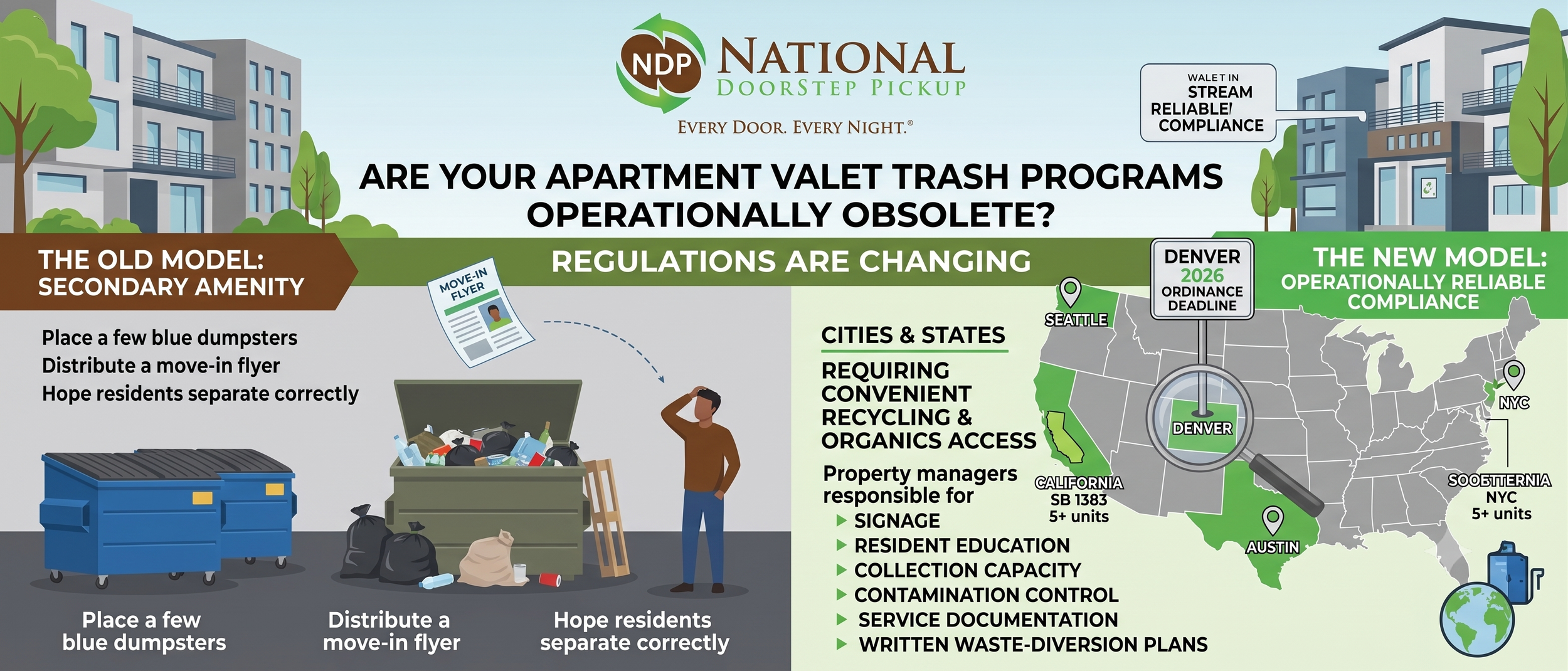
Your apartment community’s valet trash program may be one ordinance away from becoming operationally obsolete.
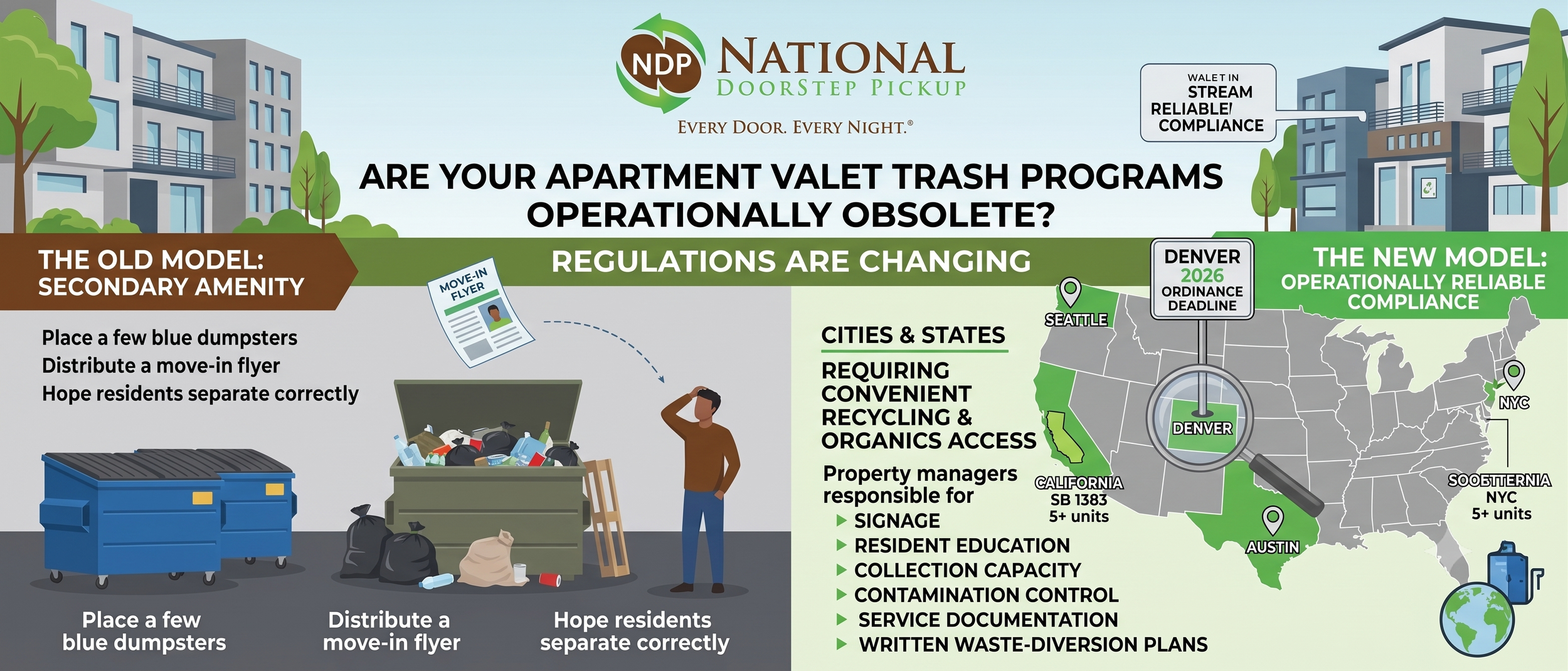
For years, many multifamily properties treated recycling as a secondary amenity: place a few blue dumpsters near the compactor, distribute a move-in flyer, and hope residents separate materials correctly.
That model is becoming harder to defend.
Denver offers an immediate example. Beginning September 1, 2026, apartment and condominium buildings with eight or more units must provide recycling and composting services to residents, employees and contractors. Covered properties must provide adequate and convenient containers, post sorting signage, educate users and maintain a waste-diversion plan. (Denvergov)
The important question is no longer:
“Should we offer recycling?”
It is:
“How do we make recycling and organics as convenient, measurable and operationally reliable as our existing valet trash service?”
The answer is a properly designed multi-stream doorstep waste program.
Why Add Recycling to an Existing Valet Trash Program?
A traditional valet trash program solves one of apartment living’s most persistent inconveniences: carrying household trash through hallways, down stairs, into elevators or across a large community at night.
But when trash is collected at the resident’s door while recycling and food scraps must be carried to distant containers, the property unintentionally rewards the wrong behavior.
Residents naturally use the easiest available option.
If trash is convenient but recycling is inconvenient, recyclable materials migrate into the trash stream. If organics require a separate trip across the property, food waste is likely to end up in the same tied bag as everything else.
Adding recycling and organics to the doorstep program creates a more logical system:
Recycling is placed in a clearly identifiable bag or container.
Organics are placed in an approved compostable bag or sealed receptacle.
Each material is collected separately.
Porters deliver each stream to its designated on-site container.
Property management receives documentation showing how the program is being performed.
Convenience becomes the mechanism that drives compliance.
Denver’s 2026 Deadline Is a Warning to Multifamily Operators Nationwide
Denver’s Universal Recycling and Composting Ordinance applies to multifamily properties with eight or more units, including apartment and condominium buildings, manufactured home communities and certain congregate-living properties.
By September 1, 2026, covered communities must provide:
Properties with eight or more units must arrange service through a licensed private waste hauler because Denver’s municipal collection is generally limited to residential buildings with seven or fewer units. (Denvergov)
Under the adopted rules, a responsible party generally has 30 calendar days after receiving a notice of violation to correct the violation before an administrative citation is issued.
First Administrative Citation: Up to $150.
Second Administrative Citation: Up to $500.
Third and Each Subsequent Administrative Citation: Up to $999.
Continuing Obligation: Paying a penalty does not eliminate the obligation to correct the violation or prevent further enforcement.
National Doorstep Pickup’s Denver multifamily compliance guide similarly emphasizes that the required operating model includes three streams—trash, recycling and organics—available on site for residents and staff. (Doorstep Valet Trash)
Denver is important, but it is not an isolated case.
Other Multifamily Markets Already Moving Beyond Trash-Only Programs
California: Under SB 1383, multifamily properties with five or more units generally must provide organics collection for tenants and employees. Property owners or managers must provide appropriately located and labeled containers, educate tenants annually, and give new residents sorting information within 14 days of occupancy. (CalRecycle)
Austin: Multifamily properties with five or more units must provide residents and employees with convenient recycling and commercial composting access. Austin also requires an annual recycling plan, sufficient capacity, multilingual labeling and proximity between trash, recycling and compost containers. Its multifamily composting requirement took effect October 1, 2024. (City of Austin)
New York City: Compost separation is mandatory citywide. Owners and managers of buildings with four or more units must provide a designated storage area with clearly labeled compost containers. (New York City Government)
Seattle: Seattle prohibits recyclable and compostable materials from being placed in garbage, while property managers oversee garbage, recycling and food-and-yard-waste service for multifamily buildings. (Seattle.gov)
The details vary by jurisdiction, but the direction is clear: multifamily waste programs are evolving from a single disposal service into a managed diversion system.
The Best Operating Model: Trash, Recycling and Organics Working Together
A successful program should not treat recycling and organics as disconnected add-ons.
The three streams must function as one coordinated system.
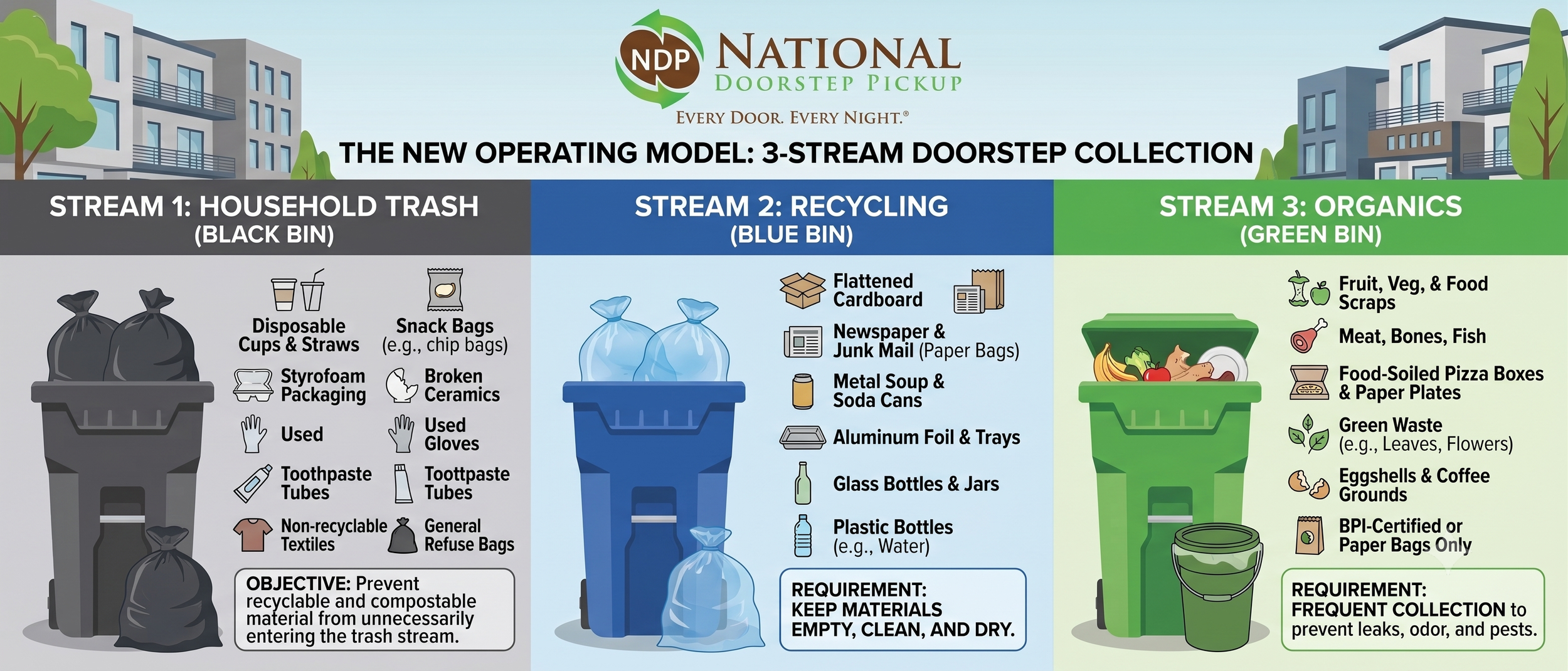
Stream 1: Household Trash
Trash should remain limited to materials that cannot be accepted by the property’s recycling or organics processor.
Residents should continue to use properly tied household bags and follow the community’s established container-placement and pickup rules.
The objective is not to eliminate trash. It is to prevent recyclable and compostable material from unnecessarily entering the trash stream.
Stream 2: Recycling
Doorstep recycling should use a visually distinct collection method.
Clear blue or blue translucent recycling bags can help residents, porters and management identify recycling without opening bags or guessing what they contain. The bags also help prevent confusion with opaque household trash bags or heavy construction bags.
Accepted materials must match the property’s actual recycling hauler and processing facility. A typical single-stream program may include:
Clean paper and cardboard.
Aluminum and steel cans.
Empty plastic bottles, jugs and approved containers.
Glass bottles and jars where locally accepted.
Residents should be instructed to keep materials empty, clean and dry, flatten cardboard and avoid placing plastic film, food, liquids or bagged household trash in recycling containers.
Stream 3: Organics
Organics collection requires more control because food scraps can leak, attract pests and generate odors when handled improperly.
An organics program may accept:
Food scraps.
Fruit and vegetable trimmings.
Meat, bones and dairy where permitted.
Food-soiled paper.
Approved compostable products.
Yard or landscape material where applicable.
The property must follow its processor’s accepted-material list. A bag labeled “compostable” is not automatically accepted everywhere. Approved bags may need to carry a recognized compostability certification and meet the requirements of the receiving facility.
Ten Best Practices for Doorstep Recycling in Apartment Communities
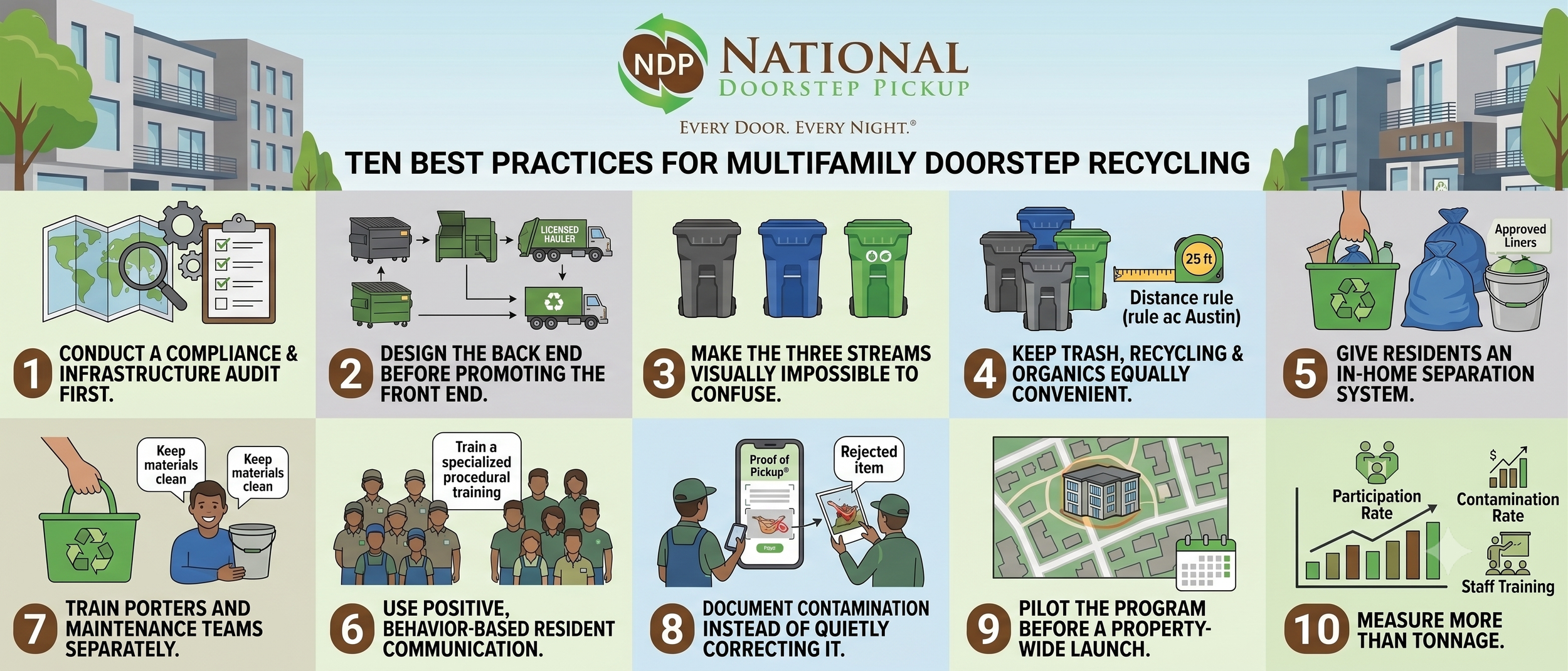
1. Conduct a Compliance and Infrastructure Audit First
Do not begin by ordering bags.
Begin by documenting:
Which regulations apply.
Which buildings and unit counts are covered.
Existing trash and recycling agreements.
Available enclosure and compactor space.
Hauler licensing requirements.
Required container capacity.
Required collection frequency.
Signage and language requirements.
Education and recordkeeping obligations.
Organics-processing availability.
Exemption or waiver procedures.
A program that works in Tampa may not satisfy Denver, Austin, Seattle, New York or a California jurisdiction.
The local ordinance, licensed hauler and receiving processor must all agree on what the program collects and how it is handled.
2. Design the Back End Before Promoting the Front End
Doorstep pickup is only the first step.
Before residents are invited to participate, management must determine:
Where porters will consolidate each stream.
Which dumpsters, carts or compactors will receive it.
Whether bagged recyclables are accepted.
Whether organics bags must be removed at processing.
How cardboard will be managed.
How spills will be contained.
What happens when a container is full.
How rejected or contaminated material will be documented.
Never launch a resident-facing program until the entire chain—from the apartment door to the processing facility—has been confirmed.
3. Make the Three Streams Visually Impossible to Confuse
Color is one of the fastest ways to reduce sorting mistakes.
A property might use:
Standard household bags for trash. 13-gallon GLAD® bag; ForceFlex MaxStrength is preferred.
Containers, door-hanger instructions, move-in materials, emails and signage should use the same visual system.
Do not call one container “compost,” another “food waste,” and a third “organics” without explaining that they refer to the same stream. Consistent language reduces hesitation and sorting errors.
4. Keep Trash, Recycling and Organics Equally Convenient
A resident should not have to walk past the recycling area to reach the trash container—or travel to the opposite end of the community to dispose of food scraps.
Where residents and staff encounter a trash collection point, corresponding recycling and organics options should be placed as close as operationally possible.
Austin, for example, requires indoor collection stations to be grouped and requires outdoor recycling and compost containers to be within 25 feet of trash containers. (City of Austin)
Even where local code does not prescribe a distance, the principle remains sound:
Equal convenience produces better separation. Unequal convenience produces contamination.
5. Give Residents an In-Home Separation System
Most contamination begins inside the apartment, not at the dumpster.
Residents need a practical way to separate materials before pickup night. Consider providing:
A small recycling tote.
Clear blue recycling bags.
A kitchen organics pail with a lid.
Approved compostable liners.
A QR code linking to current accepted materials.
Replacement bags available through the community or service provider.
6. Use Positive, Behavior-Based Resident Communication
A long list of prohibitions is rarely persuasive.
Instead of leading with:
“Do not contaminate the recycling.”
Use direct, benefit-oriented instructions:
Keep recycling empty, clean and dry so your materials can be accepted rather than sent to the landfill.
Instead of:
“No food in recycling.”
Use:
Place food scraps in your organics bag and keep containers free of food and liquid before recycling them.
Resident communications should explain:
What action to take.
Why it matters.
How to complete it correctly.
What happens when the instructions are not followed.
The goal is not merely awareness. It is repeatable behavior.
7. Train Porters and Maintenance Teams Separately
Residents, porters and maintenance employees interact with different parts of the system.
Porter training should cover:
Bag identification.
Stream-specific collection procedures.
Cross-contamination prevention.
Leaking-bag procedures.
Container access and lock protocols.
Photo documentation.
Rejected-item procedures.
Route completion standards.
Maintenance training should cover:
Enclosure cleanliness.
Overflow response.
Container-label replacement.
Pest and odor prevention.
Bulk-item separation.
Cardboard management.
Hauler escalation procedures.
Never assume that a general recycling flyer is sufficient operational training for employees.
8. Document Contamination Instead of Quietly Correcting It
When staff silently move an incorrect bag, the immediate area may look cleaner—but the behavior remains unchanged.
Contamination should be documented by:
Building.
Unit when identifiable.
Material type.
Waste stream.
Date and time.
Corrective action.
Repeat frequency.
National Doorstep Pickup’s Proof of Pickup® technology can capture route, time and photo verification while creating a clearer record of service conditions and material left behind.
The porter documents the condition. Property management enforces the community’s rules.
9. Pilot the Program Before a Property-Wide Launch
A 30- to 60-day pilot can expose problems before they affect the entire community.
Select one building or representative group of units and measure:
Resident participation.
Recycling volume.
Organics volume.
Contamination.
Bag failures.
Leaks and spills.
Porter collection time.
Container capacity.
Odor or pest complaints.
Missed or rejected collections.
Use the results to adjust bag sizes, signage, collection schedules and service frequency before expanding.
10. Measure More Than Tonnage
Diversion volume matters, but it does not tell the entire operational story.
A strong multifamily program should also track:
Participation rate.
Contamination rate.
Overflow incidents.
Repeat violations.
Missed pickups.
Collection time per building.
Resident complaints.
Bag and liner usage.
Hauler rejections.
Staff training completion.
Move-in education delivery.
Annual education completion.
These measurements help management determine whether the program is genuinely working or merely exists on paper.
Common Mistakes That Cause Doorstep Recycling Programs to Fail
Collecting Trash and Recycling in the Same Vehicle Compartment
Even when bags are visually different, placing them together can create resident skepticism and increase the risk of cross-contamination.
Separate the material physically and operationally.
Launching Organics Without Frequent Collection
Food scraps cannot be managed like dry cardboard. Organics may require more frequent service, tighter lids, washable containers and stronger spill procedures.
Using Generic Signage
A national recycling poster may show materials that the local processor does not accept. Signs must match the property’s actual program.
Hiding the Recycling Container Behind the Trash Dumpster
Convenience and visibility affect participation. Residents should not have to search for the correct container.
Failing to Educate New Residents
Treating Contamination as a Resident-Only Problem
The entire system must be audited before blame is assigned.
A Practical Implementation Timeline
90 Days Before Launch
Review applicable ordinances.
Audit the property’s waste infrastructure.
Obtain proposals from licensed haulers and service providers.
Confirm processor acceptance rules.
Calculate required container capacity.
Identify enclosure or staging modifications.
Draft the waste-diversion plan.
60 Days Before Launch
Select bags, totes and organics containers.
Develop resident and staff education.
Finalize signage.
Establish contamination categories.
Configure service-verification procedures.
Train management, maintenance and porter supervisors.
30 Days Before Launch
Begin resident announcements.
Deliver in-home separation supplies.
Conduct staff training.
Install containers and signage.
Test collection routes.
Confirm collection schedules with each hauler.
Start a limited pilot.
Launch Week
Provide reminders through email, text, resident portals and door hangers.
Increase on-site observation.
Document contamination immediately.
Correct capacity or routing problems quickly.
Reinforce successful resident behavior.
First 90 Days After Launch
Review participation and contamination weekly.
Retrain where needed.
Adjust collection frequency.
Replace unclear signage.
Communicate recurring problems by building.
Maintain compliance and education records.
Recycling Compliance Can Become an Amenity—Not Just an Obligation
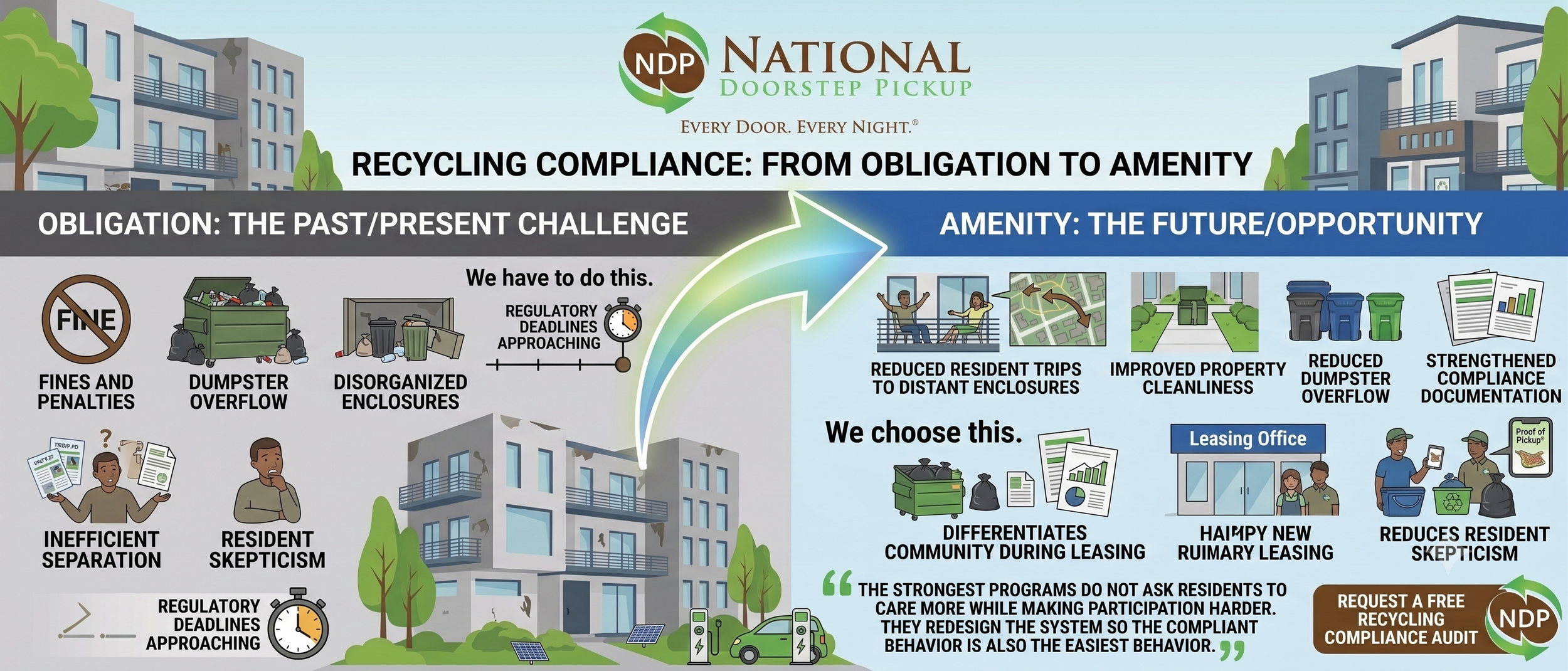
A well-designed doorstep recycling and organics program can:
Reduce trips to distant waste enclosures.
Improve property cleanliness.
Reduce dumpster overflow.
Support resident sustainability expectations.
Strengthen compliance documentation.
Improve control over contamination.
Give management better visibility into service performance.
Differentiate the community during leasing and renewals.
The strongest programs do not ask residents to care more while making participation harder.
They redesign the system so the compliant behavior is also the easiest behavior.
Prepare Before the Regulation Reaches Your Property
Denver’s September 1, 2026, deadline is an immediate operational issue for covered communities, but it is also a signal to multifamily operators everywhere.
Waiting until an enforcement date approaches leaves property teams negotiating for containers, hauler capacity, signage, staff training and resident education at the same time.
A better approach is to evaluate the existing valet trash program now and determine how recycling and organics can be integrated into the same resident-friendly collection experience.
National Doorstep Pickup helps apartment communities design and operate coordinated doorstep trash, recycling and organics programs supported by resident education, contamination documentation and Proof of Pickup® service verification.
Request a Free Recycling Compliance Audit
Identify the regulations affecting your community, evaluate the existing waste infrastructure and build a practical plan for adding recycling and organics without creating unnecessary confusion for residents or staff.
Every Door. Every Night.®
Frequently Asked Questions
Can recycling be added to an existing valet trash program?
Yes. Recycling can be added by creating a separately identifiable collection stream, confirming that the property’s hauler accepts the material, training porters to keep it separate and providing residents with clear instructions and appropriate bags or containers.
Should residents use bags for doorstep recycling?
That depends on the local hauler and processing facility. Clear blue or blue translucent bags can improve identification at the doorstep, but management must verify that bagged recyclables are accepted by the receiving facility.
Can organics be collected from apartment doorsteps?
Yes, when permitted by the property, hauler and processor. Organics should be placed in approved bags or sealed containers and handled under procedures designed to prevent leaks, odors, pests and contamination.
Should trash, recycling and organics be collected on the same night?
They may be collected during the same service window, but each stream must remain separately identifiable and physically separated through collection, transport and placement in the property’s designated containers.
Who is responsible for resident recycling violations?
Porters and service providers should document incorrect set-outs or contamination. Property management is generally responsible for resident communication and enforcement under the lease, community rules and applicable local regulations.
How often should residents receive recycling education?
Provide instructions at move-in, during the initial program launch, whenever accepted materials change and at least annually where required. California, for example, requires annual multifamily education and information for new tenants within 14 days of occupancy. (CalRecycle)
What is required for Denver apartment communities?
Beginning September 1, 2026, Denver multifamily buildings with eight or more units must provide recycling and composting services, adequate and convenient containers, appropriate signage, sorting education and a waste-diversion plan. (Denvergov)