By Les Leith, CEO & COO at National Doorstep Pickup
Your Maintenance Team Should Not Be the Backup Valet Trash Crew
A bag leaks in the hallway.
A resident leaves a mattress beside the compactor.
A trash container remains outside all weekend.
A manager receives a complaint about a missed pickup, but no one can determine whether the bag was placed out on time.
Who gets called?
Too often, it is the on-site maintenance team.
That is where a resident amenity can quietly become an operational burden.
Valet trash should make apartment operations easier. It should reduce trips to the compactor, improve curb appeal, support resident satisfaction, and help the property maintain cleaner breezeways and common areas.
But those benefits only materialize when the valet trash provider and the on-site maintenance team operate from the same playbook.
The goal is not to make maintenance responsible for valet trash. The goal is to establish clear communication, ownership, documentation, and escalation procedures so every team knows exactly what to do—and what not to do.
Here is how to coordinate valet trash with on-site maintenance teams without creating confusion, duplicated labor, or after-hours chaos.
Why Valet Trash and Maintenance Coordination Matters
Valet trash service intersects with several areas that maintenance teams already manage:
Breezeways and corridors.
Elevators and stairwells.
Trash rooms and compactor areas.
Pest control.
Leak and stain prevention.
Bulk-item removal.
Lighting and access conditions.
Resident rule enforcement.
Property inspections.
Fire and life-safety concerns.
That overlap does not mean maintenance should manage the valet trash route. It means the two services need clearly defined operational boundaries.
Without those boundaries, several problems can emerge:
Maintenance labor gets diverted
Technicians may spend time moving resident bags, cleaning preventable leaks, investigating missed pickups, or clearing bulk items that should have followed a separate removal process.
Service complaints become difficult to verify
When the property lacks time-stamped route documentation, every missed-pickup complaint becomes a debate between the resident, management, maintenance, and the service provider.
Small issues become recurring problems
A leaking bag that is picked up, i.e. with an exposed long-neck beer bottle, without documenting the apartment number, may reappear the following night. A resident who repeatedly violates placement rules may never receive corrective communication.
Accountability becomes blurred
When everyone is “helping,” no one clearly owns the outcome.
Effective coordination eliminates this ambiguity.
1. Define Responsibilities Before Service Begins
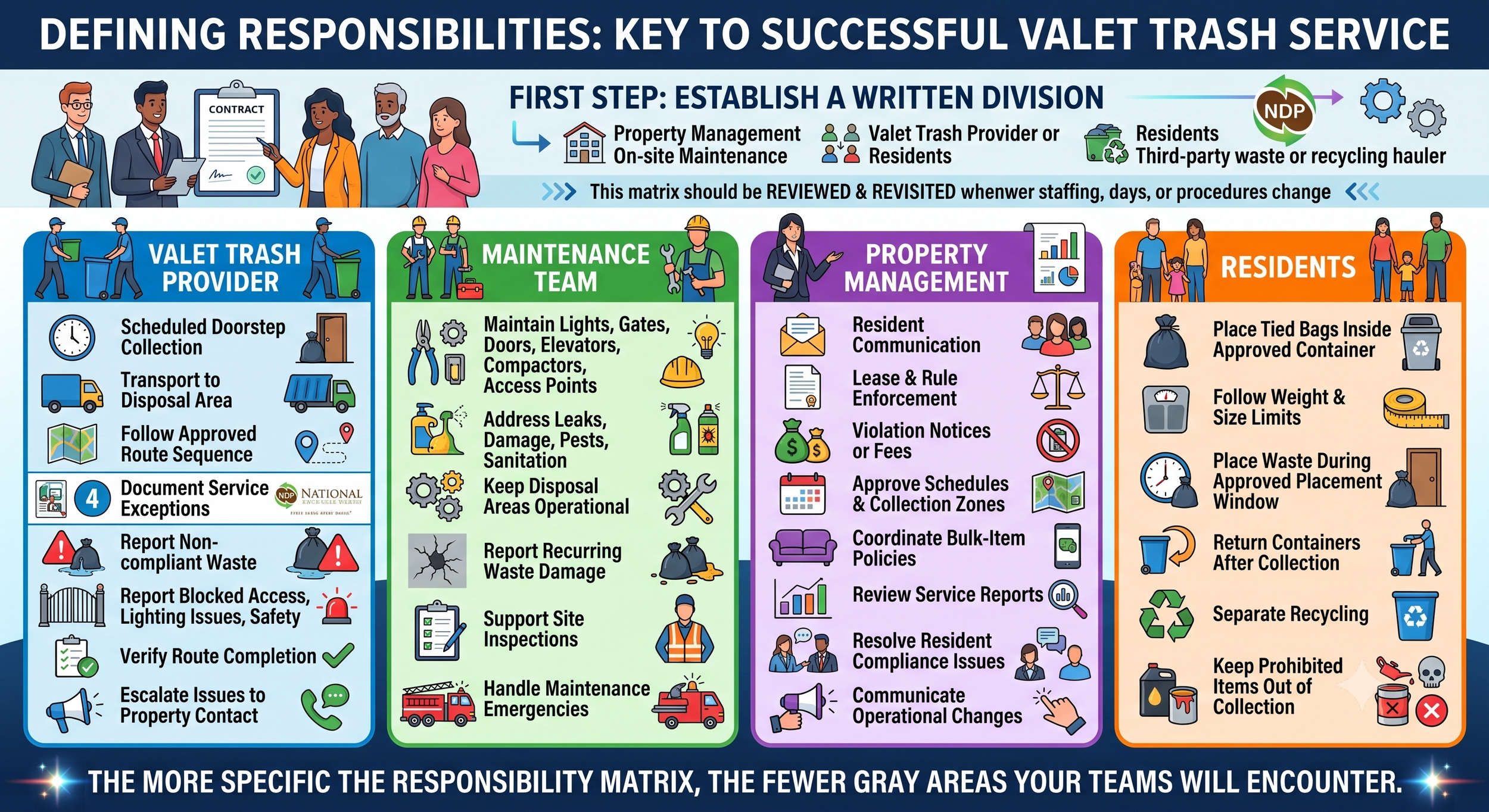
The first step is to establish a written division of responsibilities between:
Property management.
On-site maintenance.
The valet trash provider.
Residents.
Any third-party waste or recycling hauler.
This responsibility matrix should be reviewed before launch and revisited whenever staffing, service days, or property procedures or staff change.
The valet trash provider should generally own:
Doorstep collection during the scheduled service window.
Transporting properly prepared household trash to the designated disposal area.
Following the approved route sequence.
Documenting service exceptions.
Reporting leaking, oversized, loose, prohibited, or improperly prepared waste.
Reporting blocked access, lighting problems, or unsafe conditions.
Verifying completion of the collection route.
Escalating operational issues to the designated property contact.
The maintenance team should generally own:
Maintaining lighting, gates, doors, elevators, compactors, and access points.
Addressing property-related leaks, damage, pests, or sanitation concerns.
Keeping disposal areas mechanically operational.
Reporting recurring waste-related property damage.
Supporting scheduled site inspections.
Handling maintenance emergencies under the property’s normal procedures.
Property management should generally own:
Resident communication.
Lease and community-rule enforcement.
Violation notices or fees.
Approving service schedules and collection zones.
Coordinating bulk-item policies.
Reviewing service reports.
Resolving recurring resident-compliance issues.
Communicating operational changes to all parties.
Residents should generally own:
Placing tied bags inside the approved container.
Following weight and size limits.
Placing waste outside only during the approved placement window.
Returning containers after collection.
Separating recycling where required.
Keeping liquids, loose waste, hazardous materials, and prohibited items out of the collection stream.
The more specific the responsibility matrix, the fewer gray areas your teams will encounter.
2. Name One Primary Contact From Each Team
Valet trash problems often become more complicated because too many people are communicating through different channels.
A porter tells a maintenance technician.
The technician tells the assistant manager.
The assistant manager sends an email to a regional contact.
The next shift never sees the message.
Instead, assign one primary operational contact and one backup contact for both the property and the valet trash provider.
The contact list should include:
Name.
Role.
Mobile number.
Email address.
Preferred communication channel.
After-hours escalation procedure.
Issues that qualify as emergencies.
Issues that should wait until the next business day.
Maintenance technicians can still report hazards or urgent property conditions, but routine valet trash communication should flow through an organized reporting structure.
This prevents conflicting instructions and creates a clearer record of what occurred.
3. Create a Joint Property Walk Before Launch
A pre-launch property walk is one of the most effective ways to prevent future service failures.
The property manager, maintenance supervisor, and valet trash operations representative should walk the complete collection route together.
During the walk, confirm:
Building numbers.
Apartment numbering patterns.
Stairwell and elevator access.
Gate codes and access credentials.
Trash rooms.
Compactor locations.
Dumpster enclosures.
Recycling areas.
Areas with poor lighting.
Sloped walkways.
Drainage concerns.
Low-clearance areas.
Known leak-prone corridors.
Fire doors that must remain closed.
Restricted or resident-only areas.
Safe locations for carts or tilt trucks.
Procedures for elevators and interior flooring.
Alternate routes during construction or repairs.
A route that looks simple on a site map can feel very different at 10:30 p.m. while moving hundreds of pounds of waste through multiple buildings.
Maintenance personnel often know the property’s operational realities better than anyone. Their input can help the provider build a safer, cleaner, and more efficient route from day one.
4. Establish a Clear Service and Placement Window
Residents, maintenance employees, management, and the valet trash team should all receive the same schedule.
For example:
Residents place properly tied bags outside between 6:00 p.m. and 8:00 p.m.
Collection occurs during the approved evening service window.
Containers must be returned indoors after collection.
Bags placed outside after the porter has serviced the building are considered late placements.
Bags left out on non-service days are resident violations—not missed pickups.
A defined placement window helps maintenance teams distinguish among:
A legitimate missed pickup.
A late resident placement.
An improperly prepared bag.
Waste placed outside on a non-service day.
A bag rejected for safety or policy reasons.
Without a defined window, every bag left outside can appear to be a service failure.
5. Give Maintenance Access to Service Verification
When a resident reports a missed pickup, the property should be able to review objective route data before dispatching a maintenance employee or contacting the provider.
A technology-supported valet trash program can document:
Porter arrival time.
Route start and completion time.
Building progress.
Time-stamped service events.
Photo-documented violations.
Access problems.
Safety concerns.
Bags placed out after collection.
Oversized or prohibited items.
Route completion.
National Doorstep Pickup’s Proof of Pickup® approach gives property management greater visibility into what occurred during the service window.
That visibility protects everyone.
Residents receive a more accurate response. Property managers can identify patterns. Maintenance teams avoid unnecessary investigations. The valet trash provider can address legitimate service exceptions quickly.
The operational question changes from “Who says what happened?” to “What does the service record show?”
6. Use a Standard Exception-Reporting Process
Porters should not simply walk past a problem bag without documenting it.
Maintenance should not remove a recurring violation without reporting where it originated.
Management should not receive vague notes such as “trash issue in Building 4.”
Create consistent exception categories, such as:
Bag not tied.
Bag leaking.
Bag exceeds weight limit.
Loose trash.
Oversized item.
Prohibited item.
Waste placed out too early.
Late placement.
Non-service-day placement.
Recycling contamination.
Blocked access.
Gate or door malfunction.
Elevator out of service.
Compactor unavailable.
Unsafe condition.
Evidence of pests or wildlife.
Each report should identify the building, apartment, time, issue, and recommended next action.
Structured reporting makes it possible to distinguish isolated events from recurring operational problems.
7. Keep Resident Enforcement With Management
Maintenance employees should not be expected to confront residents or interpret lease requirements.
When a porter or technician identifies repeated noncompliance, the issue should be documented and sent to management.
Management can then follow the property’s established process, which may include:
A courtesy reminder.
A written violation notice.
Resident retraining.
A documented lease violation.
A fee where permitted by the lease and applicable law.
Additional escalation for repeated or hazardous conduct.
This separation is important.
Maintenance teams preserve their working relationship with residents. The valet trash provider stays focused on collection and documentation. Management retains control over lease enforcement.
8. Build a Separate Process for Bulk Items
A sofa beside the dumpster is not valet trash.
Neither is a mattress, television, appliance, shelving unit, construction debris, or abandoned furniture.
Bulk waste should have its own policy, schedule, vendor, pricing structure, and approval process.
The bulk-item procedure should answer:
What items are accepted?
Who authorizes removal?
Is there a resident bill back fee?
Who documents the item?
Where should bulk items be placed?
How quickly must they be removed?
Who handles illegal dumping?
What happens during move-out periods or turns?
Are electronic waste or appliances handled separately?
Without a bulk-item plan, maintenance teams often become the default movers. That creates injury risk, labor costs, and inconsistent enforcement.
9. Coordinate Around Compactor and Dumpster Conditions
The valet trash team depends on functioning disposal infrastructure.
If the compactor is full, jammed, locked, inaccessible, or offline, the provider needs an approved alternative—not an improvised solution.
Maintenance and management should establish procedures for:
Compactor outages.
Full dumpsters.
Blocked enclosures.
Broken gates.
Missing keys or access cards.
Roll-off container placement.
Holiday overflow.
Waste-hauler delays.
Emergency disposal locations.
Overflow prevention.
The valet trash provider should report problems promptly. Maintenance should address mechanical or property-access issues. Management should coordinate with the primary waste hauler when capacity or collection timing is the underlying problem.
The doorstep collection provider cannot solve a failed compactor by simply continuing to add waste.
10. Protect Interior Floors, Elevators, and Corridors
Mid-rise and high-rise communities require additional coordination because waste often moves through interior common areas.
The operations plan may need to include:
Leak-resistant polyurethane collection satchels.
Tilt trucks designed for indoor transport.
Elevator scheduling
Floor protection.
Separate service elevators.
Maximum cart capacity.
Rules against dragging bags.
Procedures for elevator spills.
Designated staging points.
Cleaning supplies for immediate response.
Documentation of recurring resident leaks.
Maintenance should advise the provider about flooring materials, elevator limitations, recurring drainage problems, and areas that are especially vulnerable to damage.
The provider should use appropriate equipment and handling procedures to reduce drips, odors, and wall damage.
11. Include Recycling and Waste-Separation Rules
The property may need separate procedures for:
Recyclable materials.
Cardboard.
Glass.
Food waste.
Compostable material.
Electronic waste.
Batteries.
Household hazardous waste.
Bulky items.
Move-out debris.
In most major markets, your Regional Compliance Hub can be found via city search here. Residents should receive clear instructions about which materials belong in each stream.
Where applicable, communities may provide or make available:
Recycling containers.
Educational signage.
Multilingual resident instructions.
Contamination notices.
12. Hold Brief, Recurring Operations Reviews
Coordination does not require another hour-long meeting.
A short monthly or quarterly review can identify trends before they become expensive problems.
Review:
Missed-pickup complaints.
Verified late placements.
Recurring resident violations.
Leaking-bag locations.
Bulk-item activity.
Compactor downtime.
Gate and access problems.
Recycling contamination.
Property damage.
Pest concerns.
Route completion times.
Upcoming construction.
Staffing or schedule changes.
Resident communication needs.
The purpose is not to assign blame. It is to identify the root cause and adjust the process.
For example, repeated complaints from one building could indicate:
Confusing apartment numbering.
A porter routing issue.
Residents placing bags out late.
A locked access door.
Poor lighting.
An elevator problem.
Inadequate resident onboarding.
The correct solution depends on the cause.
Common Coordination Mistakes to Avoid
Treating maintenance as the catch-all department
Maintenance should not routinely complete missed routes, move resident trash, or enforce valet trash rules.
Allowing verbal-only reporting
Important service issues need documentation. Verbal reports disappear at shift change.
Failing to update the provider
Construction, gate-code changes, elevator outages, paving projects, and dumpster relocations can disrupt service if the provider is not notified.
Ignoring repeated resident violations
Cleaning the same leak every week without addressing the source increases labor and property damage.
Combining household trash and bulk removal
These are separate operational services and should be managed accordingly.
Evaluating every complaint as a service failure
The property should first determine whether the bag was placed out correctly, on time, and on a scheduled service day.
Launching without maintenance input
Maintenance teams understand access, lighting, disposal equipment, interior surfaces, and property-specific hazards. Excluding them from route planning creates avoidable problems.
A Simple Valet Trash Coordination Workflow
A strong operational workflow can be summarized in five steps:
1. The porter documents the issue
The provider records the building, apartment, time, condition, and supporting evidence.
2. Management reviews the service record
Management determines whether the issue involves provider performance, resident noncompliance, or a property condition.
3. The correct team receives the assignment
Provider issue: valet trash operations.
Resident issue: property management.
Mechanical or access issue: maintenance.
Hauler or capacity issue: waste vendor or management.
Bulk item: approved bulk-removal process.
4. Corrective action is documented
The responsible team records what was done and whether further follow-up is required.
5. Recurring patterns are reviewed
Repeated issues trigger training, resident communication, route adjustment, equipment changes, or formal enforcement.
This workflow prevents every trash-related concern from automatically becoming a maintenance ticket.
Valet Trash Should Reduce Maintenance Burden—not Add to It
That requires more than collecting bags.
It requires:
Defined responsibilities.
Clear service windows.
Reliable communication.
Documented exceptions.
Technology-supported verification.
Resident education.
Consistent enforcement.
Functional disposal infrastructure.
Property-specific route planning.
Ongoing operational review.
When management, maintenance, residents, and the valet trash provider follow the same process, the community can reduce confusion, protect maintenance labor, improve accountability, and deliver a more consistent resident experience.
Because valet trash should not create another problem for your maintenance team.
It should remove one.
Frequently Asked Questions
Should apartment maintenance teams collect missed valet trash bags?
Maintenance should not serve as the routine backup collection team. Legitimate missed pickups should be reported to the valet trash provider under the property’s escalation process. Maintenance may respond to immediate safety or sanitation emergencies according to property policy.
Who should enforce valet trash rules?
Property management should enforce lease terms and community policies. The valet trash provider and maintenance team should document violations, but management should control resident notices, fees, and corrective action.
How can a property verify a missed pickup?
Review the service schedule, placement window, route-completion records, time stamps, photos, access reports, and any documented exceptions. This helps distinguish a provider miss from a late or improper resident placement.
What should happen when the compactor is not working?
The provider should notify the designated property contact and follow the approved contingency plan. Maintenance should address mechanical issues, while management coordinates alternative disposal capacity or waste-hauler service.
Should bulk items be included in regular valet trash service?
Not unless the contract specifically includes bulk removal. Mattresses, furniture, appliances, construction debris, and oversized items generally require a separate removal procedure.
How often should maintenance and valet trash teams meet?
A brief review during launch, followed by monthly or quarterly operational check-ins, is usually sufficient. Communities with construction, access problems, high resident turnover, or repeated complaints may need more frequent coordination.
What information should a valet trash exception report include?
The report should include the date, time, building, apartment number, type of issue, supporting photo or documentation, and required follow-up.
Make Valet Trash Easier for Your Entire On-Site Team
Is your maintenance staff spending too much time handling trash complaints, leaking bags, bulk items, or service disputes?
National Doorstep Pickup can help your community implement a clearer, more accountable doorstep waste and recycling program.
Request a proposal and property operations review today.
Every Door. Every Night.®