By Les Leith, CEO & COO at National Doorstep Pickup
Your Valet Trash Vendor Should Make Property Management Easier — Not Create Another Problem to Manage
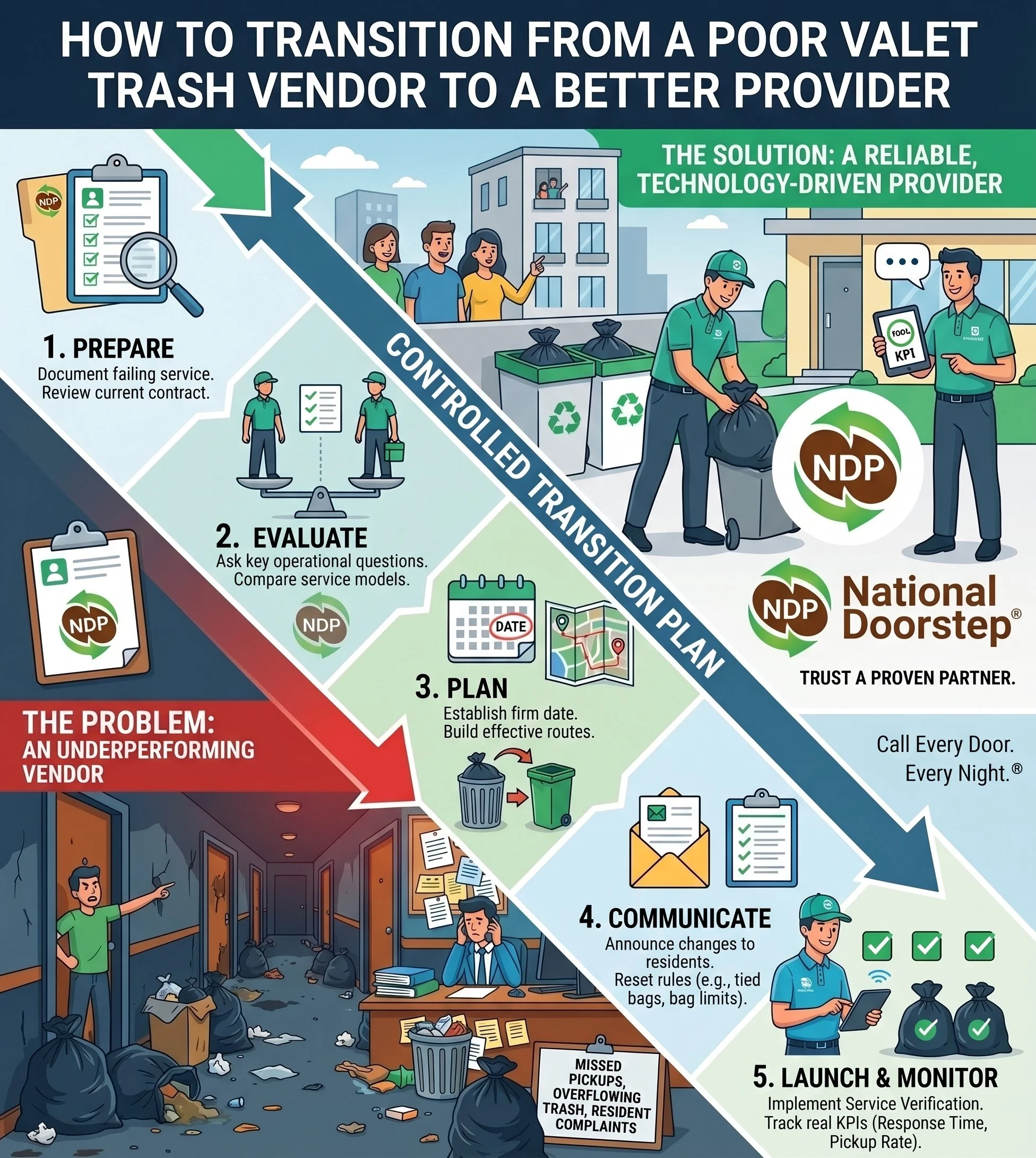
Missed pickups. Overflowing trash. Residents complaining at the leasing office. Porters arriving late—or not appearing at all. Property teams chasing down service issues that should never have become their responsibility.
At some point, an underperforming valet trash vendor stops being an amenity partner and becomes an operational liability.
The difficult part is often not recognizing the problem.
It is figuring out how to replace the vendor without creating an even bigger disruption for residents and onsite staff.
Fortunately, switching valet trash companies does not have to be chaotic. With the right transition plan, multifamily operators can move from inconsistent service to a more accountable provider while maintaining continuity throughout the property.
Here is how to do it.
The Hidden Cost of Staying With a Poor Valet Trash Vendor
Property managers sometimes tolerate inconsistent valet trash service because changing vendors feels complicated.
That can be an expensive mistake.
A weak vendor can create problems far beyond the trash itself.
Common consequences include:
Repeated resident complaints
Missed doorstep collections
Trash remaining in breezeways or corridors
Overflowing dumpsters or compactors
Increased workload for maintenance and leasing teams
Poor communication when service problems occur
Inconsistent porter appearance and professionalism
Unresolved resident violations
Odor, pest, and cleanliness concerns
Negative online reviews
Reduced confidence in an amenity residents may be paying for
The irony?
Keeping the wrong vendor to avoid disruption can create significantly more disruption than replacing them.
The goal should therefore not simply be to terminate an existing company.
The goal should be to execute a controlled valet trash vendor transition.
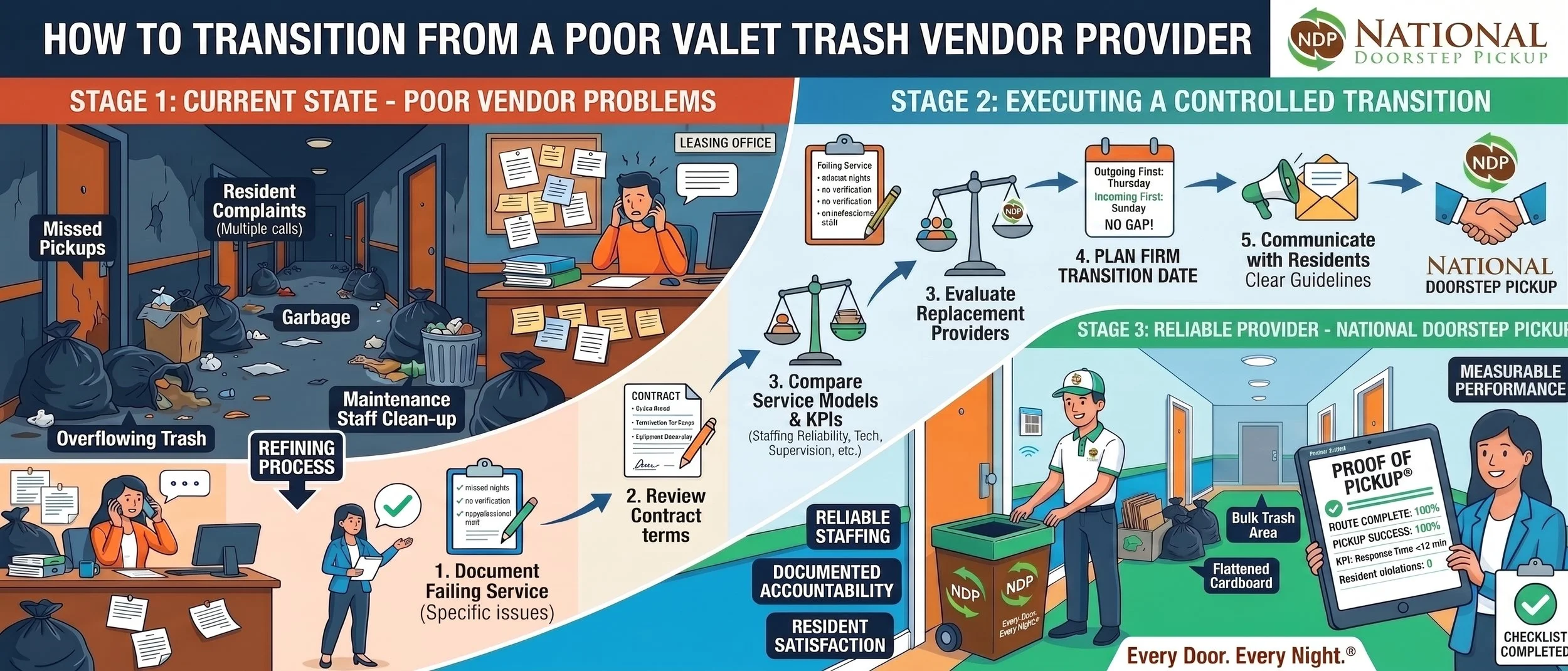
1. Document Exactly Why the Current Vendor Is Failing
Before shopping for another provider, identify the operational failures creating the problem.
Do not settle for:
“The service isn't good.”
Get specific.
Review the previous several weeks or months and document issues such as:
Number of known missed pickups
Buildings or units experiencing repeated problems
Resident complaints
Missed service nights
Porter turnover
Unanswered emails or calls
Poor violation documentation
Inconsistent service times
Spillage
Trash left at doors
Improper handling of bulk items
Dumpster or compactor problems
Failure to follow property procedures
This gives management a measurable baseline against which prospective vendors can be evaluated.
Ask one critical question:
What would the new company have to do differently for us to consider the transition successful?
That answer becomes your vendor-selection framework.
2. Review Your Current Valet Trash Contract Before Giving Notice
Before terminating a valet trash provider, review the agreement carefully.
Pay particular attention to:
Contract expiration date
Automatic renewal provisions
Required notice period
Termination-for-cause provisions
Cure periods
Service-level requirements
Pricing obligations
Equipment ownership
Resident container ownership
Insurance requirements
Indemnification language
Data or reporting access
Final invoicing procedures
Depending on the contract, a property may need to provide written notice before termination.
If the vendor is materially failing to perform, the agreement may also contain provisions addressing default or an opportunity to cure.
Property teams should coordinate termination decisions with ownership, asset management, procurement, and legal counsel when appropriate.
Do not let frustration turn into an avoidable contract dispute.
3. Start Evaluating Replacement Providers Before the Existing Service Ends
One of the biggest transition mistakes is terminating the current provider first and searching for a replacement afterward.
That creates a service gap.
Instead, overlap the processes.
Ideally, management should have the incoming provider selected, insured, contracted, staffed, and operationally prepared before the outgoing vendor performs its final service night.
When interviewing valet trash companies, ask more than:
“How much do you charge per door?”
Price matters.
Operational capability matters more.
4. Ask Prospective Valet Trash Companies the Questions That Expose Operational Weaknesses
A polished sales presentation does not guarantee consistent doorstep service.
Ask prospective vendors how the actual operation works.
Porter Staffing
Who recruits the porters?
Who trains them?
What happens when a porter calls out?
Does the company maintain backup staffing?
How quickly are vacancies filled?
Service Verification
How does the company verify that a property was actually serviced?
Ask whether reporting can confirm:
Arrival
Route completion
Pickup activity
Service time
Resident violations
Photos
Exceptions
A vendor saying “trust us” is not the same as a vendor providing documented accountability.
Management Communication
Who does the property contact when there is a service issue?
Is there local supervision?
What is the escalation process?
How quickly are problems typically addressed?
Resident Compliance
Ask how the vendor handles:
Bags placed out too early
Untied bags
Leaking trash
Oversized items
Excess bags
Prohibited materials
Containers left outside
Repeated resident violations
A successful valet trash program requires both service accountability and resident accountability.
5. Compare Service Models — Not Just Price Per Unit
The cheapest proposal can become remarkably expensive once property staff begin compensating for poor execution.
When comparing valet trash providers, evaluate the total service model.
Consider:
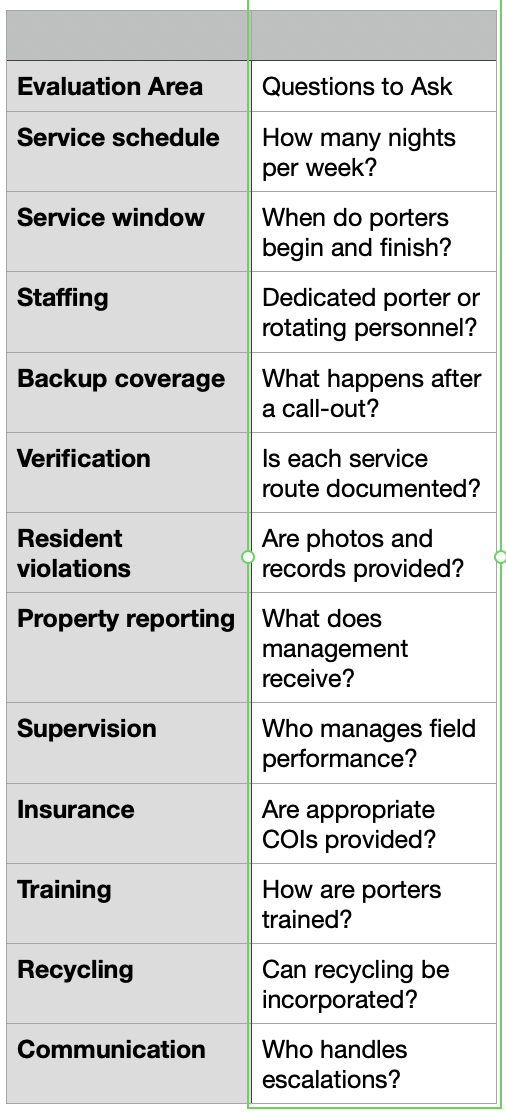
A stronger vendor should be able to explain exactly how service is delivered, monitored, corrected, and reported.
6. Establish a Firm Transition Date
Once the new provider has been selected, establish:
Outgoing vendor's final service night
and
Incoming vendor's first service night
Ideally, there should be no gap between them.
For example:
Thursday: Existing vendor's final collection
Sunday: New vendor begins regular Sunday–Thursday service
This allows the normal weekend break to become the operational handoff period.
The exact schedule will depend on the property's existing service arrangement.
7. Conduct a Property Walk Before the New Vendor Takes Over
The incoming provider should understand the property before its first service night.
A pre-launch walkthrough should identify:
Building numbers
Unit numbering
Stairwells
Elevators
Breezeways
Interior corridors
Parking restrictions
Gate access
Door access
Trash rooms
Dumpsters
Compactors
Recycling containers
Bulk disposal areas
Restricted areas
Difficult buildings
Emergency contacts
The vendor should also understand any property-specific procedures.
This simple step eliminates many preventable first-week mistakes.
8. Build the Route Before Launch Night
A professional transition should not begin with a porter arriving at the property and trying to figure out where to go.
Routes should be established beforehand.
For larger properties, route planning may include:
Building sequence
Starting location
Disposal points
Compactor trips
Elevator strategy
Cart or truck staging
Final property sweep
Efficient routes improve consistency while reducing excessive service time.
9. Decide How Resident Trash Containers Will Be Handled
One overlooked transition issue is container ownership.
Determine whether the existing trash cans belong to:
The property
Residents
The outgoing vendor
The management company
If the outgoing vendor owns the containers, coordinate removal carefully.
The incoming provider should have replacement equipment ready before service begins when containers are part of the new program.
You do not want hundreds of residents suddenly wondering:
“Where did my trash can go?”
10. Communicate With Residents Before the Change
Residents should hear about the transition from property management—not through rumors or by discovering a different porter outside their apartment.
Send a concise announcement explaining:
Effective date
New provider
Pickup nights
Set-out window
Trash preparation requirements
Bag limits
Prohibited items
Recycling procedures, if applicable
Container requirements
Contact process for service questions
Keep the message positive.
Residents usually do not need the details of the previous vendor's performance.
Instead of:
“We fired our old trash company because they kept missing pickups.”
Use:
“We are introducing a new doorstep waste collection provider as part of our continued effort to improve service consistency and resident experience.”
11. Reset the Rules During the Transition
A vendor transition creates an excellent opportunity to correct resident habits that may have developed under the previous provider.
Reissue the valet trash guidelines.
Clarify:
Set-Out Time
When residents may place trash outside.
Pickup Window
When collection occurs.
Bag Requirements
Trash should typically be securely tied and capable of being safely handled.
Bag Limits
Clearly communicate any nightly limit.
Prohibited Materials
Identify items that cannot be placed outside for doorstep collection.
Cardboard
Explain whether boxes must be flattened and where they should go.
Bulk Trash
Residents should understand that furniture, mattresses, appliances, and other oversized items generally require separate handling unless specifically included in the service.
Consistency becomes much easier when everyone begins with the same expectations.
12. Put Service Verification in Place From Night One
One of the most important improvements a property can make when changing vendors is implementing objective service verification.
National Doorstep uses Proof of Pickup® technology to provide documented service accountability and property-level reporting.
Route completion
Pickup activity
Service timing
Resident violations
Photos
Service exceptions
Operational performance
For property managers, this changes the conversation from:
“The resident says nobody picked up their trash.”
to:
“Let's review the service record.”
That difference can dramatically reduce time spent investigating conflicting accounts.
13. Pay Close Attention to the First Two Weeks
The first several service nights establish resident perception of the new company.
Management and the vendor should monitor:
Missed pickups
Route timing
Resident complaints
Disposal capacity
Porter performance
Access issues
Repeated resident violations
Buildings requiring route adjustments
Small operational changes during this period can prevent recurring problems later.
A good vendor should actively identify these issues rather than waiting for management to discover them.
14. Track Performance With Real KPIs
Once the transition is complete, measure whether service actually improved.
Useful valet trash KPIs include:
Pickup Success Rate
How consistently is eligible trash collected?
Complaint Frequency
Are resident complaints declining?
Missed-Service Incidents
How often are pickups genuinely missed?
Response Time
How quickly does the vendor resolve problems?
Resident Compliance Rate
Are rule violations increasing or decreasing?
Porter Reliability
Are routes being completed consistently?
Property Cleanliness
Are breezeways, corridors, trash rooms, and disposal areas improving?
A vendor relationship should be measurable.
If nobody can demonstrate whether service is improving, management is relying largely on perception.
15. Keep Property Staff Out of the Trash Business
This is perhaps the most important test.
Ask:
How much time is our onsite staff spending managing the valet trash vendor?
Your property management team should not routinely have to:
Investigate missed pickups
Track down porters
Move resident trash
Photograph violations
Handle operational staffing problems
Explain recurring failures
Clean up after incomplete routes
Valet trash is supposed to reduce friction for residents and management.
When onsite staff effectively becomes the vendor's quality-control department, something is wrong.
Red Flags That Suggest It Is Time to Change Valet Trash Providers
One occasional problem does not necessarily justify replacing a vendor.
A pattern does.
Consider evaluating alternatives when you consistently experience:
Missed pickups
High porter turnover
Residents repeatedly complaining
Trash remaining outside overnight
Poor communication
Unresponsive account management
Lack of service documentation
Poor violation reporting
Unprofessional personnel
Failure to provide backup staffing
Recurring cleanliness problems
Constant excuses instead of corrective action
The strongest warning sign may be this:
Your property team no longer trusts that the service will happen unless someone checks.
That is not a scalable vendor relationship.
Switching Valet Trash Providers: Property Manager Checklist
Review the existing vendor agreement
Document recurring service failures
Establish requirements for the replacement provider
Solicit and compare qualified proposals
Verify insurance and vendor requirements
Evaluate service-verification technology
Confirm porter staffing and backup coverage
Select the incoming provider
Establish outgoing and incoming service dates
Complete a property walkthrough
Map service routes and disposal locations
Resolve trash-container ownership
Provide gate, access, and property procedures
Notify residents
Redistribute resident service rules
Monitor the first several service nights closely
Track complaints and service performance
Conduct a 30-day service review
What Does a Better Valet Trash Provider Look Like?
A better valet trash company is not simply the company promising fewer mistakes.
It is the company that has systems designed to prevent, identify, document, and correct mistakes.
Look for a provider offering:
Reliable staffing.
Residents should not experience service interruptions because one porter called out.
Operational supervision.
Someone should be accountable for what happens in the field.
Transparent reporting.
Property management should have visibility into service performance.
Documented resident violations.
Management needs objective information when enforcing property rules.
Responsive communication.
Problems should receive action—not disappear into an inbox.
Scalable procedures.
Service quality should not depend entirely on one exceptional porter.
A genuine partnership with management.
The vendor should remove operational burden from the property rather than adding to it.
Don't Let Fear of Switching Keep You With the Wrong Vendor
Property managers often know when a vendor relationship is failing.
They hesitate because replacing the company sounds disruptive.
But a well-managed transition can happen with very little resident inconvenience.
The bigger risk may be allowing poor service to continue month after month.
Residents do not care which company appears on the valet trash contract.
They care about something much simpler:
Was my trash picked up when you said it would be?
That is ultimately the standard every valet trash provider has to meet.
Considering a Change in Valet Trash Providers?
National Doorstep helps apartment owners, operators, regional managers, and onsite teams transition from inconsistent doorstep waste programs to structured valet trash and doorstep recycling service.
Our approach combines professional field operations with Proof of Pickup® service verification, giving property management greater visibility into collections, resident compliance, and service performance.
Whether you are experiencing recurring missed pickups, communication problems, resident complaints, or simply want to benchmark your existing program, changing providers can be simpler than you think.
Every Door. Every Night.®
Ready to compare your current valet trash program with a better alternative?
Request a Valet Trash Proposal
Frequently Asked Questions About Switching Valet Trash Companies
Can an apartment community change valet trash providers?
Yes. Apartment owners and management companies can generally change providers subject to the terms of their existing service agreement. Management should review termination, renewal, notice, and cure provisions before making the change.
How long does it take to transition to another valet trash provider?
Timing depends on the existing contract, property size, staffing requirements, equipment, and resident communication. The operational objective should be to have the replacement provider prepared before the previous company's final service date.
Can we switch companies without interrupting resident service?
Yes. A properly coordinated transition can allow one provider to complete its final scheduled collection and the replacement provider to begin on the next normal service night.
Should residents be notified when the valet trash company changes?
Yes. Residents should receive advance communication explaining the effective date, service schedule, set-out rules, and any procedural changes.
What happens to the existing trash cans?
That depends on ownership. Containers may belong to the property, residents, or outgoing vendor. Ownership should be established before termination so replacement containers can be distributed if necessary.
What should we look for in a new valet trash company?
Evaluate staffing reliability, supervision, service verification, resident violation documentation, insurance, communication, escalation procedures, technology, reporting, and backup coverage—not simply price per unit.
How can property managers verify that valet trash was actually collected?
Digital service-verification systems can provide time, route, photographic, compliance, and service records that help management investigate complaints and monitor vendor performance.
Should we choose the lowest-priced valet trash company?
Not necessarily. Price should be evaluated alongside staffing, reliability, reporting, supervision, technology, responsiveness, and historical service performance. A lower contract price can create higher indirect costs if onsite personnel must continually manage service failures.
What should happen during the first week with a new provider?
Management and the vendor should closely monitor route completion, building access, disposal capacity, resident compliance, complaints, and porter performance so operational adjustments can be made immediately.
How do we know whether the new valet trash provider is actually better?
Establish measurable KPIs before the transition. Compare pickup reliability, resident complaints, missed-service incidents, response times, porter reliability, compliance reporting, and staff involvement before and after the change.