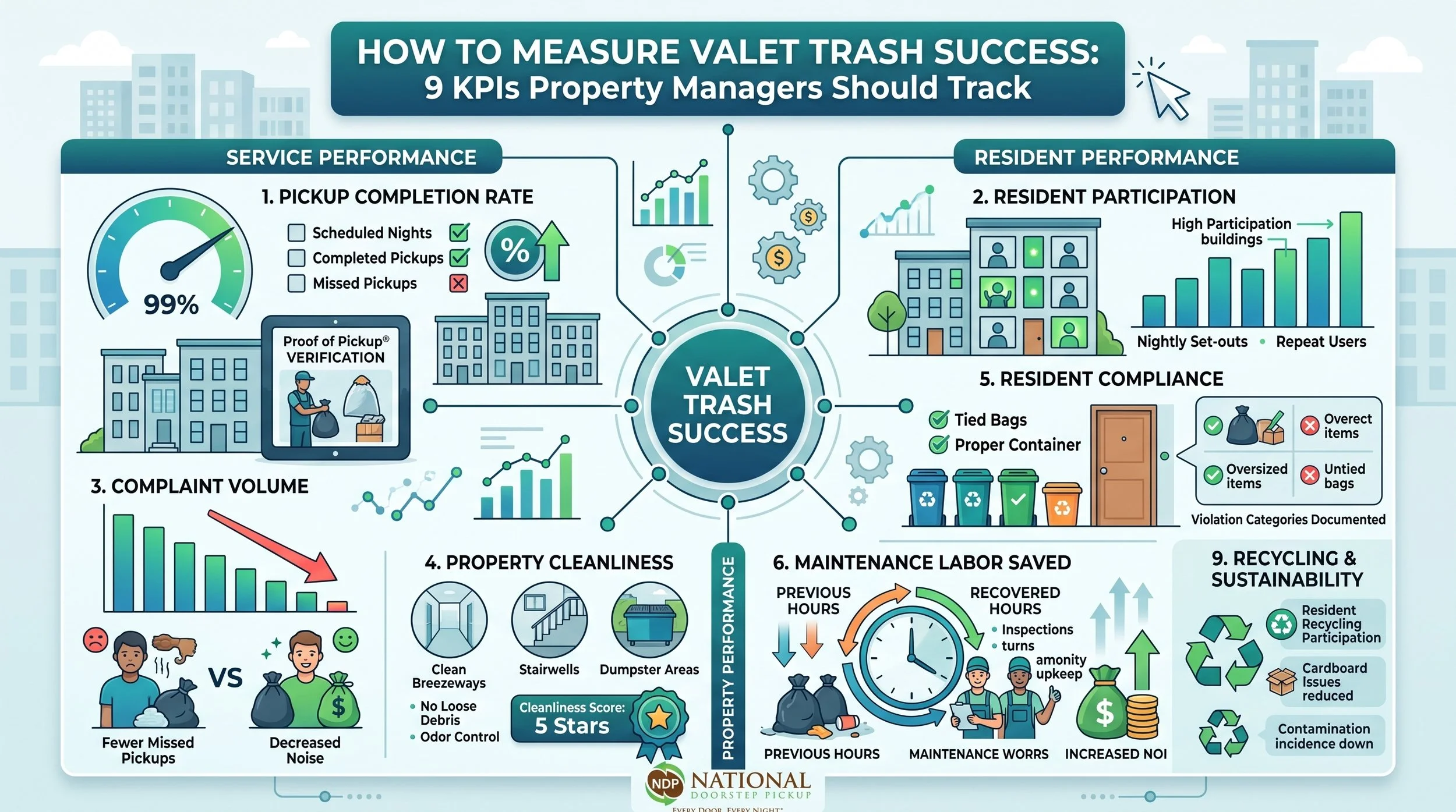
How to Measure Valet Trash Success After Implementation: 8 KPIs Property Managers Should Track
By Les Leith, CEO & COO at National Doorstep Pickup
Launching a valet trash program is only the beginning.
The real test comes after implementation.
Are pickups happening consistently? Are breezeways cleaner? Is your team spending less time dealing with trash problems? And, most importantly, is the program producing measurable value for the property?
A successful valet trash program should do more than move bags from apartment doors to a dumpster.
It should create measurable improvements in:
Resident convenience
Property cleanliness
Operational efficiency
Service accountability
Recycling participation
Compliance documentation
Resident satisfaction
Ancillary revenue
Net operating income
The key is knowing what to measure—and when.
Here are the nine performance indicators multifamily owners, regional managers, and property teams should track after implementing valet trash.
1. Pickup Completion Rate
Start with the most fundamental question:
Was the trash actually picked up?
A valet trash provider should be able to demonstrate service completion—not simply tell management that a route was completed.
Track:
Scheduled service nights
Completed pickups
Missed pickups
Partial route completions
Buildings or floors with recurring problems
Time service began and ended
Exceptions requiring follow-up
The KPI
Pickup Completion Success Percentage Rate = Completed Pickup Days x Units — Errors and Mistakes
The goal should be consistent, verifiable performance across the property. We aim for 99.5%
Repeated missed pickups create a ripple effect: overflowing bags, resident complaints, odors, pests, additional maintenance work, and declining confidence in the amenity. It’s Lean Six Sigma.
Better Question for Property Managers
Instead of asking:
"Did the porter show up?"
Ask:
"Can we verify what happened at the property last night?"
That distinction matters.
National Doorstep uses Proof of Pickup® service verification to provide operational visibility into doorstep collection activity.
Learn how valet trash service verification works.
2. Resident Participation Rate
A valet trash amenity cannot create its full value if residents are not using it.
Measure participation during the first 30, 60, and 90 days.
Look at:
Percentage of occupied units using the service
Average nightly set-outs
Repeat users
Low-participation buildings
Recycling participation, where applicable
Low participation does not automatically mean the service is failing.
It may indicate an onboarding problem.
Residents may not understand:
Which nights collection occurs
What time trash should be placed outside
How bags should be prepared
Where recycling belongs
What items are prohibited
When containers must be brought back inside
Clear move-in communication, resident reminders, signage, and digital instructions can significantly improve adoption.
3. Missed Pickup and Complaint Volume
Want one of the fastest ways to determine whether your valet trash program is working?
Measure how often residents complain about it.
Create a baseline before implementation and compare:
Before valet trash
Overflowing dumpster complaints
Trash left in breezeways
Resident trips to disposal areas
Trash-related maintenance tickets
Recycling confusion
After implementation
Track:
Missed pickup complaints
Late pickup complaints
Service-quality complaints
Trash left outside after service
Recurring unit-level issues
But don't stop at the total number.
Look for patterns.
If most complaints originate from one building, one service night, one route segment, or one type of violation, management can identify the underlying problem faster.
That is much more useful than simply counting tickets.
4. Property Cleanliness
Valet trash should improve the appearance of the property—not create another source of clutter.
We conduct routine property inspections and track changes in:
Breezeway cleanliness
Hallway cleanliness
Stairwells
Elevator areas
Dumpster enclosures
Compactor areas
Trash leakage
Loose debris
Odor complaints
Pest activity
You are not looking for one perfect inspection.
We are looking for and communicating a trend.
5. Resident Compliance
Valet trash performance is a two-way equation.
The provider must perform consistently—but residents must also follow property guidelines.
Common violations include:
Untied bags
Leaking bags
Oversized items
Excessive bag quantities
Loose trash
Prohibited materials
Improper recycling
Trash placed outside approved set-out times
Containers left outside beyond the permitted window
Without documentation, these problems can quickly become a dispute between the resident, management team, and service provider.
A stronger program tracks violations by:
Unit
Building
Violation category
Date
Frequency
Resolution
This allows management to distinguish between a service failure and a resident compliance problem.
That distinction is critical.
6. Maintenance Labor Saved
This metric is frequently overlooked.
Ask your maintenance team:
How much time were we spending dealing with trash before valet service began?
Potential activities include:
Picking up abandoned bags
Cleaning spills
Moving trash to dumpsters
Breaking down boxes
Handling resident complaints
Cleaning trash rooms
Removing debris around compactors
Investigating improper disposal
Then measure the same activities after implementation.
Example
If maintenance previously spent 20 labor hours per week addressing trash-related issues and that falls to eight hours, considering in-house trashouts, if not contracted, the property has recovered:
12 labor hours per week
Over 52 weeks:
624 labor hours annually
Those hours can be redirected toward:
Work orders
Preventive maintenance
Turns
Inspections
Amenity upkeep
Resident service
That operational capacity has value even before revenue from the valet trash program is considered.
7. Revenue and NOI Contribution
For owners and asset managers, operational performance eventually connects to financial performance.
Residents pay an amenity or trash-related fee, calculate the program's contribution.
Basic Valet Trash Revenue Formula
Monthly Revenue = Occupied Units × Monthly Resident Fee
Net Monthly Contribution = Resident Revenue − Program Cost − Direct Administrative Costs
Annual Contribution = Net Monthly Contribution × 12
Because multifamily assets are commonly valued using income capitalization, sustainable increases in property-level NOI can potentially influence asset value.
Illustrative Formula
Potential Value Impact = Incremental Annual NOI ÷ Capitalization Rate
For example, $50,000 in additional annual NOI at a hypothetical 6% capitalization rate would mathematically equal approximately:
$833,333
This is an illustrative valuation calculation—not a guarantee of property value.
Actual valuation depends on market conditions, underwriting, operating expenses, occupancy, buyer assumptions, lender requirements, and other factors.
The important point is simple:
Measure valet trash as an operating program, not merely an expense line.
8. Recycling and Sustainability Performance
If doorstep recycling is included, measure it separately from trash collection.
Useful metrics can include:
Resident recycling participation
Number of recycling set-outs
Contamination incidents
Recycling education violations
Cardboard issues
Participation by building
Changes following resident education campaigns
Don't Measure Valet Trash With One Number
The biggest mistake property managers can make is reducing success to:
"We don't get many complaints."
Low complaint volume is useful, but it doesn't tell the entire story.
A high-performing valet trash program should balance several categories.
Service Performance
Pickup completion
Route consistency
Missed pickups
Service verification
Resident Performance
Participation
Satisfaction
Compliance
Complaint trends
Property Performance
Cleanliness
Maintenance workload
Dumpster conditions
Recycling performance
Financial Performance
Revenue
Program cost
Net contribution
NOI impact
Together, these metrics provide a much clearer picture.
The 30-60-90 Day Valet Trash Scorecard
Don't wait until the end of the year to determine whether implementation worked.
Measure performance from day one.
First 30 Days: Stabilize
Focus on:
Resident onboarding
Route execution
Access problems
Pickup verification
Service timing
Early complaints
Resident violations
The objective is to identify implementation friction quickly.
Days 31–60: Optimize
Now look for trends.
Evaluate:
Repeat complaints
Buildings with lower participation
Recurring violations
Maintenance feedback
Porter route efficiency
Dumpster or compactor conditions
Resident communication gaps
Make operational corrections before small problems become permanent habits.
Days 61–90: Measure the Business Impact
At 90 days, management should have enough information to compare before-and-after performance.
Review:
Pickup reliability
Resident satisfaction
Complaint reduction
Property cleanliness
Maintenance labor
Recycling participation
Program revenue
Net financial contribution
Then establish quarterly performance targets.
10 Questions to Ask During Your Valet Trash Performance Review
Property managers and regional managers should be able to answer these questions:
What percentage of scheduled service is being completed?
Can individual service activity be independently verified?
Which buildings generate the most service issues?
Are resident complaints increasing or decreasing?
What percentage of residents regularly use the amenity?
Are resident violations being documented consistently?
Has property cleanliness improved?
Has trash-related maintenance labor decreased?
Is the program generating positive financial contribution?
What should be improved during the next 90 days?
If your reporting cannot answer these questions, you may not have enough visibility into program performance.
Warning Signs Your Valet Trash Program Needs Attention
Watch for these red flags:
Repeated missed pickups
No service verification
Increasing resident complaints
Bags routinely remaining outside overnight
Excessive loose trash
Recurring dumpster overflow
Unexplained service gaps
High resident violation rates
Low resident participation
Property teams repeatedly cleaning up after service
No measurable performance reporting
Inability to distinguish resident violations from porter failures
One isolated problem does not necessarily indicate a failing program.
Repeated patterns do.
That is why measurement matters.
From Amenity to Operating System
The best valet trash programs should not operate as a black box.
Property managers should be able to see what is happening, identify problems, measure improvement, and hold both residents and service providers accountable.
That means combining:
People + Process + Verification + Reporting
National Doorstep's approach uses its Porter Software and Proof of Pickup® technology to support service verification, route information, compliance documentation, and property-level operational visibility.
Explore National Doorstep Valet Trash Porter Software.
What Does Successful Valet Trash Look Like?
Ultimately, successful valet trash should be easy to recognize.
Residents know how the program works.
Trash disappears consistently.
Common areas stay cleaner.
Management receives fewer avoidable trash complaints.
Resident violations are documented.
Service performance can be verified.
Maintenance teams spend less time dealing with doorstep waste.
And ownership can determine whether the program is producing a measurable operational and financial return.
That is the difference between simply having valet trash and running a high-performing valet trash program.
Ready to Measure—or Improve—Your Valet Trash Performance?
Whether you are evaluating an existing provider or preparing to implement doorstep collection across one property or an entire multifamily portfolio, start with measurable performance standards.
National Doorstep provides Doorstep Valet Trash, Doorstep Recycling, Proof of Pickup® verification, compliance reporting, and property-level service visibility designed for modern multifamily operations.
Every Door. Every Night.®
Request a Valet Trash Proposal
Explore National Doorstep Services
Frequently Asked Questions
How do you measure whether valet trash is successful?
Measure pickup completion, resident participation, complaints, cleanliness, compliance violations, maintenance labor, resident satisfaction, recycling participation, and financial contribution. Reviewing multiple KPIs provides a more accurate picture than relying on complaints alone.
What is the most important valet trash KPI?
Pickup reliability is one of the most important operational KPIs because the amenity cannot deliver value unless scheduled collection occurs consistently. However, service verification, resident satisfaction, cleanliness, and financial performance should also be measured.
How soon should property managers evaluate a new valet trash program?
Begin measuring immediately. A 30-, 60-, and 90-day review structure allows management to stabilize implementation, identify recurring issues, optimize operations, and then assess broader financial and resident impacts.
Can valet trash improve NOI?
Potentially. When properly structured, resident-paid amenity revenue may exceed program expenses and contribute incremental NOI. Actual results depend on occupancy, pricing, provider cost, administrative expenses, collections, and the property's operating model.
How can property managers reduce valet trash complaints?
Clear resident instructions, consistent service standards, documented violations, accessible reporting, and verifiable pickup information can help management identify the cause of complaints and correct recurring problems faster.
Why is valet trash service verification important?
Verification provides management with evidence of service activity and helps distinguish missed service from resident noncompliance, access problems, late set-outs, or other exceptions. This creates greater accountability for both the property and service provider.