The Apartment Amenity Residents Notice Every Night — and Owners Can Monetize Every Month
By Les Leith, CEO & COO at National Doorstep Pickup
Most apartment amenities are used occasionally.
The fitness center? A few times a week for some residents.
The pool? Seasonal.
The clubhouse? Maybe for events.
But trash?
Residents deal with it every day.
That is why valet trash service has become one of the most practical, high-visibility amenities in multifamily housing. When structured correctly, it does more than make life easier for residents. It can become a recurring revenue stream, reduce operational friction, protect the property’s curb appeal, and improve Net Operating Income.
The key is not simply adding doorstep trash pickup.
The key is turning valet trash into an NOI-boosting amenity with the right pricing, rollout, resident communication, recycling strategy, and operational controls.
What Is Valet Trash Service?
Valet trash service is a doorstep waste collection amenity for apartment communities, condominiums, student housing, senior living, and other multifamily properties.
Residents place their tied trash bags outside their doors during a designated evening collection window. A trained service professional collects the bags and transports them to the property’s dumpster, compactor, or designated waste area.
For residents, it eliminates the nightly walk to the dumpster.
For property managers, it helps reduce overflow, hallway complaints, trash room issues, maintenance burden, and resident friction.
For owners and asset managers, it can become a measurable ancillary revenue opportunity.
Why Valet Trash Can Increase NOI
Net Operating Income is driven by two major levers:
Increase income.
Reduce operating costs.
Valet trash service can support both.
When a community purchases valet trash service at a wholesale rate and bills residents at a higher monthly amenity fee, the spread can become recurring ancillary income. At the same time, a well-run program can reduce costly waste-related problems such as overflowing dumpsters, loose trash, contamination, compactor misuse, and maintenance team hours spent cleaning up trash areas.
That combination is what makes valet trash different from a cosmetic amenity.
It is not just a convenience.
It is a nightly operational system.
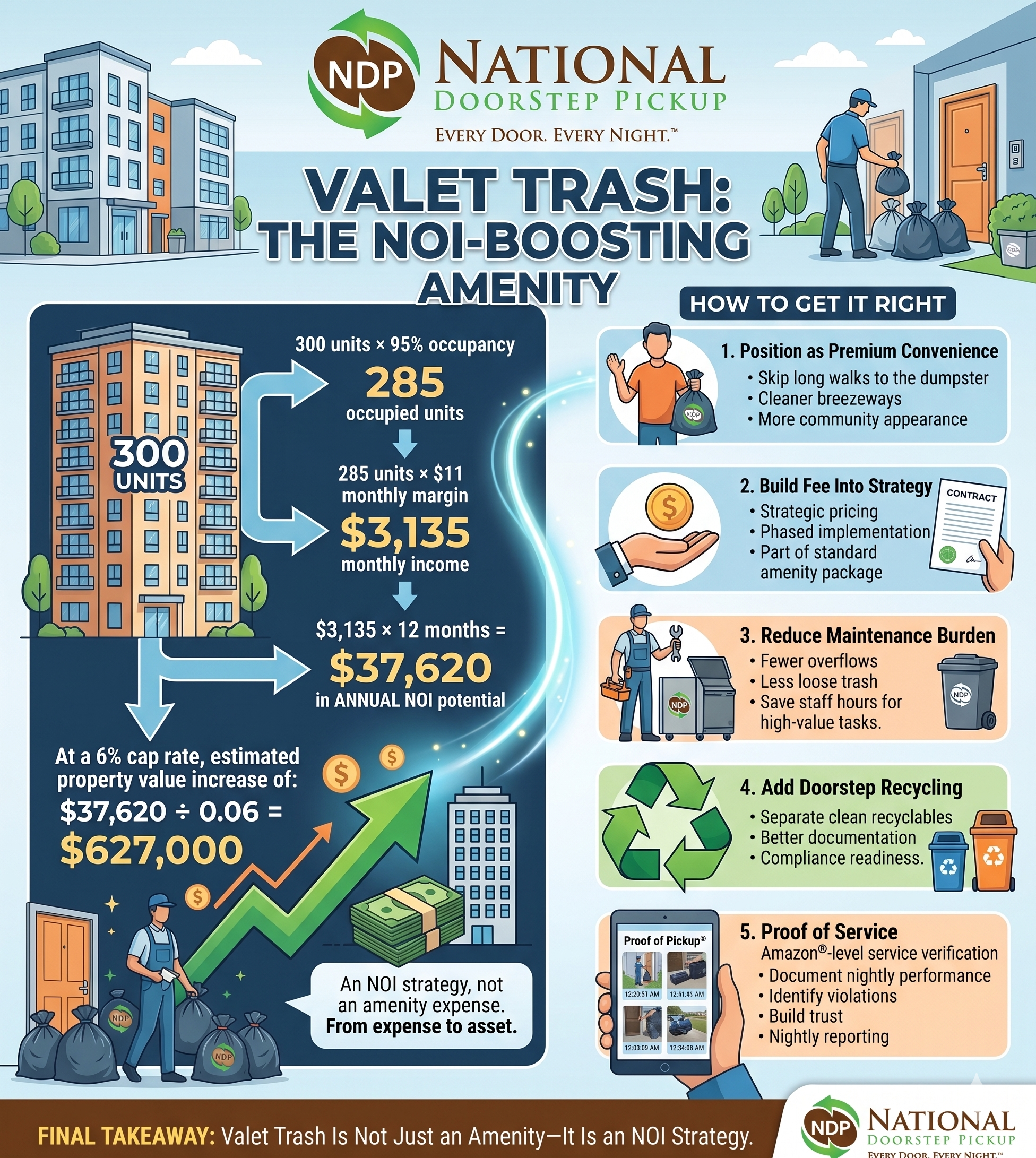
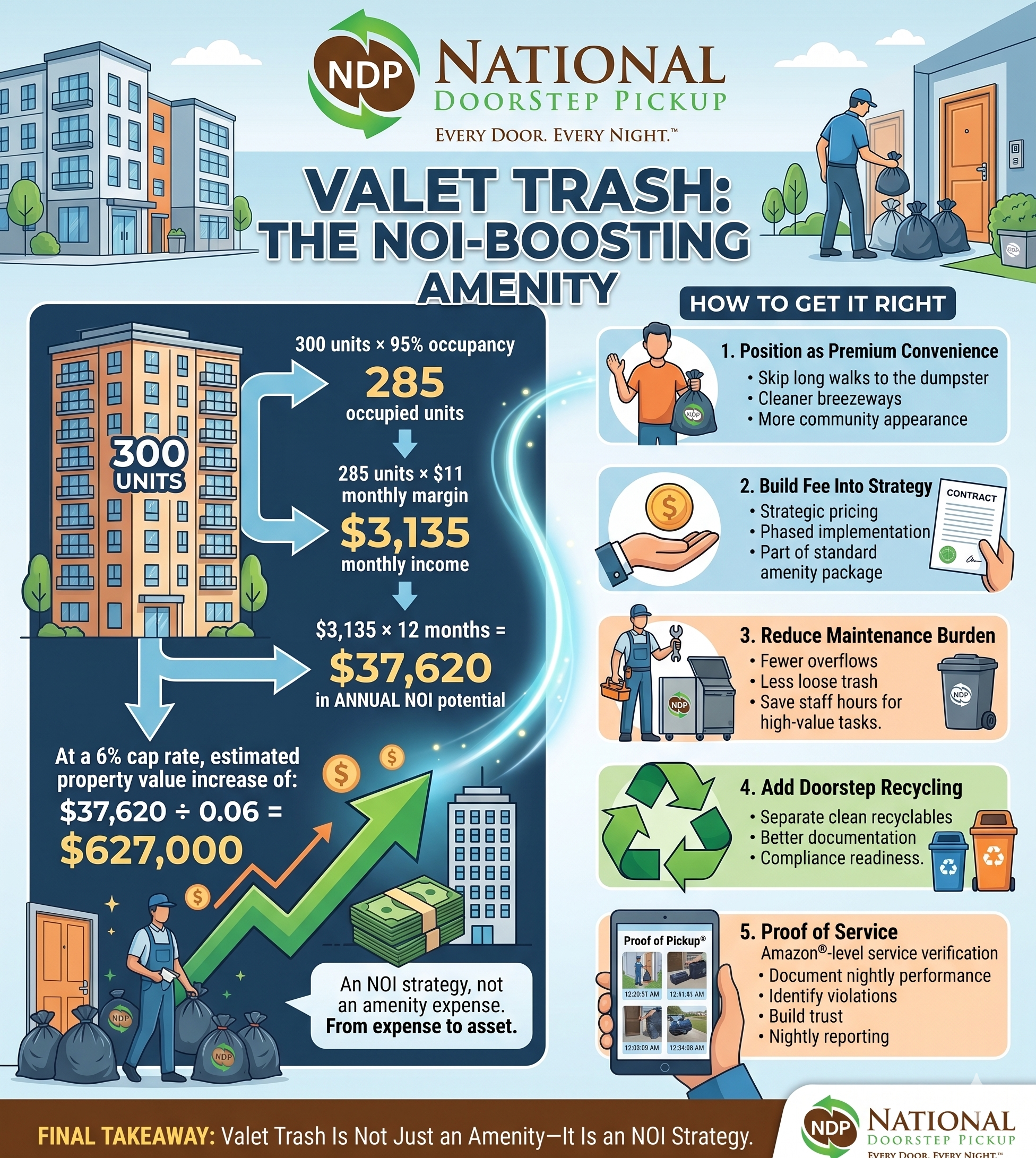
Example: How Valet Trash Can Create Ancillary Revenue
Let’s say a 300-unit apartment community adds valet trash service.
At a 6% cap rate, that income could support an estimated property value increase of:
The Mistake: Treating Valet Trash Like a Vendor Expense
Many communities underperform with valet trash because they treat it like a simple vendor line item.
That approach misses the point.
Valet trash should be managed like an amenity, a compliance support system, and an operational efficiency tool.
A low-cost provider that creates missed pickups, resident complaints, hallway leaks, or poor documentation can damage the entire program. When residents do not trust the service, they push back against the fee. When managers do not have proof of performance, they lose confidence. When ownership cannot see the financial lift, the amenity gets questioned.
The right model requires:
Reliable nightly collection
Clear resident rules
Strong communication
Documented service verification
Consistent enforcement
Recycling alignment where applicable
Clean reporting for property teams
That is how valet trash moves from expense to asset.
Step 1: Position Valet Trash as a Premium Convenience Amenity
Residents are more likely to accept a monthly valet trash fee when they understand what they are paying for.
Do not position it as “trash pickup.”
Position it as:
Doorstep convenience
Cleaner breezeways and hallways
No more long walks to the dumpster at night
Better community appearance
A safer, simpler evening routine
Less overflow around dumpsters and compactors
The message should be resident-focused.
Instead of saying:
We are adding valet trash service for the community.
Say:
Starting soon, residents will be able to place tied trash bags outside their door during the evening collection window and skip the walk to the dumpster. This service is designed to make daily living easier while helping keep the community cleaner.
That framing matters.
Residents do not buy trash service.
They buy convenience.
Step 2: Build the Amenity Fee Into the Revenue Strategy
Valet trash creates the strongest NOI impact when the pricing strategy is intentional.
Common structures include:
Monthly resident amenity fee
A fixed valet trash charge added to the resident ledger.
Bundled amenity package
Valet trash included as part of a broader lifestyle or convenience package.
Phased-in pricing
New leases and renewals absorb the fee over time, reducing resident backlash.
Split rent-and-fee strategy
A portion is captured in rent growth and a portion is billed as a separate service fee.
For many communities, phased implementation is the cleanest path. Existing residents can be introduced with clear communication, while new residents see the service as part of the community’s standard amenity package.
The goal is simple:
Make the service feel expected, valuable, and professionally managed.
Step 3: Use Valet Trash to Reduce Maintenance Burden
Trash problems often look like resident behavior issues.
But many times, they are system design issues.
When dumpsters are too far away, compactors are inconvenient, trash rooms are confusing, or residents are moving out with oversized items, the result is predictable:
Overflowing dumpsters
Loose bags around compactors
Hallway trash complaints
Pest concerns
Maintenance cleanup
Poor curb appeal
Negative online reviews
Valet trash reduces access friction by creating a cleaner, easier disposal path.
The operational value is not just the time saved.
It is what the team gets back:
More time for work orders
Faster unit turns
Cleaner common areas
Better resident interactions
Less reactive cleanup
That is why valet trash should be discussed with maintenance supervisors and regional managers, not just leasing teams.
Step 4: Add Doorstep Recycling Where It Makes Sense
Doorstep recycling can strengthen the financial and compliance case for valet trash.
A valet recycling program can help by making recycling easier for residents and more visible for property managers.
Instead of relying only on distant recycling containers, the community can create a doorstep recycling behavior loop:
Residents separate clean recyclables.
Service teams collect on a defined schedule.
The property improves recycling capture.
Managers receive better documentation.
The community reduces avoidable waste friction.
For mandated markets, this can support compliance readiness.
Step 5: Protect the Program With Clear Rules
Valet trash works best when expectations are simple and enforceable.
Your resident instructions should clearly explain:
Collection days
Set-out window
Bag requirements
Weight limits
Prohibited items
Holiday schedule
Recycling rules
Bulk item process
Violation process
A strong set of rules prevents the most common problems: leaking bags, early set-outs, oversized items, loose trash, contamination, and blocked walkways.
Sample resident rule language:
Trash must be bagged, tied, and placed outside the apartment door during the approved collection window. Loose trash, leaking bags, hazardous materials, bulk furniture, and oversized items are not permitted as part of standard valet trash collection.
This protects the property, the service team, and the resident experience.
Step 6: Use Proof of Service to Build Trust
One of the biggest challenges with valet trash is proving what happened.
A resident says the bag was missed.
A porter says it was not outside.
A manager needs answers.
Ownership wants reporting.
That is where documentation matters.
A strong valet trash program should include service verification, route accountability, photo documentation when needed, and nightly reporting. This gives property managers the confidence to manage resident questions quickly and fairly.
That documentation helps protect the amenity fee because it proves the service is real, consistent, and professionally managed.
Step 7: Roll It Out Without Resident Backlash
The rollout can make or break the program.
Residents are less likely to object when the launch explains the “why” before the fee appears.
Your communication should answer:
Why is the community adding valet trash?
How does it make life easier?
When does service begin?
What nights are included?
What are the rules?
How much does it cost?
Who handles questions?
How are missed pickups reported?
The best rollout uses multiple touchpoints:
Resident email
Printed door notice
Lease addendum
FAQ page
Move-in packet update
Resident portal announcement
Leasing team talking points
Avoid surprising residents with a fee before they understand the value.
Lead with convenience, cleanliness, safety, and consistency.
Step 8: Tie the Amenity to Renewals and Reputation
Valet trash is especially valuable because it touches daily life.
Residents may forget about other amenities, but they notice when trash is easy.
They also notice when trash is a problem.
Overflowing dumpsters, leaking bags, pest issues, and messy trash rooms can quickly become renewal objections and online review triggers.
A well-run valet trash program can support:
Higher resident satisfaction
Cleaner breezeways
Better first impressions
Reduced trash complaints
Stronger renewal conversations
Improved leasing tours
More professional community operations
That matters because reputation has real financial impact.
A cleaner community is easier to tour, easier to renew, and easier to defend as a premium living experience.
Step 9: Track the Right KPIs
To turn valet trash into an NOI-boosting amenity, track it like one.
Key metrics include:
Monthly valet trash revenue
Service cost per occupied unit
Net monthly amenity margin
Resident participation rate
Trash complaints before and after launch
Missed pickup reports
Violation trends
Maintenance hours saved
Bulk trash incidents
Compactor pulls or dumpster overflows
Recycling capture, where applicable
The more data you collect, the easier it is to prove the program’s value to ownership.
This also helps regional managers compare performance across properties.
Step 10: Choose the Right Valet Trash Partner
Not all valet trash providers create the same financial outcome.
The cheapest provider may not be the most profitable if poor execution creates complaints, refunds, staff burden, or resident resistance.
Look for a partner that understands:
Multifamily operations
Resident communication
Nightly route consistency
Doorstep recycling
Compliance documentation
Property manager reporting
Bulk trash coordination
Service verification
Scalable regional support
The right provider should not just pick up bags.
They should help protect the value of the amenity.
Valet Trash ROI Formula for Apartment Communities
Here is a simple way to estimate the revenue opportunity:
Occupied Units × Monthly Resident Fee = Gross Monthly Valet Trash Revenue
Then:
Gross Monthly Revenue − Monthly Service Cost = Net Monthly NOI Contribution
Then:
Net Monthly NOI × 12 = Annual NOI Contribution
To estimate potential asset value impact:
Annual NOI Contribution ÷ Market Cap Rate = Estimated Property Value Impact
Example:
This is why valet trash should be evaluated as more than an amenity expense.
It can be an income-producing operating strategy.
Common Valet Trash Mistakes That Reduce NOI
Charging the Fee Without Selling the Value
Residents need to understand the convenience before they accept the charge.
Using Weak Resident Communication
Confusion creates complaints. Clear rollout materials prevent friction.
Ignoring Recycling Opportunities
In many markets, recycling can support compliance, cost control, and sustainability goals.
Choosing the Lowest-Cost Provider
Missed pickups and poor reporting can destroy trust in the amenity.
Failing to Track Performance
If you do not measure the value, you cannot prove the NOI impact.
Letting Bulk Trash Become a Separate Problem
Move-out furniture, mattresses, and oversized items need a clear process.
High-Converting Resident FAQ
Is valet trash worth it for apartment residents?
Yes. Valet trash saves residents time by eliminating routine trips to the dumpster or compactor. It is especially valuable at larger communities, garden-style apartments, senior living communities, and properties where waste areas are far from apartment homes.
How does valet trash increase apartment NOI?
Valet trash can increase NOI by creating recurring ancillary income through a resident amenity fee while also reducing waste-related maintenance burden, dumpster overflow, resident complaints, and cleanup costs.
Can valet trash help with apartment recycling?
Yes. Doorstep recycling can make recycling easier for residents and help properties improve recycling participation, reduce contamination, and support local compliance goals where multifamily recycling requirements exist.
Should valet trash be required or optional?
What makes a valet trash program successful?
A successful program needs clear resident rules, consistent nightly service, strong communication, service verification, manager reporting, and a provider that understands multifamily operations. For more in-depth frequently asked questions, click here.
Final Takeaway: Valet Trash Is Not Just an Amenity — It Is an NOI Strategy
The best multifamily operators are not just adding amenities.
They are adding amenities that solve operational problems, improve resident experience, and strengthen property performance.
Valet trash does all three when executed correctly.
It gives residents a convenience they use every week.
It gives managers a cleaner, more controlled waste system.
It gives owners a recurring income opportunity.
It gives asset managers a measurable NOI lever.
That is the real opportunity.
When valet trash is priced, communicated, documented, and managed correctly, it becomes more than doorstep pickup.
It becomes a nightly system for cleaner communities, happier residents, and stronger multifamily returns.