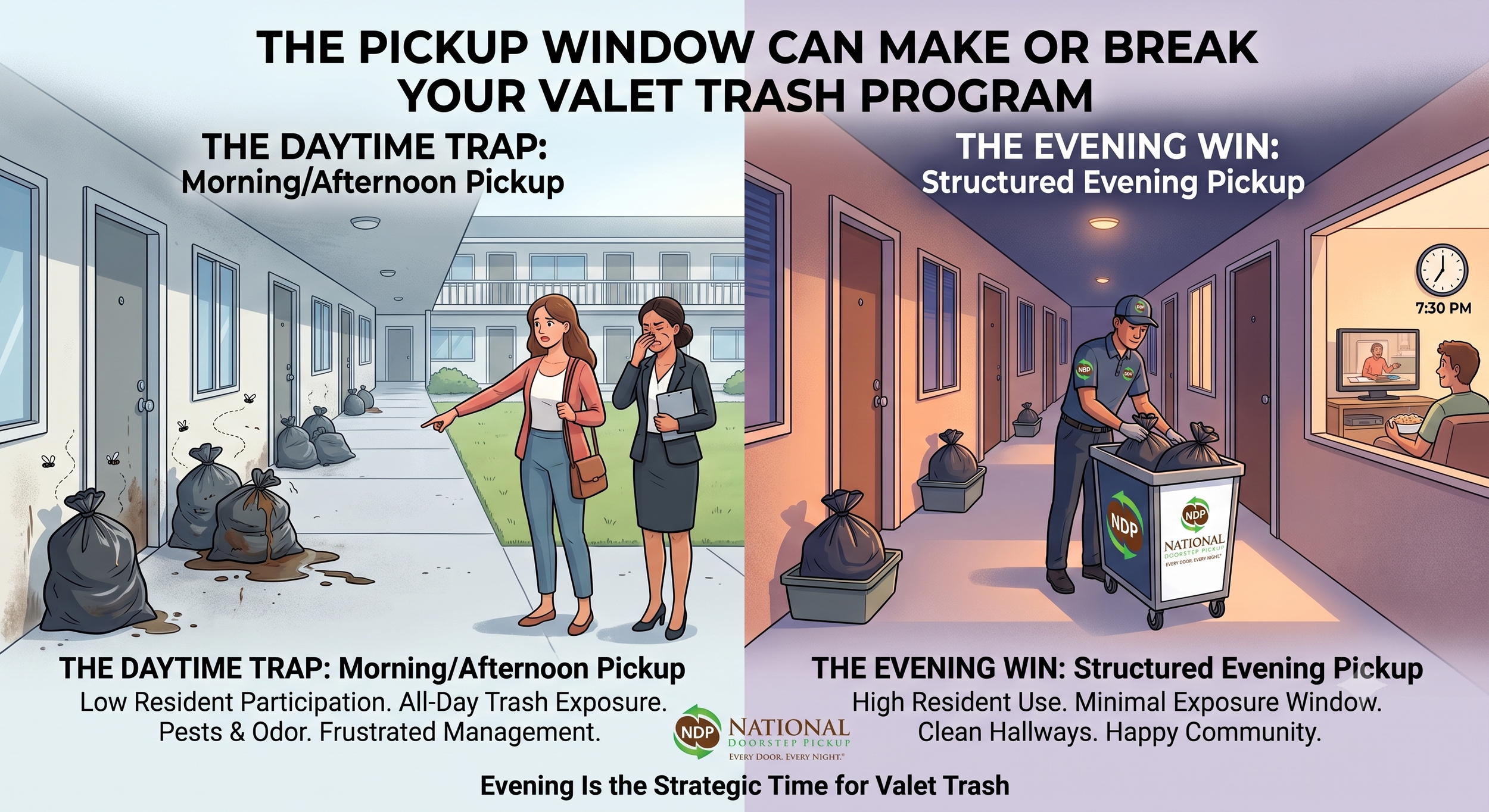
The Pickup Window Can Make or Break Your Valet Trash Program
By Les Leith, CEO & COO at National Doorstep Pickup
Valet trash sounds simple on paper.
Residents place bagged trash outside their door. A porter collects it. The property stays cleaner. Residents enjoy a convenient amenity. Property managers reduce trash complaints, protect curb appeal, and create a cleaner daily rhythm for the community.
But one operational detail determines whether valet trash feels seamless or frustrating:
The pickup window.
Set the window too early, and residents miss it after work, dinner, errands, school activities, or commute delays. Set it too late, and bags sit outside longer than necessary, creating odor, hallway clutter, pest concerns, and resident complaints. Set it inconsistently, and both residents and property teams lose trust in the program.
For most apartment communities, the best valet trash pickup window is in the evening — after residents have returned home, but before trash has sat outside all night.
At National Doorstep Pickup, our service model is built around the way residents actually live. Residents place tied bags outside during an approved early-evening set-out window, and collection occurs later that evening during a structured pickup window.
That timing is not random.
It is cleaner, safer, more resident-friendly, and better for property operations.
Why Evening Is the Best Time for Valet Trash Pickup
The best valet trash program works with the natural rhythm of apartment living.
Most residents are not thinking about trash at 10:00 AM. They are working, commuting, attending class, running errands, managing kids, or simply not home. Morning and afternoon pickup windows may sound efficient on a spreadsheet, but in real communities they often create more missed pickups, more exceptions, and more resident confusion.
Evening service works better because it matches the daily pattern of the property.
Residents come home. They prepare dinner. They clean up. They tie off their kitchen trash. They place bags outside during the approved set-out window. Then porters collect the trash before it becomes an overnight issue.
That simple sequence is what makes evening valet trash service so effective.
The right pickup window should support four goals at once:
Resident convenience
Property cleanliness
Porter safety
Operational accountability
Evening pickup is one of the few service windows that can realistically support all four.
The Ideal Resident Set-Out Window
A strong valet trash program should separate the resident set-out window from the porter pickup window.
The resident set-out window is the time residents are allowed to place trash outside their door. For many communities, an ideal set-out window is:
6:00 PM to 8:00 PM
This gives residents enough time to return home, prepare dinner, clean up, and place tied trash bags outside before service begins.
A clear set-out window also prevents doorside trash from appearing throughout the day. That matters because all-day trash exposure makes hallways, breezeways, elevators, stairwells, and common areas feel neglected.
The goal is not simply to remove trash.
The goal is to control when trash appears, how long it remains visible, and how quickly it disappears.
When residents understand the set-out window, the property looks cleaner, porters can work more efficiently, and management has a clearer basis for enforcing the program.
The Ideal Valet Trash Pickup Window
Once residents have had time to place trash outside, the porter pickup window should begin later in the evening.
For many multifamily communities, a strong service window is:
8:00 PM to 12:00 AM, Sunday through Thursday
This timing works well because it gives residents a predictable routine while allowing porters enough time to complete the property thoroughly.
An evening pickup window helps accomplish several important things:
Residents are more likely to be home.
Trash is not sitting outside all day.
Property teams reduce next-day complaints.
Daytime curb appeal stays stronger.
Porters avoid the most intense daytime summer heat.
Routes can be documented, verified, and improved.
This is especially important in garden-style communities, mid-rise apartments, high-rise buildings, senior living communities, and student housing, where access, timing, elevators, breezeways, stairs, parking lots, compactors, trash rooms, and resident traffic all affect the route.
Why Morning Pickup Usually Creates Problems
Morning pickup may sound clean and efficient, but in most apartment communities it creates a participation problem.
Residents often forget to place trash outside before leaving for work. Others set it out the night before, which means bags sit outside for hours. That defeats one of the main purposes of valet trash: reducing visible waste and improving the resident experience.
Morning pickup can also compete with property operations. Maintenance teams, vendors, leasing appointments, package deliveries, school traffic, and resident departures are often active during the morning rush.
When trash collection overlaps with peak morning movement, the service can feel disruptive instead of convenient.
Even worse, morning pickup can train residents to place trash outside overnight. That leads to odor, pests, leaks, stained breezeways, hallway clutter, and more complaints.
For most properties, morning pickup solves one problem while creating several more.
Why Afternoon Pickup Is Usually Too Early
Afternoon valet trash pickup is often too early for resident behavior.
Many residents are not home yet. Trash generated from dinner, evening cleanup, pet waste, daily household routines, and end-of-day activity has not been bagged yet. The result is predictable: low participation and more missed pickups.
If the porter comes too early, residents either miss service entirely or start placing trash outside earlier in the day. Both outcomes weaken the program.
Afternoon pickup can also damage leasing impressions. Bags outside doors during tours can hurt curb appeal, especially in mid-rise and high-rise communities where prospects may walk corridors, ride elevators, or pass common areas before signing a lease.
A good valet trash pickup window should support leasing, resident satisfaction, cleanliness, and property presentation.
Afternoon pickup often works against all four.
Why Evening Pickup Supports Porter Safety
Evening valet trash service is not just better for residents.
It can also be better for porter safety, especially during the summer.
Valet trash porters perform physical work. They walk routes, climb stairs, move through breezeways, handle bags, transport trash to compactors or dumpsters, and may work across large communities with multiple buildings. During hot months, that work becomes more demanding.
In many markets, daytime heat can create serious safety concerns. Garden-style properties with long walking routes, stair-heavy buildings, asphalt parking lots, limited shade, and high humidity can place additional strain on porters.
That is one major reason evening service makes sense.
By shifting collection away from the hottest part of the day, communities can reduce exposure to peak summer heat while still giving residents a convenient service window.
Evening pickup does not eliminate heat risk, but it can help reduce it.
A responsible valet trash program should treat porter safety as part of service quality. When porters are safer, routes are more consistent. When routes are more consistent, residents and property teams get better results.
Summer Heat Safety Should Be Built Into the Pickup Window
During the summer, the pickup window should be designed with heat stress prevention in mind.
That means property teams and valet trash providers should think beyond convenience. They should consider the physical conditions porters face while servicing the community.
A safer summer program may include:
Evening routing to avoid peak daytime heat
Hydration before, during, and after routes
Access to water or planned water stops
Reasonable route pacing
Rest breaks when heat conditions require them
Lighter route loads for new or returning porters during acclimation
Clear check-in procedures
Buddy systems or supervisor monitoring when appropriate
Proper lighting for safe evening collection
Reflective or high-visibility gear where vehicle traffic is present
Clear access to compactors, dumpsters, and trash rooms
Use of carts, tilt trucks, or proper equipment where needed
Training on warning signs of heat illness
A clear stop-work and escalation process if a porter feels unsafe
The best valet trash pickup window is not just the one residents like.
It is the one that allows the service to be completed safely, consistently, and professionally.
Heat Stroke Prevention Matters in Valet Trash Operations
Heat stroke and serious heat illness are not abstract risks for outdoor or semi-outdoor workers.
Valet trash routes may include long walking distances, stairs, enclosed corridors, hot breezeways, parking lots, trash rooms, compactor areas, and repeated lifting. In humid or high-temperature markets, the physical load can increase quickly.
A smart evening pickup window helps reduce exposure, but it should be paired with common-sense safety standards.
Porters should be encouraged to hydrate before they are thirsty, take rest breaks when needed, and report early symptoms such as dizziness, confusion, nausea, headache, weakness, heavy sweating, cramps, or feeling faint.
Supervisors should take heat-related concerns seriously. A porter who is showing signs of heat illness should not be pushed to “finish the route” without evaluation and support.
Clean communities matter.
Resident satisfaction matters.
But no pickup window is worth compromising worker safety.
Evening Pickup Helps Reduce Odor and Pest Issues
Trash problems are often timing problems.
The longer bags sit outside, the more likely they are to create odor, attract pests, leak, or become a resident complaint.
Evening pickup minimizes that exposure window.
Instead of residents placing trash outside in the morning, afternoon, or overnight, the community creates a controlled rhythm. Trash appears during a short set-out period and is removed during a predictable service window.
That is especially important during warmer months, in humid markets, and in communities with interior corridors or elevator access.
For high-rise and mid-rise apartments, timing becomes even more critical. Trash left too long in enclosed hallways can create odor issues quickly. A smart evening pickup window protects the indoor resident experience.
For garden-style communities, evening pickup helps prevent trash from sitting in breezeways, stairwells, and building entrances throughout the heat of the day.
Evening Pickup Improves Resident Participation
The best amenity is the one residents actually use.
That matters because valet trash is not only an operations service.
It is a resident-facing amenity.
When residents can easily use the service, they value it more. When they value it more, the property can better defend amenity fees, improve satisfaction, and position valet trash as part of the lifestyle experience.
A poorly timed pickup window turns valet trash into a complaint generator.
A well-timed evening pickup window turns it into a convenience residents notice every week.
Evening Service Supports Cleaner Leasing Impressions
Prospects judge a property fast.
Trash outside doors, overflowing compactors, stained breezeways, leaking bags, and visible waste near common areas can damage the first impression before the tour even begins.
Evening pickup helps protect daytime curb appeal.
By collecting trash after normal leasing activity, the property can keep walkways, corridors, elevators, breezeways, leasing paths, and common areas cleaner during the hours when prospects, vendors, ownership groups, and regional managers are most likely to visit.
That gives property teams a cleaner-looking asset during the day without sacrificing resident convenience at night.
In competitive multifamily markets, that matters.
Your trash program should not work against your leasing team.
Evening Pickup Creates Better Route Accountability
A defined evening pickup window also improves porter accountability.
When the service window is consistent, routes can be measured, verified, and improved. Property teams can track whether collections occurred, when they occurred, and where issues appeared.
This is where photo verification and route documentation become especially valuable.
With a structured evening window, management can see whether the issue was a missed pickup, a late set-out, a non-compliant item, or a resident placing trash outside after service.
That distinction matters.
Without a clear pickup window, every issue feels like a vendor problem. With a clear window and verification process, the property has better visibility and fewer unnecessary disputes.
The Right Pickup Window Depends on the Property Type
Evening is usually the best foundation, but the exact window should be tailored to the community.
Garden-Style Apartments
Garden-style communities often have spread-out buildings, breezeways, stairs, surface parking, and multiple collection points.
Evening pickup works well because residents can place trash outside after dinner, and porters can service buildings in a mapped route after peak daytime heat and leasing traffic have passed.
The key is giving porters enough time to complete the full property without rushing, especially during summer months when hydration and pacing matter.
Mid-Rise Apartments
Mid-rise communities often involve interior corridors, elevators, trash rooms, controlled access points, carts, and compactors.
Evening pickup helps reduce daytime corridor clutter and keeps the building presentation stronger during leasing hours.
For these properties, leak prevention, elevator timing, cart handling, and odor control are especially important.
High-Rise Apartments
High-rise communities require the most disciplined timing.
Elevators, service corridors, trash chutes, loading docks, compactors, resident traffic, and security access can all affect the route.
Evening pickup works best when it is coordinated with building access rules and designed to avoid peak elevator congestion.
Senior Living Communities
Senior living communities may require earlier evening communication and very clear rules.
Residents benefit from predictability, and property teams should avoid service windows that are confusing, inconsistent, or too disruptive.
Student Housing
Student housing often needs stricter enforcement because residents may test boundaries.
Evening service is still the right fit, but the program needs strong communication, reminders, documented non-compliance procedures, and consistent follow-through.
The Biggest Mistake: Letting Trash Sit Out Too Long
The biggest mistake in valet trash scheduling is not choosing the “wrong” hour.
It is allowing the exposure window to become too long.
If residents can place trash outside at 4:00 PM and pickup does not happen until midnight, that is an eight-hour exposure window.
If residents place bags outside overnight for morning pickup, that can become a ten- to twelve-hour exposure window.
That is when communities start seeing the problems everyone wants to avoid:
Odors
Leaks
Stains
Pests
Hallway clutter
Resident complaints
Bad leasing impressions
Non-compliance issues
Overflow around compactors and trash rooms
The cleaner strategy is simple:
Short set-out window. Predictable evening pickup. Clear enforcement. Verified service. Safe routing.
How to Communicate the Pickup Window to Residents
Even the best pickup window fails if residents do not understand it.
Your valet trash policy should be simple enough to remember and easy enough to follow.
A strong resident message might look like this:
“Please place tied trash bags inside your approved container outside your door between 6:00 PM and 8:00 PM on scheduled service nights. Collection begins after 8:00 PM. Trash placed outside after collection may not be picked up until the next scheduled service night.”
That message does three important things.
First, it tells residents when to set trash out.
Second, it tells them when collection begins.
Third, it makes late set-outs clear without blaming the porter or property team.
The goal is to remove ambiguity before it becomes a complaint.
How Many Nights Per Week Should Valet Trash Run?
For many communities, five-night service is the operational sweet spot.
A Sunday through Thursday schedule works especially well because it covers the heaviest household trash patterns while giving residents a predictable routine before the weekend.
Sunday service is important because residents often generate more trash over the weekend. Monday through Thursday service keeps the property clean throughout the core week.
The right schedule depends on occupancy, property type, resident profile, compactor capacity, local waste logistics, and community rules, but most apartment communities benefit from consistent weekday evening service.
The Best Valet Trash Window Is Resident-Friendly, Property-Friendly, and Porter-Safe
A valet trash pickup window should not be chosen only for vendor convenience.
It should be chosen around the full operating reality of the property:
When residents are actually home
When trash is most likely to be generated
When leasing traffic is highest
When common areas need to look their best
When porters can safely complete the route
When summer heat exposure can be reduced
When compactors, dumpsters, and trash rooms are accessible
When trash can be removed before it becomes an odor, pest, or appearance issue
That is why evening service is usually the best answer.
It gives residents convenience without turning the property into an all-day trash staging area.
It also gives porters a safer, more practical service window during hot weather, especially in summer markets where daytime heat can create real operational and health risks.
The National Doorstep Pickup Approach
At National Doorstep Pickup, we build valet trash and doorstep recycling programs around consistency, accountability, resident convenience, and professional service execution.
Our evening service model is designed to support cleaner communities, stronger resident satisfaction, safer routes, and better property presentation.
We help apartment communities set practical pickup windows, communicate service rules, improve participation, reduce missed pickups, protect curb appeal, and support safer porter operations.
Because when the timing is right, valet trash becomes more than a service.
It becomes a cleaner, easier, NOI-supporting amenity residents actually use.
Final Takeaway: Evening Wins
The right valet trash pickup window should make life easier for residents, property teams, and porters.
Morning pickup often encourages overnight set-outs. Afternoon pickup misses too many residents. Unstructured late-night pickup creates confusion. Daytime summer routes can increase heat exposure for porters.
Evening pickup works because it fits real apartment life.
Residents are home. Trash is ready. Porters can avoid the worst daytime heat. The property looks cleaner the next day.
For most multifamily communities, the winning formula is clear:
Early evening resident set-out. Structured evening pickup. Verified service. Clear communication. Porter-safe routing.
That is how you turn valet trash from a basic convenience into a clean, reliable, resident-loved amenity.
Ready to Set the Right Valet Trash Pickup Window?
National Doorstep Pickup helps multifamily communities design cleaner, safer, more reliable valet trash and doorstep recycling programs built around the way residents actually live.
Request a proposal today and discover how the right evening pickup window can improve resident satisfaction, reduce complaints, support porter safety, and protect your property’s curb appeal.