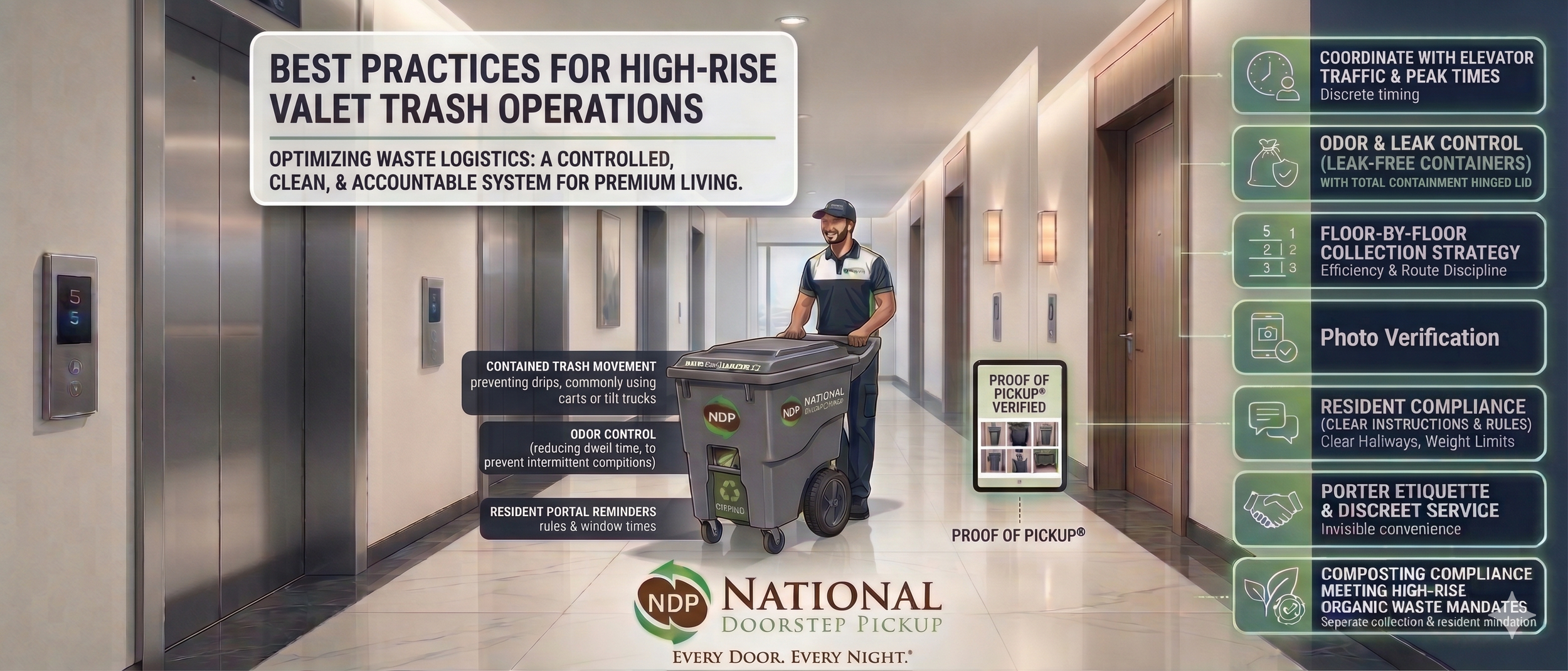
By Les Leith, CEO & COO at National Doorstep Pickup
High-rise apartment living comes with one major expectation: convenience without chaos.
Residents want hotel-style service. Property managers want clean corridors, quiet elevators, odor control, fewer complaints, and a waste program that does not turn the building into a nightly logistics problem.
That is where valet trash becomes more than an amenity.
In high-rise apartments, valet trash is an operational system. When it is done correctly, it protects your building, improves the resident experience, supports lease value, and keeps waste from piling up in elevators, trash rooms, chutes, and loading areas.
When it is done poorly, the problems show up fast: leaking bags, hallway odors, elevator delays, missed pickups, compactor backups, angry residents, and unnecessary staff headaches.
Here are the best practices every high-rise apartment community should follow.
Why High-Rise Valet Trash Is Different
Valet trash in a garden-style or mid-rise community is usually route-based and exterior-focused. High-rise service is different because everything moves through shared interior spaces.
That means the valet trash program must account for:
Long vertical travel times
Elevator scheduling and resident traffic
Central corridors
Trash rooms and chute rooms
Loading dock access
Compactor timing
Odor control
Leak prevention
Noise control
Fire code and egress safety
Resident compliance by floor
1. Use a Floor-by-Floor Collection Strategy
The biggest mistake high-rise communities make is treating the building like one large route.
High-rise valet trash works best when it is broken into controlled floor zones.
A strong route plan should define:
Which floors are collected first
Which elevator is used for service
Where bags are transferred
How trash moves from corridors to carts
How full carts move to the compactor or disposal area
What happens when an elevator is delayed or unavailable
This prevents random movement through the building and keeps porters focused, efficient, and accountable.
2. Require Tight, Bagged, Leak-Free Trash
High-rise buildings have less margin for error. A leaking bag in a garden-style community is a nuisance. A leaking bag in a high-rise corridor or elevator can become a resident complaint, flooring issue, odor issue, and service failure.
Residents should be required to:
Use tied trash bags
Avoid loose trash in containers
Double-bag wet waste when needed
Keep liquids out of trash bags
Break down boxes separately
Follow pickup window rules
Clear resident instructions reduce mess, prevent odor, and protect interior finishes.
3. Use Carts or Tilt Trucks to Prevent Indoor Drips
High-rise valet trash should never rely on porters carrying loose bags through long corridors, elevators, or amenity-level hallways.
The better practice is to use properly sized trash carts, covered carts, or tilt trucks where the building layout allows it.
This matters because carts help:
Reduce dripping in corridors
Protect elevator flooring
Improve porter efficiency
Prevent bag dragging
Reduce repeated trips
Keep collection more professional and contained
For high-rise apartments, equipment selection is not a small detail. It is one of the difference-makers between a clean service and a complaint-heavy one.
4. Coordinate Service Around Elevator Traffic
Elevators are the heartbeat of a high-rise property. If valet trash service competes with peak resident traffic, complaints will follow.
Best practice is to schedule service after the evening resident rush but before trash sits out too long.
Property managers should consider:
Resident return-home traffic
Package delivery volume
Move-ins and move-outs
Amenity floor activity
Freight elevator availability
Service elevator restrictions
Quiet hours
The right timing keeps service discreet and minimizes disruption.
5. Keep Hallways Clear and Code-Friendly
Valet trash should improve the property, not create a hallway obstacle course.
Containers and bags should never block:
Stairwells
Fire doors
Exit paths
Elevator lobbies
ADA access routes
Mechanical rooms
Trash chute access
High-rise communities should provide residents with specific placement instructions. A simple rule works best: place trash neatly outside the unit during the approved window only, without blocking the corridor.
6. Build a Clear Cardboard and Recycling Process
High-rise communities often struggle with cardboard because residents receive frequent deliveries and large boxes do not fit neatly into trash bags or chutes.
A strong program should separate regular bagged trash from oversized cardboard and recycling.
Best practices include:
Requiring residents to flatten cardboard
Creating designated cardboard collection rules
Using clear blue bags for recycling where applicable
Preventing boxes from blocking chute rooms
Scheduling bulk or overflow pickups when needed
Educating residents on what is acceptable
Cardboard is one of the most visible waste problems in high-rise apartments. When it is ignored, trash rooms fill fast.
7. Control Odors Before They Reach Residents
The best way to control odor is to reduce dwell time.
That means:
Enforcing set-out windows
Preventing overnight hallway trash
Removing trash consistently
Keeping carts clean
Addressing leaking bags immediately
Monitoring trash rooms and compactor areas
Communicating resident rules clearly
Odor control is not just about deodorizing. It is about operational discipline.
8. Use Photo Verification for Accountability
In a high-rise environment, property managers need more than “we picked it up.”
They need proof.
Photo verification helps confirm:
Service was completed
Trash was removed from specific areas
Non-compliant set-outs were documented
Overflow areas were checked
Missed pickup claims can be reviewed
Porter performance can be measured
National Doorstep’s Proof of Pickup® system gives property managers better visibility into nightly service, route activity, and issue documentation.
Learn more about Proof of Pickup® here:
https://www.nationaldoorsteppickup.com/valet-trash-porter-software
9. Create a Resident Compliance System
Even the best valet trash provider cannot overcome unclear resident rules.
High-rise communities should have simple, repeated instructions for:
Approved set-out times
Approved pickup days
Bag weight limits
Cardboard rules
Recycling rules
Prohibited items
Container placement
Holiday or service interruption procedures
Resident education should happen at move-in, renewal, email reminders, resident portals, and posted community notices.
The easier the rules are to understand, the easier they are to enforce.
10. Do Not Let Bulk Trash Become a Backdoor Problem
High-rise properties often see bulk waste from move-outs, furniture deliveries, package overflow, and resident cleanouts.
Bulk trash should not be handled casually through standard nightly valet trash service unless it is specifically included in the program.
Best practice is to create a separate process for:
Mattresses
Furniture
Large boxes
Appliances
Move-out piles
Construction debris
Oversized household items
Without a bulk plan, these items end up in trash rooms, loading docks, stairwells, or beside compactors.
11. Train Porters for High-Rise Etiquette
High-rise service requires more than collection speed. Porters are working inside a premium residential environment.
Porters should be trained on:
Elevator etiquette
Quiet service
Professional appearance
Cart handling
Resident interaction
Spill response
Service route discipline
Building access rules
Photo documentation
Escalation procedures
The best valet trash service feels almost invisible to residents, but highly visible to management through reporting and accountability.
12. Align Valet Trash With the Compactor Schedule
A high-rise trash program can fail at the compactor even if every floor was collected correctly.
The nightly route must align with:
Compactor capacity
Hauler pickup schedule
Loading dock access
Trash room layout
Overflow procedures
Weekend volume
Move-out periods
Holiday surges
When compactor timing is ignored, trash backs up and the whole building feels it.
Why National Doorstep Is Built for High-Rise Apartment Communities
National Doorstep helps apartment owners, managers, and operators turn valet trash into a cleaner, more controlled, higher-value resident amenity.
Our high-rise service model focuses on:
Interior-friendly collection procedures
Carts and equipment designed to reduce mess
Floor-by-floor route planning
Photo verification through Proof of Pickup®
Resident compliance support
Recycling and cardboard coordination
Professional porter standards
Clean, consistent nightly execution
High-rise apartments need more than someone to “take out the trash.” They need a waste logistics partner that understands vertical buildings, shared corridors, elevators, trash rooms, compactors, ventilation, and resident expectations.
That is where National Doorstep delivers.
Final Takeaway: High-Rise Valet Trash Must Be Controlled, Clean, and Accountable
Valet trash can be one of the most appreciated amenities in a high-rise apartment building, but only when it is managed with precision.
The winning formula is simple:
Clean corridors.
Contained trash movement.
Clear resident rules.
Reliable nightly service.
Photo-verified accountability.
A provider that understands high-rise operations.
When all of those pieces work together, valet trash becomes more than convenience. It becomes a resident satisfaction tool, an operations upgrade, and a premium amenity that supports property performance.
Ready to improve valet trash service at your high-rise apartment community?
Request a proposal from National Doorstep today: