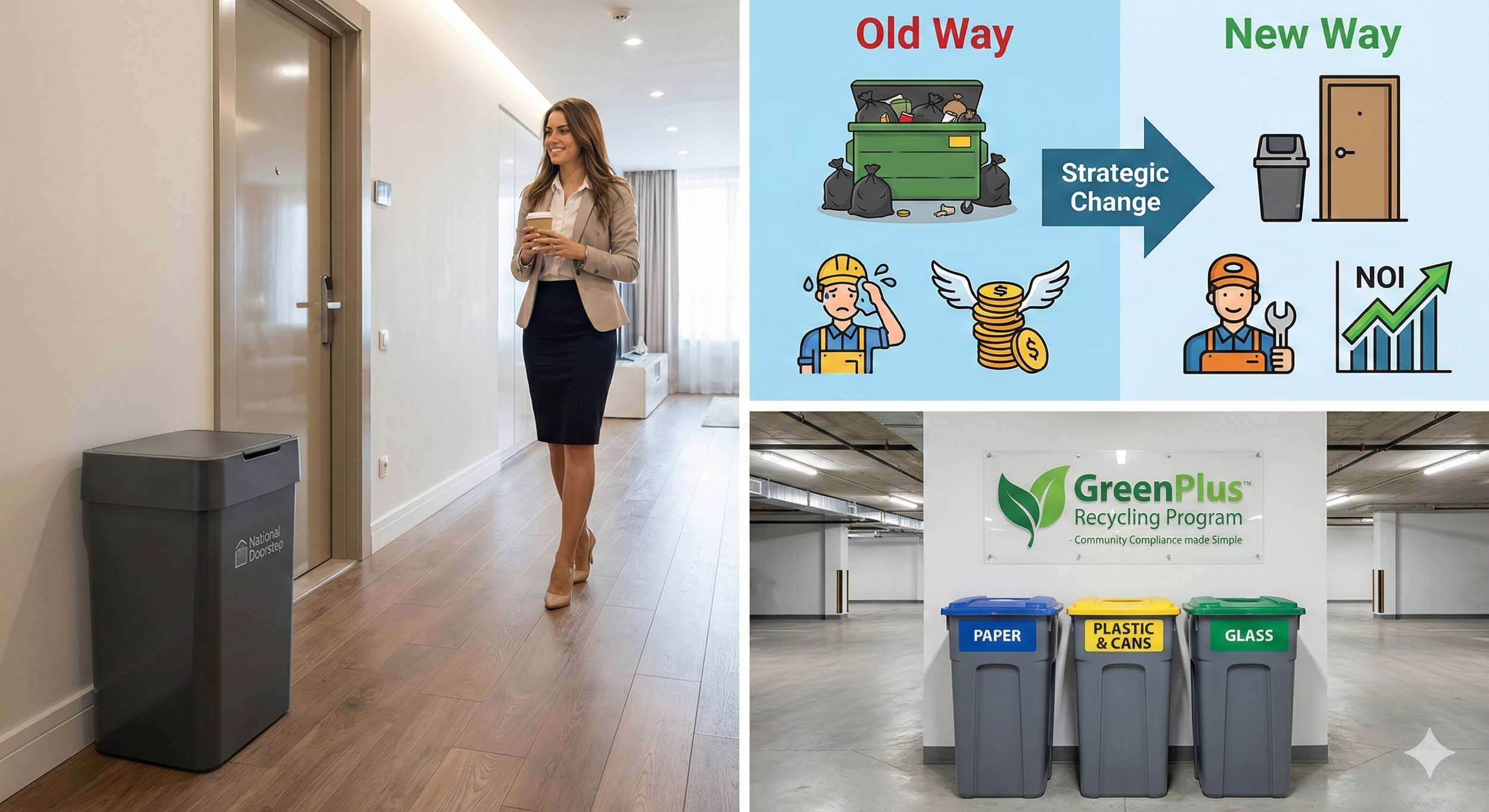
Why Smart Property Managers Are Rethinking Waste & Recycling—and How It Directly Impacts NOI
Waste & Recycling Strategies Every Multi-Family Property Manager Should Know
By Les Leith, CEO & COO at National Doorstep Pickup
In today’s competitive multifamily landscape, waste and recycling are no longer background operations. They are resident-facing amenities, compliance obligations, and controllable cost centers that directly influence satisfaction, renewals, and property value.
Residents expect convenience. Cities expect compliance. Owners expect efficiency and margin protection.
The properties that win long-term are the ones that treat waste and recycling as a strategic system, not a dumpster behind the building.
This guide breaks down the why, what, and how of modern multifamily waste and recycling strategy—and how services like valet trash service and recycling have become essential tools for high-performing property management teams.
Key Takeaways for Property Management
Resident Experience Is Revenue Protection
Convenient, reliable waste and recycling—especially doorstep valet trash service—drives satisfaction, renewals, and competitive differentiation.Operational Control Lowers Costs
Audits, right-sized hauling, and contamination reduction reduce overflow fees, emergency pickups, and staff time drains—protecting NOI.Sustainability Is No Longer Optional
Recycling compliance and visible environmental stewardship improve marketability, investor confidence, and regulatory standing.
Why Waste & Recycling Strategy Matters More Than Ever
For multifamily properties, waste touches every resident, every day. When it works, no one complains. When it fails, it becomes one of the fastest sources of negative reviews, service requests, and lease friction.
Modern property management must balance three pressures:
Rising resident expectations
Increasing municipal recycling mandates
Escalating hauling and landfill costs
A reactive approach—adding dumpsters, responding to overflows, chasing contamination issues—no longer works. Strategic communities are shifting toward proactive, resident-centric systems that solve problems upstream.
Resident Satisfaction, Retention & Market Advantage
Residents don’t think in terms of “waste infrastructure.” They think in terms of effort.
How far do I have to walk?
Is the area clean and safe?
Does recycling feel confusing or inconvenient?
When trash rooms overflow or recycling rules feel unclear, frustration builds quickly. By contrast, properties that implement doorstep valet trash service and recycling remove friction entirely—creating a premium living experience that residents notice and value.
Convenience directly correlates with renewals.
And renewals protect revenue far more efficiently than new leases.
Operational Efficiency & Cost Control
Poor waste strategy quietly erodes NOI.
Common cost leaks include:
Strategic waste planning—supported by audits and data—allows property management to:
Reallocate staff time to higher-value work
Waste doesn’t have to be a sunk cost. Managed correctly, it becomes a controlled expense.
Environmental Stewardship & Community Image
Residents and investors increasingly evaluate communities through a sustainability lens.
Visible recycling programs, clean waste areas, and clear education signal professional management and long-term thinking. Properties that ignore recycling compliance risk fines, failed inspections, and reputational damage.
Sustainability isn’t just about optics—it’s about future-proofing the asset.
The Most Common Waste Challenges in Multifamily Communities
Even well-managed properties face structural challenges that require intentional solutions.
Limited Space & Aging Infrastructure
Older properties weren’t designed for modern recycling volumes. Poor layout leads to clutter, confusion, and contamination.
High Resident Turnover
Every move-in resets recycling knowledge. Without systems, education gaps compound quickly.
Contamination & Improper Disposal
When residents guess, recycling fails—raising costs and undermining sustainability goals.
Missed Pickups & Irregular Service
Holidays, staffing issues, or miscommunication can trigger cascading overflows and complaints.
Accessibility & Equity
Residents with mobility limitations shouldn’t have to choose between convenience and compliance.
How to Build an Effective Recycling Program That Actually Works
Successful recycling programs are designed for behavior, not ideal scenarios.
1. Make Education Simple & Visual
Clear signage, quick-reference guides, and real-world examples outperform dense rule lists every time.
2. Design for Convenience
Recycling must be as easy—or easier—than trash. Proximity and clarity matter.
3. Monitor, Adjust, Communicate
Audits and walkthroughs reveal issues early. Sharing wins (diversion rates, reduced contamination) reinforces participation.
Boosting Recycling Rates Through Resident Engagement
Education isn’t a one-time event—it’s an ongoing system.
Reinforce guidelines during move-ins
Send seasonal reminders
Use visuals instead of paragraphs
Highlight positive outcomes, not just rules
Engaged residents don’t just comply—they participate.
Waste Audits: The Fastest Path to Cost Savings
Waste audits uncover what invoices don’t show.
They reveal:
Over-servicing
Underused recycling
Chronic contamination sources
Opportunities to reduce hauling frequency
When paired with resident education and right-sized service, audits often produce immediate, measurable savings.
Staying Compliant With Local Waste & Recycling Regulations
Municipal recycling rules are expanding—and enforcement is tightening.
Property management must stay ahead of:
Mandatory recycling ordinances
Container placement rules
Signage requirements
Documentation and reporting obligations
Compliance failures don’t just risk fines—they expose the property to operational disruption and reputational harm.
Why Property Managers Partner With National Doorstep GreenPlus™
Modern waste strategy requires more than bins and pickup schedules.
National Doorstep GreenPlus™ delivers a turnkey, resident-friendly system designed specifically for multifamily communities.
Doorstep Valet Trash & Recycling
Residents place materials outside their door—no hauling, no confusion, no complaints.
Cleaner Communities, Less Staff Burden
Centralized collection reduces overflow, litter, pests, and odor—while freeing maintenance teams from waste management.
Data-Driven Optimization
Track volumes, participation, and contamination to continuously improve performance and costs.
Integrated Community Solutions
Valet service pairs seamlessly with bulk item support, pet waste management, and sustainability initiatives—creating a cohesive resident experience.
Final Thoughts
Waste and recycling are no longer operational afterthoughts. They are resident amenities, compliance requirements, and financial levers.
Property managers who invest in education, optimization, and services like doorstep valet trash and recycling create cleaner communities, stronger renewals, and more resilient NOI.
Partnering with National Doorstep GreenPlus™ transforms waste from a problem into a performance advantage.
Frequently Asked Questions
How can recycling rates be improved in multifamily communities?
Make recycling convenient, visual, and consistent. Doorstep valet trash and recycling removes friction entirely.
What materials are typically recyclable?
Most municipalities accept paper, cardboard, plastics #1–#2, and aluminum. Always verify local rules.
How should residents be educated?
Move-in materials, signage, digital reminders, and ongoing reinforcement outperform one-time flyers.
What about hazardous waste and electronics?
These require special handling. Residents should be directed to approved drop-off locations or scheduled events. Always verify local rules.
Can valet trash service really impact NOI?
Yes. Higher renewals, fewer service issues, reduced labor strain, and controlled hauling costs directly protect margins.