By Les Leith, CEO & COO at National Doorstep Pickup
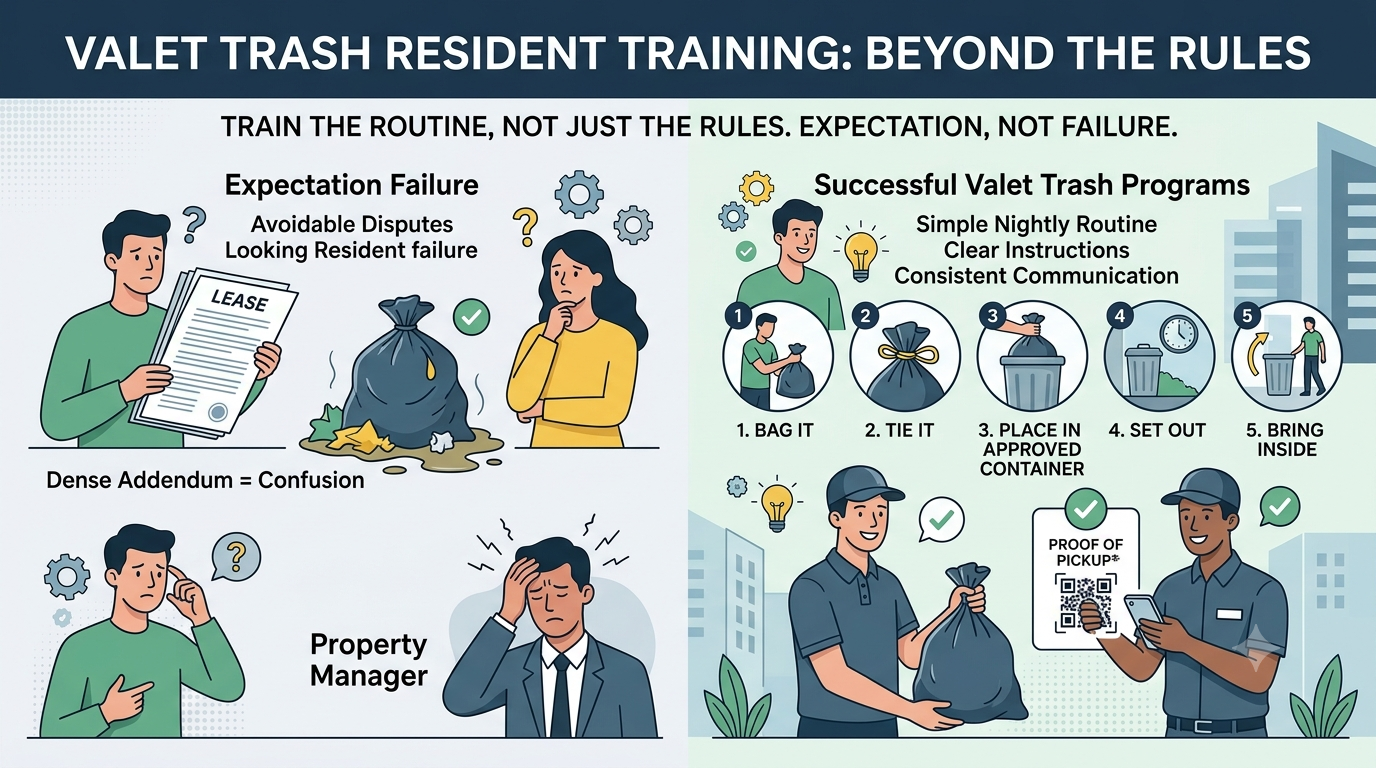
Most valet trash complaints are not pickup failures. They are expectation failures.
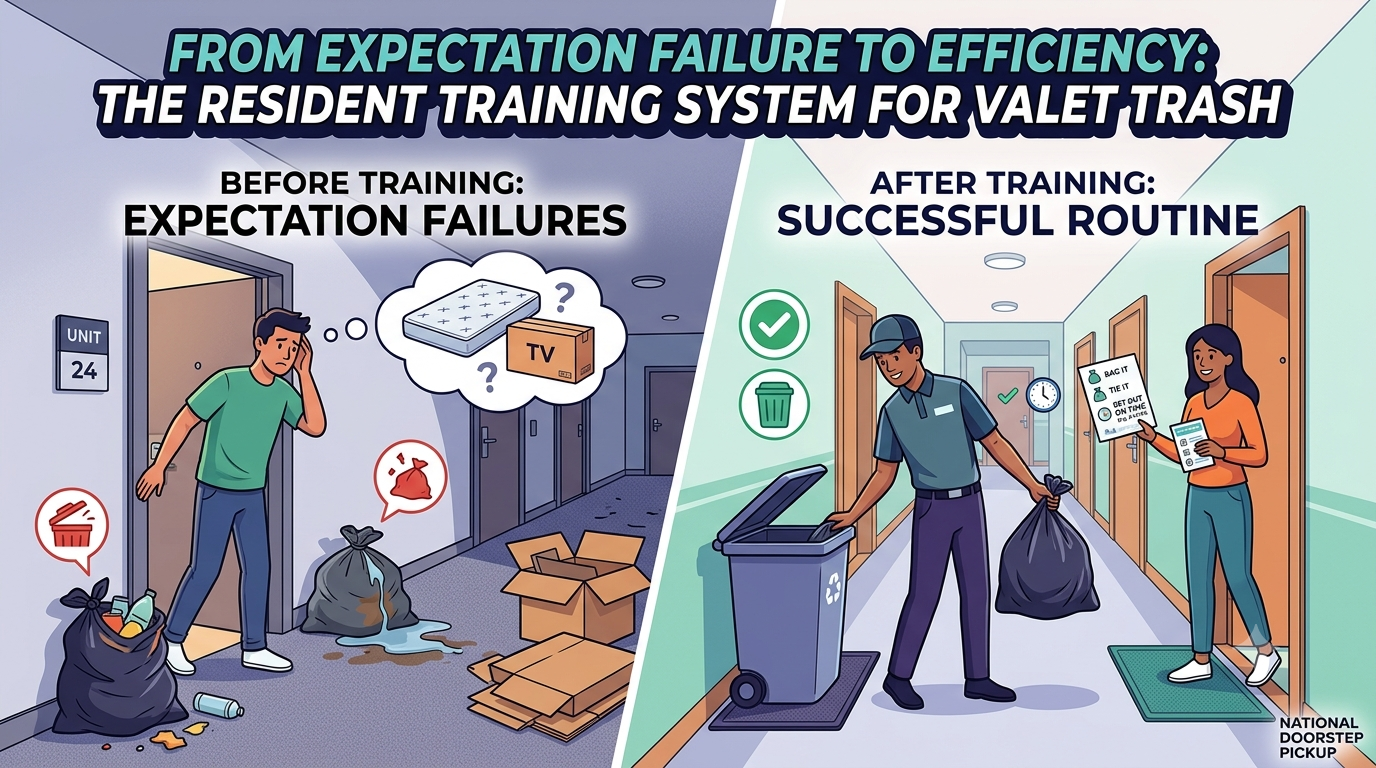
A resident leaves an untied bag outside at noon.
Another places a leaking kitchen bag directly on the hallway floor.
Someone expects a mattress, television box, or pile of loose cardboard to disappear with the nightly collection.
The problem often began weeks earlier, when the resident received a dense lease addendum but was never actually shown how doorstep trash pickup works.
Successful valet trash programs do not simply publish rules. They train residents to follow a simple nightly routine.
That requires clear instructions, repeated communication, visual examples, consistent enforcement, and a service provider capable of documenting what happened at each door.
Here is how apartment communities can train residents on valet trash pickup rules without making the program feel complicated, punitive, or difficult to use.
The First Rule of Resident Training: Make the Correct Behavior Easy
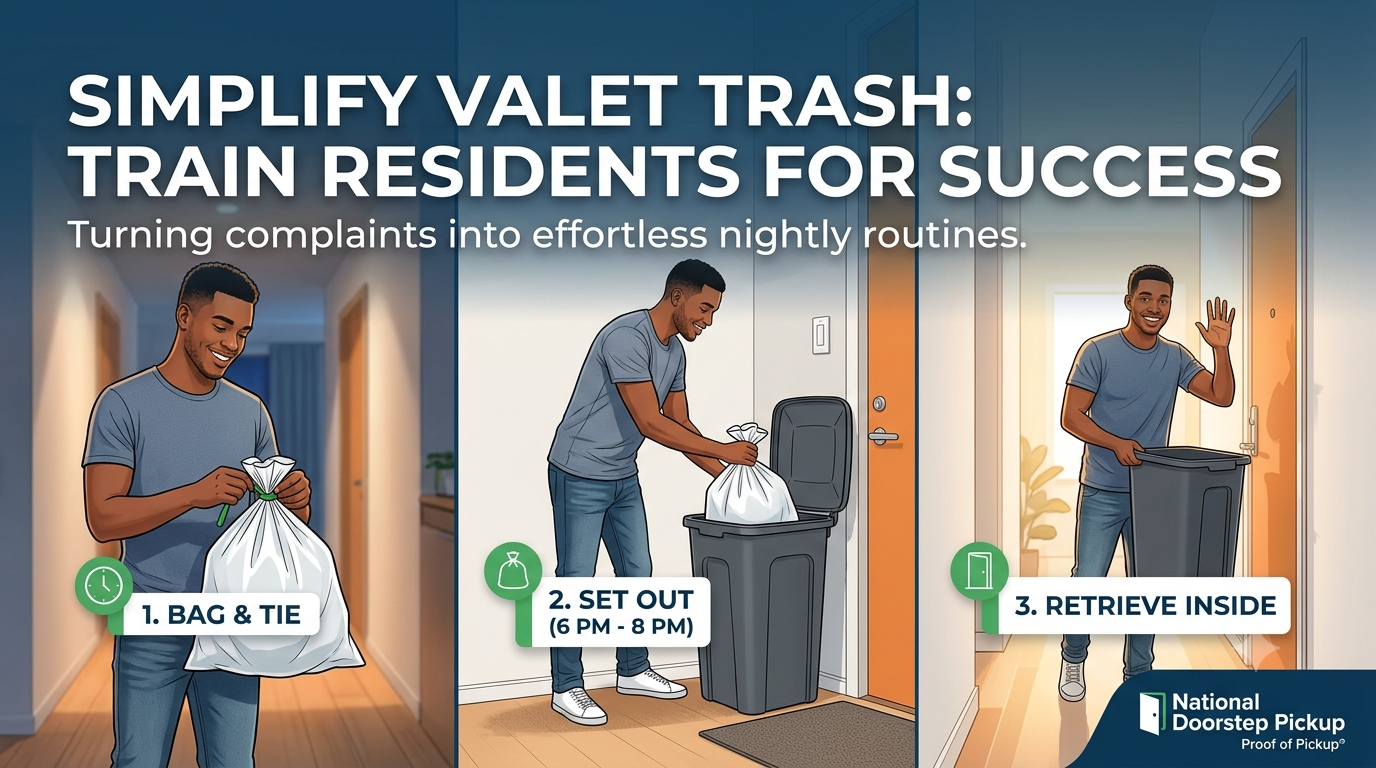
Residents should be able to understand the entire doorstep trash process in less than a minute:
Bag it.
Tie it.
Place it in the approved container.
Set it out during the approved window.
Bring the container back inside after collection.
When property teams add too many exceptions, inconsistent instructions, or complicated policy language, compliance declines.
The goal is not to make residents memorize a waste-management manual. The goal is to create one repeatable behavior that fits naturally into their evening routine.
The Seven Valet Trash Rules Every Resident Must Understand
Although specific requirements may vary by property, building type, vendor, and local fire code, every resident training program should clearly address the following rules.
1. Follow the Exact Service Schedule
“Pickup happens at night” is not specific enough.
Residents need to know:
Which nights service is provided.
When they may place trash outside.
When collection begins.
When the container must be returned inside.
Which holidays or weather conditions may affect service.
The setout window matters because trash placed outside too early can create odors, attract pests, obstruct walkways, and make an otherwise clean community look neglected.
Train residents to think of the service as an evening pickup window—not overnight trash storage.
2. Every Bag Must Be Securely Tied and Leak-Free
A trash bag should be capable of being lifted, carried, and transported without opening, tearing, or leaking.
Residents should never place out:
Open bags.
Bags tied with weak handles that can separate.
Overfilled bags.
Loose household trash.
Bags with liquid leaking from the bottom.
Grocery bags being used as primary trash bags.
A leaking bag is not merely unpleasant. It can stain concrete, damage carpets, create odors, attract insects, contaminate carts, and expose collection personnel to unsanitary materials.
Use one memorable instruction:
If the bag cannot be lifted safely without leaking or opening, it is not ready for collection.
3. Use the Approved Container or Trash Mat
Residents should place their tied bag inside the community-approved container, on the approved trash mat, or in another location specifically designated by management.
Do not allow residents to assume that “near the door” is good enough.
Training materials should show:
The exact container residents must use.
Where the container should be positioned.
Which direction the opening should face.
Whether the lid must remain closed.
Whether a second bag is permitted.
Where trash mats should be placed.
When the container must be brought back inside.
Requirements can differ significantly by jurisdiction. For example, North Carolina’s fire-code provisions for certain apartment occupancies regulate how long valet trash may remain in a corridor, prohibit obstruction of required egress width, and require qualifying materials to remain inside approved closed-lid containers.
Property managers should verify local requirements with the applicable fire marshal or authority having jurisdiction rather than assuming one national container rule applies everywhere.
4. Keep Hallways, Breezeways, Stairs, and Doors Clear
Trash should never block:
Stairwells.
Exit doors.
Fire equipment.
Elevators.
Accessible routes.
Neighboring entrances.
Required corridor width.
Common walkways.
Teach residents to position the container close to their own door without placing it in the middle of the travel path.
This is especially important in mid-rise and high-rise communities, where one incorrectly placed container can affect an entire corridor.
The resident-facing message should be simple:
Place the container beside your door—not in the path residents use to exit the building.
5. Do Not Place Prohibited or Oversized Items Outside
Standard doorstep trash pickup is not the same as bulk-item removal.
Residents should be told exactly what the nightly porter will not collect. Depending on the property’s program, prohibited materials may include:
Furniture.
Mattresses.
Appliances.
Electronics.
Construction debris.
Paint.
Chemicals.
Flammable materials.
Automotive + lithium batteries.
Medical sharps.
Exposed broken glass.
Large quantities of loose cardboard.
Bags exceeding the stated 25 llb weight limit.
Residents should also be given an alternative. We have national city-based regional compliance hubs behind our hamburger link, in the upper right corner, at NationalDoorstep.com. There, residents and maintenance can find drop-off for household hazardous chemicals (paint, pesticides, pool chemicals, automotive fluids, batteries) and select electronics (computers/cell phones).
Instead of writing only “No bulk items,” explain how a resident can request bulk removal, where oversized materials should be taken, or who they should contact before setting an item outside.
A rule without an alternative creates frustration. A rule with a clear next step creates compliance.
6. Follow the Community’s Recycling Rules
Recycling rules should never be buried inside the trash instructions.
Residents need to know:
Whether doorstep recycling is offered.
Which bag color should be used.
Which materials are accepted.
Whether containers must be rinsed.
Whether cardboard must be flattened.
Whether plastic bags are prohibited.
Whether trash and recycling are collected separately.
Recycling requirements vary by municipality and processing facility. Materials accepted in one market may be considered contamination in another.
Therefore, resident materials should use the property’s actual local recycling list—not a generic national list copied from another community.
Where separate bags are required, explain that trash and recycling cannot be mixed simply because they are placed in the same doorstep container. Industry guidance notes that non-recyclable materials can contaminate otherwise recyclable material and that accepted items vary by community.
7. Bring the Container Back Inside
Resident training should not end when the bag is collected.
Containers left outside all day can create:
Corridor clutter.
An inconsistent property appearance.
Fire-code concerns.
Trip hazards.
Water accumulation.
Misplaced or stolen containers.
Confusion about whether service was completed.
Give residents a clear retrieval deadline. For example:
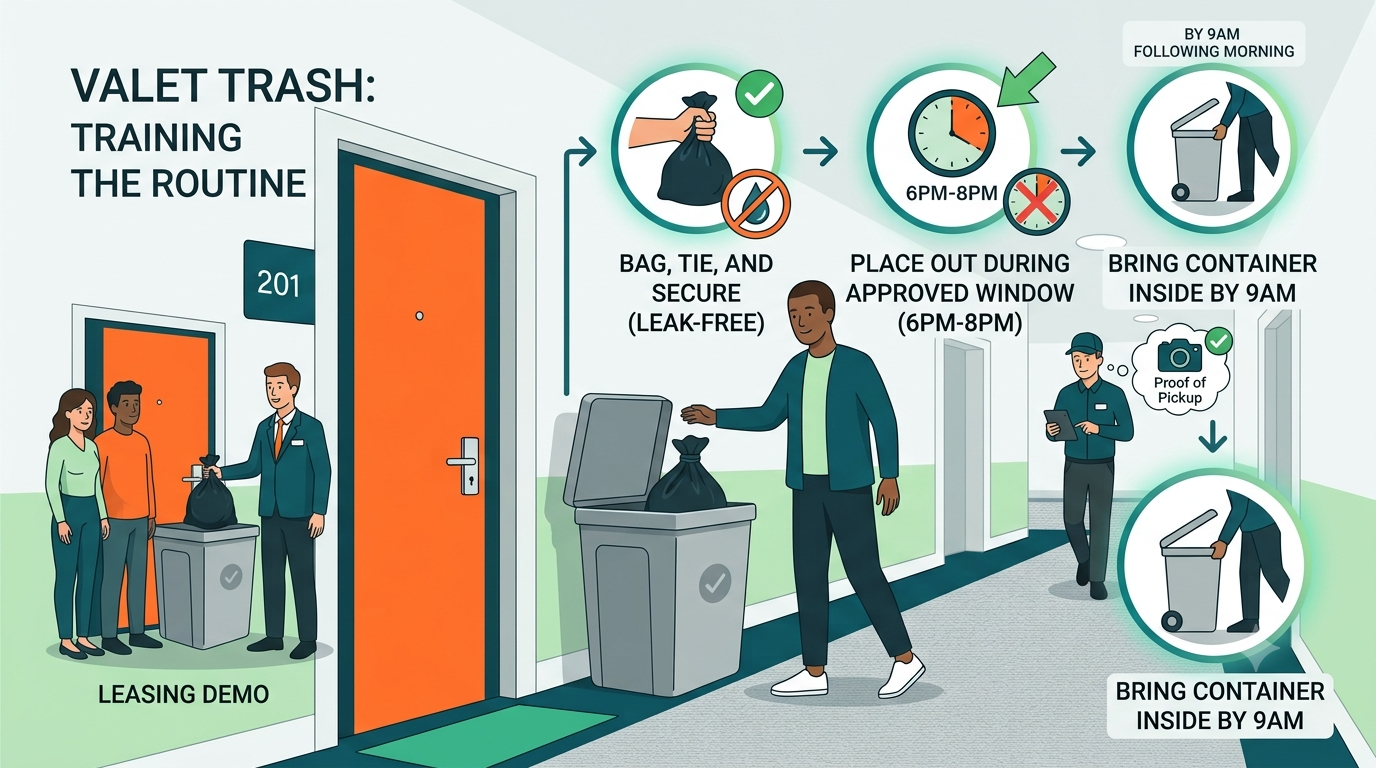
Please bring your empty container inside by 9:00 AM the following morning.
The exact deadline should match the property’s operating procedures and local requirements.
Why a Lease Addendum Alone Is Not Resident Training
A lease addendum is important, but it is primarily a legal and operational document.
It should define the fee, service schedule, resident responsibilities, prohibited items, violation process, and applicable terms. However, handing someone a multi-page addendum during move-in does not guarantee that they understand the nightly process.
Residents are often processing dozens of details at the same time:
Rent payment instructions.
Parking registration.
Package procedures.
Amenity access.
Pet policies.
Utility setup.
Move-in inspections.
Community rules.
Valet trash instructions can easily disappear into that information overload.
The addendum establishes the rule. Training turns the rule into behavior.
Use a Five-Touch Resident Training System
The strongest communities repeat the same core instructions across multiple resident touchpoints.
Touchpoint 1: The Leasing Conversation
Introduce valet trash as a convenience before discussing restrictions.
A leasing professional might say:
“Your community includes doorstep trash pickup five nights per week. You place a securely tied bag in the provided container during the evening setout window, and the porter collects it directly from your door.”
That framing explains the value while establishing the basic routine.
Residents should also receive transparent information about whether the service is mandatory, how it is billed, and what it costs. The service should never feel like a surprise fee discovered after the lease decision.
Touchpoint 2: The Lease and Addendum
The written policy should match what residents heard during the tour.
We provide an addendum template for use as needed.
It should clearly state:
Service nights.
Setout window.
Pickup window.
Holiday policy.
Approved container requirements.
Accepted and prohibited materials.
Container retrieval deadline.
Missed-pickup reporting process.
Violation and fee policy.
Do not use vague language such as “trash may be collected at designated times.”
Write the actual times.
Touchpoint 3: The Move-In Demonstration
Show residents the container during move-in.
A 60-second demonstration can prevent months of recurring violations:
Open the container.
Place a properly tied bag inside.
Show the correct location beside the door.
Explain the setout time.
Point out the printed rules or QR code.
Explain when to retrieve the container.
Residents remember what they see more readily than what they skim in a packet.
We provide a matching one-page resident rules handout, which would be the strongest companion asset for for leasing managers.
Touchpoint 4: The First-Week Reminder
Send a text message, email, resident-app notification, or printed reminder shortly after move-in.
The message should arrive close to the setout window, when the resident can act on it.
Sample First-Week Resident Message
Welcome to doorstep trash pickup.
Place securely tied, leak-free trash bags in your approved container between 6:00 PM and 8:00 PM, Sunday through Thursday. Collection takes place between 8:00 PM and midnight.
Please do not place out loose trash, leaking bags, furniture, hazardous materials, or unflattened bulk cardboard. Bring your empty container back inside after collection.
Questions or service concerns? Follow the QR code for more help.
Touchpoint 5: Visual Reminders at the Door
Use a small, professionally designed rules card on the inside of the resident’s utility closet, cabinet door, refrigerator, or container lid.
The best visual guide uses icons rather than paragraphs:
Green checkmark: tied bag.
Green checkmark: bag inside container.
Clock: approved setout window.
Red X: loose trash.
Red X: leaking bag.
Red X: furniture or bulk waste.
Red X: container left outside all day.
Residents should be able to understand the guide without reading dense policy language.
Train Residents Before You Fine Residents
Starting with fines can make an amenity feel adversarial.
A better enforcement ladder is:
First Issue: Courtesy Coaching
Send a friendly reminder explaining:
What was placed outside.
Which rule applies.
Why the item could not be collected.
What the resident should do differently next time.
Second Issue: Documented Written Notice
Identify the repeated behavior and provide another copy of the community rules.
Use photographs or service documentation when available, but keep the tone factual rather than accusatory.
Continued Noncompliance: Lease Enforcement
Apply the property’s written violation process consistently, subject to the lease, addendum, company policy, and applicable law.
The purpose of enforcement should be to protect cleanliness, safety, service reliability, and the resident experience—not to generate violation revenue.
Replace Generic Violation Notices With Instructional Door Tags
A door tag that says only “Violation” creates defensiveness.
A better tag identifies the specific issue:
Bag was not tied.
Bag was leaking.
Trash was placed outside the approved window.
Loose items were placed outside the container.
Item requires bulk pickup.
Cardboard must be flattened.
Container blocked the walkway.
Container must be brought back inside.
Trash contained a prohibited sharp or hazardous item.
The resident should immediately understand what happened and how to correct it.
A useful notice might read:
We were unable to collect this item because the bag was not securely tied. Please retie or replace the bag and place it inside your approved container during the next scheduled setout window. Thank you for helping us keep the community clean and safe.
That is more effective than a generic red warning slip.
Make the Rules Easy to Find
Residents should not have to search through their lease every time they have a question.
Publish the rules in several accessible locations:
Resident portal.
Community app.
Welcome email.
Move-in packet.
Container label.
QR code near the trash enclosure.
Management office handout.
Community website FAQ.
Renewal communication.
Posted signage where permitted.
Use the same language in every location.
One department should not say pickup ends at 10:00 PM while another says midnight. One document should not permit two bags while another permits only one.
Train the Property Team, Too
Resident education fails when onsite employees give different answers.
Every leasing professional, assistant manager, maintenance technician, and resident-services employee should know:
The service nights.
Setout and pickup windows.
Holiday schedule.
Bag and container requirements.
Prohibited items.
Bulk-removal process.
Recycling rules.
Missed-pickup reporting procedure.
Violation escalation policy.
Vendor contact and service-verification process.
We include a one-page valet trash reference sheet in the property’s employee onboarding materials.
The property team and service provider should also agree on who communicates with residents, who issues notices, how photographs are stored, and how disputed pickups are resolved.
Use Proof of Pickup® to Separate Service Problems From Setout Problems
Resident training works best when the service itself is documented.
When a resident reports a missed pickup, management should be able to determine:
Whether the porter completed the route.
When the building or unit area was serviced.
Whether access was blocked.
Whether the bag was placed out after collection.
Whether the setout violated a community rule.
Whether a photograph or exception report was submitted.
National Doorstep Pickup’s Proof of Pickup® process supports route visibility, time verification, and photo-based issue reporting. This helps management distinguish a true service exception from a late, leaking, prohibited, or otherwise noncompliant setout.
Documentation protects both sides.
Residents receive faster answers, and property managers no longer have to resolve every complaint using competing recollections.
Measure Whether Resident Training Is Working
Do not assume the training program is successful simply because materials were distributed.
Total violations per 100 occupied units.
Repeat violations by category.
Leaking-bag incidents.
Early setouts.
Containers left outside after collection.
Bulk items placed at doorways.
Missed-pickup complaints.
Review the information by building, floor, and move-in cohort.
A cluster of violations in one building may indicate signage or communication problems. A high violation rate among new residents may indicate that the move-in process needs improvement.
The goal is not to issue more notices. The goal is to need fewer notices.
Frequently Asked Questions About Resident Valet Trash Training
When should residents first learn about valet trash?
Residents should first hear about the service during the leasing process. The rules should then be repeated in the lease or addendum, during move-in, and again during the resident’s first week.
How many rules should be included in a resident handout?
Keep the primary handout focused on the five to seven behaviors residents need most often. Place detailed exceptions and legal terms in the lease addendum or expanded policy.
Should residents be fined for their first valet trash violation?
A courtesy reminder is usually a better first step unless the violation presents an immediate safety concern or the lease requires a different response. Repeated issues can then move through the property’s documented enforcement process.
What should happen when a resident reports a missed pickup?
Management should verify the resident’s unit, setout time, bag condition, service date, and route documentation. A true service failure should be corrected promptly. A noncompliant or late setout should be explained with the applicable rule.
Can residents leave bulk items outside for the porter?
Not unless the property specifically offers scheduled bulk-item collection. Furniture, mattresses, appliances, construction debris, and similar items are generally outside the scope of standard nightly doorstep pickup.
Why must bags be tied?
Securely tied bags help prevent spills, odors, stains, pests, loose debris, and unsafe exposure during collection and transport.
Do the same valet trash rules apply in every city?
No. Fire, building, recycling, waste, and corridor-storage requirements can differ by state and municipality. Property management should confirm the applicable rules with local authorities and ensure the resident policy matches them.
Final Takeaway: Train the Routine, Not Just the Rule
A well-run doorstep trash program should feel effortless to residents.
That does not happen because management writes a longer policy or issues more violation notices. It happens because the community teaches one clear routine and repeats it consistently:
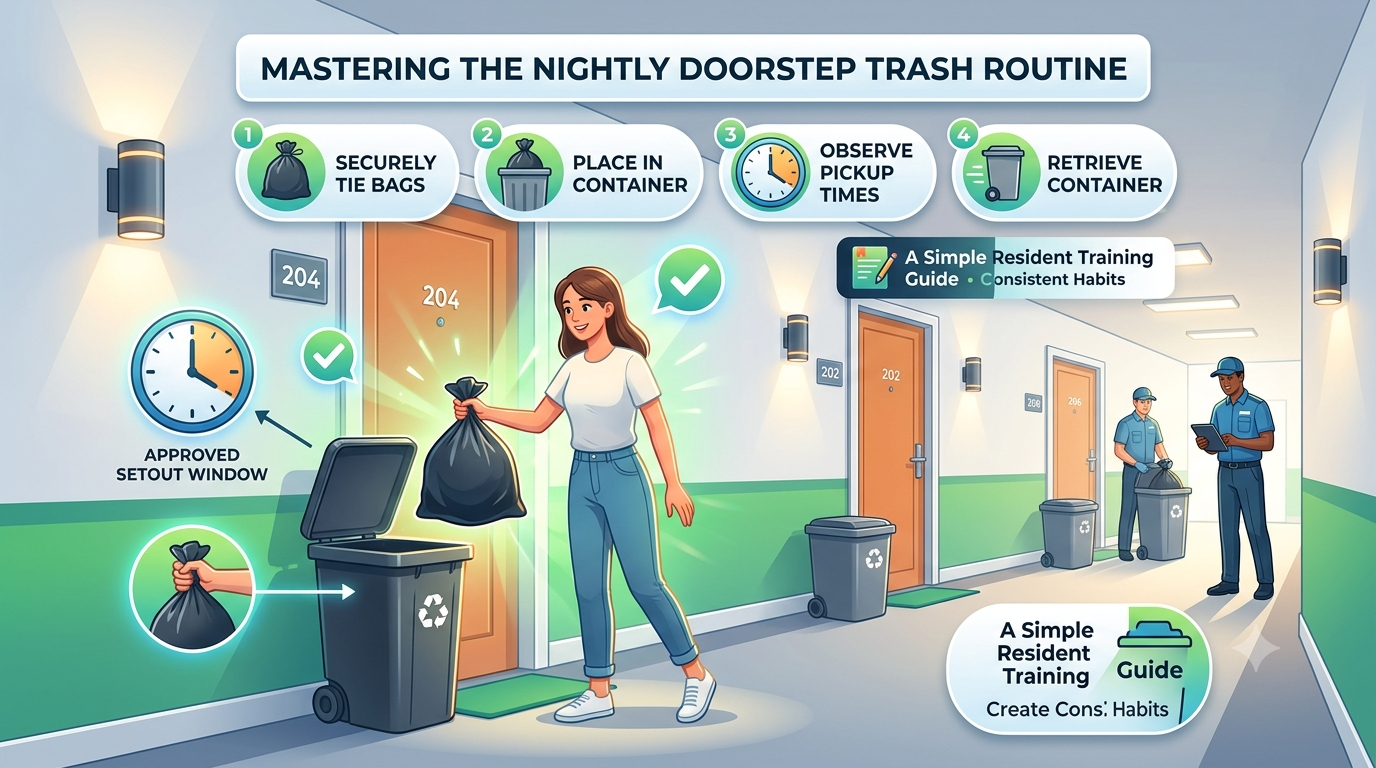
Bag it. Tie it. Place it correctly. Set it out on time. Bring the container back inside.
Introduce the service during leasing. Demonstrate it at move-in. Reinforce it during the first week. Use visual reminders. Correct mistakes with specific instructions. Document service activity. Apply repeated enforcement consistently.
When residents understand both what to do and why it matters, communities experience fewer leaking bags, fewer hallway problems, fewer disputed pickups, and fewer resident complaints.
National Doorstep Pickup helps multifamily communities build cleaner, more accountable doorstep waste and recycling programs backed by uniformed porters, resident-friendly operating procedures, and Proof of Pickup® service verification.
Every Door. Every Night.®
Ready to improve resident compliance and gain better visibility into your valet trash program?
Request a proposal from National Doorstep Pickup today.