By Les Leith, CEO & COO at National Doorstep Pickup
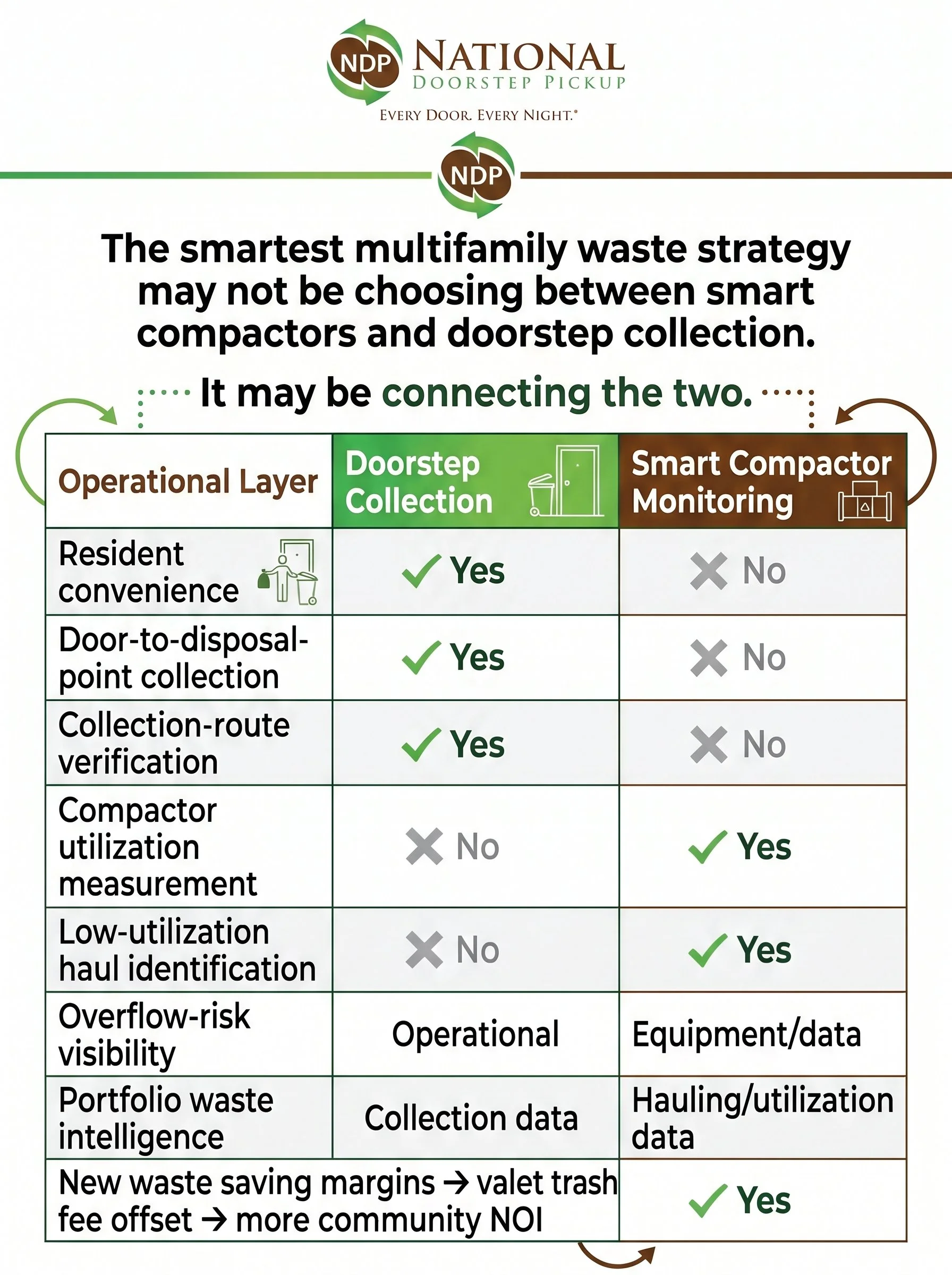
The smartest multifamily waste strategy may not be choosing between smart compactors and doorstep collection.
It may be connecting the two and not paying for air.
For Regional Property Directors and Facilities Managers, waste expense is rarely driven by just one problem.
A property can have an efficient doorstep collection program and still haul a half-full compactor.
It can have sophisticated compactor sensors and still struggle with trash outside resident doors, bags left beside dumpsters, contamination, overflowing collection areas, and maintenance teams spending valuable time moving waste.
That is why the better question is not:
Smart compactor or valet trash?
It is:
How do we control the waste stream from the resident’s door all the way through the final haul?
The answer increasingly looks like a two-layer system:
Doorstep collection manages the front end.
IoT compactor intelligence manages the back end.
The Hidden Problem: Most Waste Systems Optimize Only Half the Journey
Think about the waste journey inside an apartment community.
A resident generates trash.
That waste must move from:
Apartment → doorstep → collection route → compactor → hauler → disposal facility.
Every transition creates an opportunity for inefficiency.
Traditional waste management tends to concentrate on the final step: getting a container hauled.
But a Regional Director managing dozens of communities has to worry about everything upstream as well.
How reliably does trash reach the compactor?
When does it arrive?
Are residents following set-out rules?
Are bags piling up around the property?
Is maintenance moving resident trash?
Is the compactor actually full when the hauler arrives?
Are weekend volumes different from weekday volumes?
Are move-ins, move-outs, holidays and seasonal occupancy changing the property’s waste curve?
And perhaps most importantly:
Are you paying to move air?
That is where smart compactor monitoring becomes valuable.
What Does a Smart Compactor Actually Do?
Instead of relying entirely on:
“The truck comes every Tuesday.”
the property can begin moving toward:
“The truck comes when this compactor is approaching its appropriate hauling threshold.”
WM describes compactor-monitoring technology that can wirelessly transmit operating information including pressure, weight and usage patterns so pickup schedules can be adjusted around actual operating conditions.
That distinction matters.
A scheduled haul asks:
What day is it?
A data-driven haul asks:
How full is the container?
Those can produce very different hauling economics.
The Real Enemy Is the Low-Utilization Haul
Every property needs waste hauled.
The objective is not to eliminate hauling.
The objective is to make each haul do more work.
Consider two identical communities.
Property A
The compactor is hauled every seven days regardless of utilization.
Some weeks it is full.
Other weeks it may be nowhere near its efficient hauling threshold.
Property B
Compactor utilization is monitored and hauling frequency is adjusted where the property’s contract and operational requirements allow it.
Instead of asking:
“Did we get our scheduled pickup?”
management starts measuring:
“How much waste did we move with each pickup?”
That is a much more powerful KPI.
Recent multifamily case studies reported by compactor-monitoring provider DSQ illustrate the opportunity. One Texas multifamily property reportedly reduced hauls 47% and saved $10,689 over one year after moving away from an automatic weekly schedule. Another North Georgia apartment property reported a 43.6% reduction in hauls and $13,783 in savings over six months. These are vendor-reported examples rather than guaranteed outcomes, but they demonstrate why utilization deserves attention.
At portfolio scale, small improvements in haul efficiency can compound quickly.
But Sensors Cannot Pick Up Trash From 300 Apartment Doors
This is where the “smart compactor versus valet trash” argument breaks down.
A fullness sensor can help answer:
When should this container be hauled?
It cannot answer:
How does the resident’s trash reliably get there?
That is the role of a well-designed doorstep waste collection program.
National Doorstep Pickup manages the resident-facing collection layer by moving properly prepared household waste from designated resident set-out locations to the property’s approved disposal point.
The two systems therefore solve fundamentally different problems:

One manages waste movement.
The other manages container utilization.
Put them together and you begin managing the entire chain.
Doorstep Collection Creates a More Controlled Waste Stream
There is another advantage that is easy to miss.
A structured doorstep collection program can make the flow of waste into the property’s central disposal system more predictable.
Instead of trash arriving randomly throughout the day from hundreds of individual households, a scheduled collection window creates a more organized operating rhythm.
That provides Facilities Managers with a better picture of when waste is moving through the property.
The compactor system can then provide intelligence about what happens at the downstream container.
These systems do not necessarily need a direct software integration to be operationally complementary.
Think of them as two datasets describing two parts of the same system:
Proof of Pickup®: Was the doorstep collection route completed?
Compactor monitoring: What happened to container utilization afterward?
That is much more useful than managing each vendor in isolation.
IoT Can Help Eliminate the “Just in Case” Haul
Waste schedules are frequently designed around avoiding the worst-case scenario.
Nobody wants an overflowing compactor on Saturday morning.
So the natural response is often:
Schedule another pull.
That protects the property operationally—but it can introduce unnecessary hauling expense if containers are regularly serviced well below their efficient capacity.
IoT monitoring changes the decision.
Instead of hauling “just in case,” management can potentially use actual equipment data to determine when another pull is justified.
That does not mean waiting until the compactor physically cannot accept another bag.
A sophisticated program needs an operating buffer.
The target should be:
Maximum practical utilization without creating overflow, overweight, equipment or service-risk problems.
That threshold will vary by property, equipment configuration, hauler response time and contract.
Fullness Data Can Also Help Prevent Overflows
Optimization works in both directions.
A smart system should not merely identify containers being hauled too early.
It should also identify containers filling faster than expected.
Imagine a 350-unit apartment community entering a high-volume period.
Move-outs increase.
Residents receive more deliveries.
Cardboard volume rises.
A holiday changes the normal waste pattern.
Without visibility, management may discover the problem only when the disposal area starts overflowing.
With monitoring, an abnormal utilization curve can potentially be detected before the problem becomes visible to residents.
That gives operations teams an opportunity to coordinate an earlier haul rather than responding after waste has accumulated around the enclosure.
The same technology that can prevent unnecessary pickups can therefore help prevent late pickups.
Smart Hauling Is Really About Variability
Waste generation is not perfectly linear.
Yet many hauling schedules assume that it is.
A community may have approximately the same number of apartment homes every week, but its waste volume can still change because of:
Occupancy changes
Lease turns
Move-ins and move-outs
Holidays
Online shopping volume
Weather events
Resident behavior
Seasonal patterns
Property events
Bulk disposal activity
That makes fixed-frequency hauling inherently imprecise.
Monitoring gives Regional Directors another option:
Match hauling frequency to actual demand rather than assuming demand always matches the calendar.
One large multifamily operator using predictive compactor monitoring reportedly eliminated more than 600 hauls in 2025 and reduced hauling costs by 39% across monitored locations, according to a September 2026 DSQ case study. Again, results will depend heavily on existing service levels, contracts, equipment and waste volumes.
The Metric Regional Directors Should Start Watching: Tons Per Haul
Property teams often track monthly waste cost.
That is necessary.
But it does not necessarily explain why the bill increased.
Regional Directors should consider tracking several operational KPIs together:
Average tons per haul
Days between hauls
Hauls per month
Cost per haul
Total monthly hauling expense
Overflow or pack-out events
Extra-service charges
Compactor downtime
Doorstep collection completion rate
Resident waste violations
The most revealing metric may be average tons per haul.
If hauling costs are increasing while tons per haul are falling, there may be a service-frequency problem hiding inside the invoice.
If tons per haul increase while overflow incidents remain controlled, the asset may be getting more value from each truck movement.
A Simple Example: What Happens When You Remove One Unnecessary Haul?
Assume a community averages:
5 compactor pulls per month
at an illustrative:
$500 all-in transportation-related cost per pull
That is:
$2,500 per month
or:
$30,000 per year.
If monitoring and contract flexibility allow the property to eliminate just one unnecessary monthly pull:
12 avoided pulls × $500 = $6,000 annual gross savings
Scale the same operational improvement across 25 comparable properties:
$150,000 in potential gross annual savings.
The actual calculation must use the property’s real hauling contract.
Disposal charges, fuel/environmental fees, minimums, rental charges, tonnage rates, on-call pricing and other contract provisions can materially change the economics.
That is why Facilities Managers should analyze the invoice—not simply count trucks.
Important: IoT Does Not Automatically Lower the Waste Bill
This is where procurement strategy matters.
Installing a sensor and continuing exactly the same fixed hauling schedule accomplishes very little.
The property needs the ability to act on the data.
Before installing monitoring technology, determine how the hauling contract handles:
Scheduled versus on-call service
Cost per pull
Disposal or tipping fees
Fuel/environmental surcharges
Compactor rental
Minimum service frequency
Overage or overweight charges
Dry-run or return-trip charges
Emergency pulls
Cancellation requirements
Hauler response times
If you are contractually paying the same amount regardless of how many qualifying hauls occur, eliminating a pull may not immediately produce equivalent invoice savings.
The technology identifies the operational opportunity.
The contract determines how much of that opportunity becomes NOI.
Now Add Doorstep Collection to the Equation
This is where the full system begins to take shape.
Step 1: Residents follow defined set-out procedures.
Step 2: Doorstep collection consolidates the waste stream.
Step 3: Proof of Pickup® documents collection execution.
Step 4: The compactor receives the consolidated waste.
Instead of relying solely on visual inspection or a calendar, monitoring technology can track equipment utilization.
Step 5: The hauling decision becomes data-driven.
When permitted by the hauling agreement, pickup timing can be adjusted around actual or predicted container utilization.
Step 6: Management measures the result.
Regional teams can compare:
Collection reliability + haul frequency + tons per haul + hauling cost + overflow events.
Now the property is no longer managing separate pieces of waste service.
It is managing a waste logistics system.
New waste saving margins → valet trash fee offset → more community NOI
Smart Compactors Don’t Replace Valet Trash—and Valet Trash Doesn’t Replace Smart Compactors
That distinction matters.
IoT technology is excellent at generating equipment intelligence.
It cannot walk an apartment community.
It cannot collect a tied bag from a resident’s doorstep.
It cannot correct improper resident set-outs.
It cannot move flattened cardboard to the appropriate collection point.
And it cannot provide resident-facing convenience.
Likewise, a doorstep collection porter should not be expected to determine the most economically efficient compactor pull schedule by looking at the container.
Humans are good at moving and managing the physical waste stream.
Sensors are good at continuously measuring equipment behavior.
Use each for what it does best.
The Bigger Opportunity: Portfolio-Level Waste Intelligence
For a single apartment community, saving a few unnecessary hauls can matter.
For a Regional Director responsible for 20, 50 or 100 properties, the larger opportunity is benchmarking.
Imagine being able to identify:
Property A: 8.1 tons per haul
Property B: 5.9 tons per haul
Property C: 2.7 tons per haul
The question becomes obvious:
Why is Property C being hauled at 2.7 tons?
Maybe the answer is legitimate.
Maybe the compactor is undersized.
Maybe the property has unusual constraints.
Maybe there is contamination.
Maybe scheduled service frequency is too high.
Maybe multiple compactors are poorly balanced.
Or maybe nobody has questioned the hauling schedule in years.
Data creates the question.
Operations produces the answer.
The Future of Multifamily Waste Management Is Not More Trucks
It is better coordination.
The industry’s next operating model is unlikely to be built around blindly adding pickups whenever a waste problem appears.
It will increasingly rely on visibility across the complete waste journey:
Resident behavior
↓
Doorstep collection
↓
Route verification
↓
Centralized disposal
↓
Compactor utilization
↓
Predictive hauling
↓
Invoice verification
That is how waste management moves from being treated as a recurring nuisance to being managed as a controllable operating system.
Smart Waste Management Should Protect Both the Property and the NOI
The objective is not simply to reduce hauls.
Reducing one haul while creating overflowing trash is not optimization.
Neither is running extra trucks every week to make sure overflow never occurs.
The objective is to find the operational balance:
Reliable resident service.
Clean communities.
High container utilization.
Fewer unnecessary truck movements.
Documented collection performance.
Lower avoidable operating expense.
Increased NOI
That is where IoT monitoring and professional doorstep collection can work exceptionally well together.
One controls how waste reaches the compactor.
The other helps determine when that compactor should leave the property.
And for Regional Property Directors trying to protect NOI across an entire portfolio, connecting those two decisions may be much more valuable than optimizing either one alone.
Want to Evaluate Your Community’s Waste Workflow?
National Doorstep Pickup provides technology-enabled multifamily valet trash, doorstep recycling and waste-diversion services across the lower 48 states.
With Proof of Pickup® route, time and photo verification, property teams gain greater visibility into doorstep collection execution while maintaining a resident-friendly waste program.
Every Door. Every Night.®