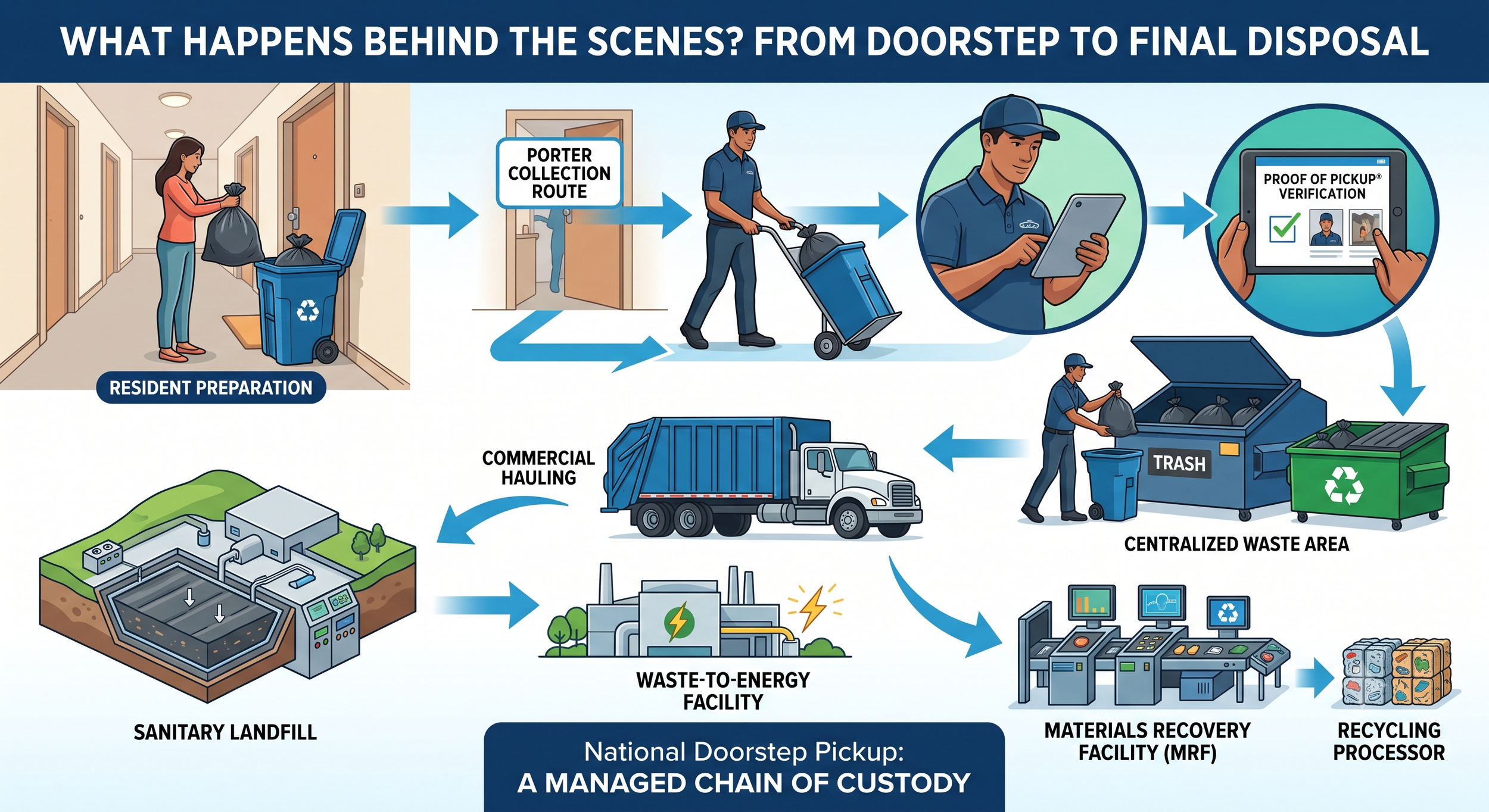
What Happens After Valet Trash Pickup? From Doorstep to Final Disposal
By Les Leith, CEO & COO at National Doorstep Pickup
A resident ties a trash bag, places it outside the apartment door, and finds it gone later that evening.
Simple, right?
What residents do not see is the coordinated process happening behind the scenes: trained porters following property-specific routes, pickup verification, leak-prevention procedures, centralized waste placement, commercial hauling, material sorting, and final disposal.
Here is what happens between the moment a resident places a bag outside the door and the moment that material reaches a landfill, recycling facility, transfer station, or other authorized destination.
Step 1: Residents Prepare Their Trash for Collection
The process begins inside each apartment.
Residents place household waste into securely tied bags and set those bags inside an approved valet trash container or designated placement area during the community’s scheduled set-out window.
At many National Doorstep Pickup communities, residents place their tied bags outside between 6:00 and 8:00 p.m., with collection occurring during the evening service window.
Proper preparation matters.
Loose trash, leaking bags, oversized items, hazardous materials, and excessively heavy bags can create safety and sanitation problems. Clear resident instructions help prevent:
Hallway spills and stains.
Pest activity.
Odors.
Torn bags.
Sharp-object injuries.
Blocked walkways.
Recycling contamination.
The better the resident education, the cleaner and more predictable the entire waste collection process becomes.
Step 2: The Porter Begins a Property-Specific Collection Route
Once the pickup window begins, a uniformed valet trash porter follows a route designed specifically for the community.
The route may cover:
Garden-style apartment buildings.
Interior corridors.
Breezeways.
Stairwells.
Elevators.
Parking structures.
High-rise floors.
Senior living communities.
Student housing buildings.
Mixed-use developments.
The goal is to provide consistent service without creating unnecessary noise, congestion, dripping bags, or repeated traffic through resident areas.
Step 3: Each Doorstep Is Checked and Serviced
The porter moves through the assigned route, checking each participating apartment for properly prepared trash or recycling.
Bags are collected from the doorstep and transferred into larger transport equipment. Depending on the property type, this may include:
Leak-resistant collection totes.
Rolling carts.
Tilt trucks.
Wheeled trash containers.
Property-approved collection vehicles.
The equipment used should match the property.
A garden-style community with exterior entrances may require a different collection method than a 20-story apartment tower with shared elevators and interior trash rooms.
Step 4: Pickup Activity Is Verified
Residents and property managers should not have to guess whether service occurred.
National Doorstep Pickup uses Proof of Pickup® technology to provide greater visibility into valet trash operations. Route, time, and photo-verification capabilities help document service and provide property teams with real-time situational awareness.
Verification can help answer important questions such as:
Was the building serviced?
When was the route completed?
Was a bag placed outside after the porter had already passed?
Was an oversized or prohibited item left at the door?
Was waste placed in an unauthorized location?
Was a dumpster already overflowing?
Did an access issue prevent service?
This creates accountability for both the service provider and the community.
It also allows property managers to address resident concerns using documented information instead of relying solely on conflicting recollections.
Learn more about National Doorstep Pickup’s Proof of Pickup® porter technology here.
Step 5: Waste Is Transported to the Property’s Central Collection Area
After the doorstep collection portion of the route, the porter transports the accumulated waste to the community’s designated disposal location.
Depending on the property, the destination may be:
A front-load dumpster.
A roll-off container.
A compactor.
A trash chute termination room.
A recycling enclosure.
A centralized waste room.
Another property-approved collection point.
The porter must place bags fully inside the correct container—not beside it, on top of it, or near the curb unless specifically authorized.
This step is more important than it may appear.
Improperly placed bags can lead to:
A professional doorstep collection program should include a final visual check of the disposal area whenever possible. The porter should confirm that bags are contained, lids or doors are secured, and no waste was accidentally left along the route.
Step 6: Recycling Is Kept Separate—When the Program Requires It
At communities offering doorstep recycling, recyclable materials must remain separated from regular household trash throughout the collection process.
Residents may use clear blue bags, and compostable bags for food waste, for designated recycling containers, or another property-approved system. The porter then collects the recycling separately and places it into the correct recycling dumpster, cart, room, or compactor.
However, collecting an item as “recycling” does not automatically guarantee that it will be recycled.
The material must also comply with the local recycling program’s rules.
Common contamination problems include:
Non-compostable, food-filled containers.
Plastic grocery bags.
Styrofoam.
Liquids.
Batteries.
Electronics.
Tangled cords.
Bagged recyclables where loose material is required.
Non-recyclable plastics.
Trash mixed into recycling containers.
That is why resident education, clear signage, proper containers, and recurring contamination monitoring are essential parts of a successful multifamily recycling program.
Step 7: The Commercial Hauler Collects the Material
Valet trash service and commercial waste hauling are usually two separate parts of the waste-management chain.
The valet trash provider moves bags from apartment doors to the property’s centralized container. A licensed commercial hauler then empties the dumpster, compactor, or recycling container according to the property’s hauling schedule.
The frequency of hauler service depends on several factors:
Community size.
Number of occupied units.
Container capacity.
Seasonal move-ins and move-outs.
Resident behavior.
Recycling participation.
Bulk-waste volume.
Local regulations.
Holiday schedules.
A mismatch between the valet trash schedule and the commercial hauling schedule can create operational problems.
For example, even a perfectly completed doorstep collection route can result in overflowing dumpsters if the property does not have enough container capacity or sufficiently frequent hauler service.
This is why property managers should evaluate the complete waste system—not just the doorstep portion.
Step 8: Trash May Travel Through a Transfer Station
After the commercial hauler collects the waste, it may not travel directly to a landfill.
In many markets, collection trucks first unload at a transfer station. A transfer station consolidates waste from multiple collection routes into larger vehicles that can transport the material more efficiently to a landfill, waste-to-energy facility, or other final destination.
Transfer stations can help reduce the distance traveled by local collection trucks, allowing those vehicles to return to their routes more quickly.
From the resident’s perspective, the trash simply disappeared from the doorstep. Behind the scenes, however, the same bag may pass through several controlled stages before reaching final disposal.
Step 9: Recyclables May Be Delivered to a Processing Facility
At the facility, recyclable materials may be sorted using a combination of:
Conveyor systems.
Screens.
Air separation.
Manual quality-control stations.
Paper, cardboard, metals, some plastics, and glass may be separated into different commodity streams before being baled, processed, and sold to manufacturers.
The exact process varies by municipality, hauler, processing facility, and local market conditions.
Some communities participate in single-stream recycling, where accepted materials can be placed together. Others require source-separated materials.
Property managers should never assume that all recycling programs accept the same items. Local rules determine which materials belong in the recycling stream.
Step 10: Waste Reaches Its Final Destination
Ordinary household waste may ultimately be delivered to one of several authorized destinations.
Landfill
A sanitary landfill is an engineered disposal site designed to isolate waste from the surrounding environment. Modern landfills may use liners, leachate-collection systems, soil coverage, groundwater monitoring, and landfill-gas controls.
Waste-to-Energy Facility
In some markets, waste is delivered to a facility that uses controlled combustion to generate electricity, steam, or other forms of energy.
Recycling Processor
Accepted recyclable materials may be processed into feedstock for new paper products, metal goods, plastic products, glass containers, packaging, or construction materials.
Specialized Disposal Facility
Certain materials—including batteries, electronics, chemicals, paint, medical waste, and hazardous items—may require specialized handling. These items generally should not be placed in ordinary doorstep trash or recycling.
The final destination depends on the property’s hauler, local infrastructure, municipal contracts, disposal regulations, and the type of material collected.
What Happens When the Process Breaks Down?
Waste problems rarely begin with only one failure.
An overflowing dumpster, for example, may result from several connected issues:
Residents placing out excessive waste.
Insufficient dumpster capacity.
Missed commercial hauling.
Bulk items blocking the enclosure.
Unauthorized dumping.
Poor compactor operation.
Recycling contamination.
Move-out activity.
Incorrect service frequency.
A professional valet trash provider should document visible conditions and communicate operational concerns to property management.
The valet porter may not control the commercial hauling contract, dumpster size, or municipal collection schedule, but early reporting can help prevent a small capacity problem from becoming a major sanitation issue.
Why the Behind-the-Scenes Process Matters to Property Managers
The resident sees convenience.
The property manager sees—or should see—a controlled operational system.
When properly managed, doorstep trash collection can help a community:
Reduce resident trips to distant dumpsters.
Improve the appearance of breezeways and corridors.
Limit leaking bags in elevators.
Reduce unauthorized trash placement.
Support elderly residents and residents with mobility limitations.
Document service concerns.
Improve recycling participation.
Strengthen amenity value.
Create an additional revenue opportunity.
Protect the resident experience.
When poorly managed, the same service can contribute to complaints, hallway stains, inconsistent pickups, overflowing disposal areas, and confusion about responsibility.
The difference comes down to training, route design, communication, equipment, verification, and accountability.
The Hidden Chain Behind a Simple Resident Amenity
Valet trash may appear simple from the outside:
Place the bag outside. The bag disappears.
But the complete system involves resident preparation, porter routing, service verification, interior transport, centralized placement, commercial hauling, processing, and final disposal.
Every step affects what comes next.
A leaking bag can damage a corridor. A contaminated recycling load can be rejected. An undersized dumpster can overflow. A missed hauler service can disrupt the entire property. An undocumented pickup complaint can become a resident-retention issue.
That is why National Doorstep Pickup treats doorstep waste collection as a managed property operation—not merely a bag-removal service.
With trained porters, property-specific collection routes, appropriate transport equipment, and Proof of Pickup® technology, National Doorstep Pickup helps multifamily communities create a cleaner, more accountable resident experience.
Take Control of Your Community’s Waste-Collection Process
Is your current valet trash program providing verified service, clear communication, and consistent operational oversight?
National Doorstep Pickup serves multifamily communities with scalable doorstep trash and recycling programs designed around each property’s layout, resident population, and waste infrastructure.
Every Door. Every Night.®
Request a proposal or complimentary program review: