Solving Waste Management Challenges in Build-to-Rent (BTR) & Single-Family Rental Communities
Build-to-Rent communities may operate like multifamily assets—but they do not move waste like traditional apartment communities.
That distinction matters.
The resident count may be similar.
The waste logistics are not.
For BTR developers and Single-Family Rental operators, the challenge is creating a waste-management system that delivers convenience without turning the community into a landscape of overflowing carts, missed pickups, inconsistent set-outs, and unnecessary truck traffic.
The solution starts with designing the waste program around the horizontal layout of the property.
The BTR Waste Problem Is a Logistics Problem
Traditional multifamily waste collection is relatively centralized.
Residents move waste toward:
Chutes
Trash rooms
Dumpsters
Compactors
Central collection areas
Build-to-Rent reverses much of that equation.
Instead of hundreds of residents moving waste toward a few disposal points, the waste-management system may need to reach hundreds of individual homes distributed throughout the community.
That creates a fundamentally different operational question:
How do you efficiently move waste through a horizontal residential community without sacrificing convenience, curb appeal, or operating efficiency?
Answering that question requires more than simply placing a trash cart at every residence.
It requires route engineering, container management, resident communication, and disposal coordination.
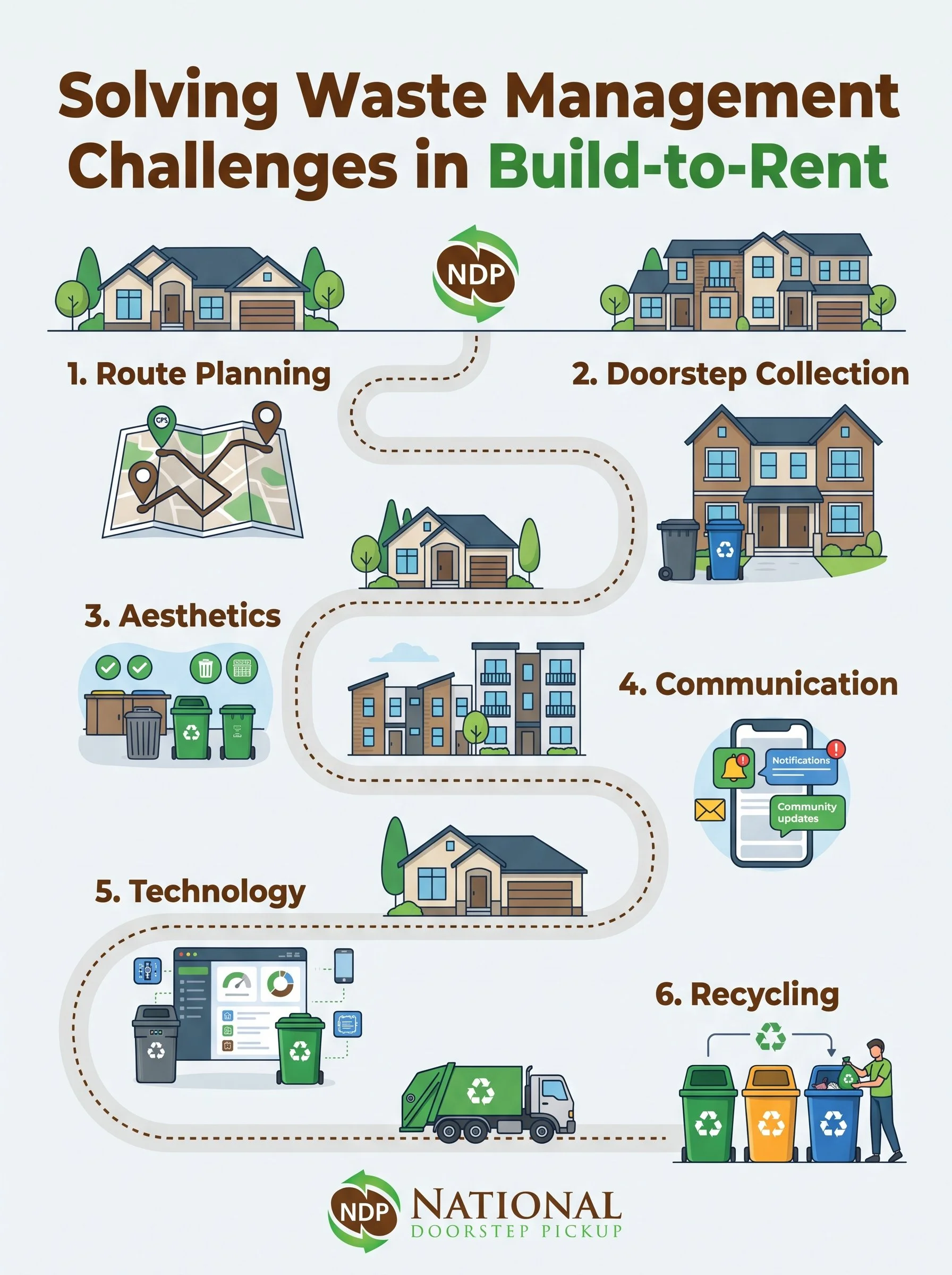
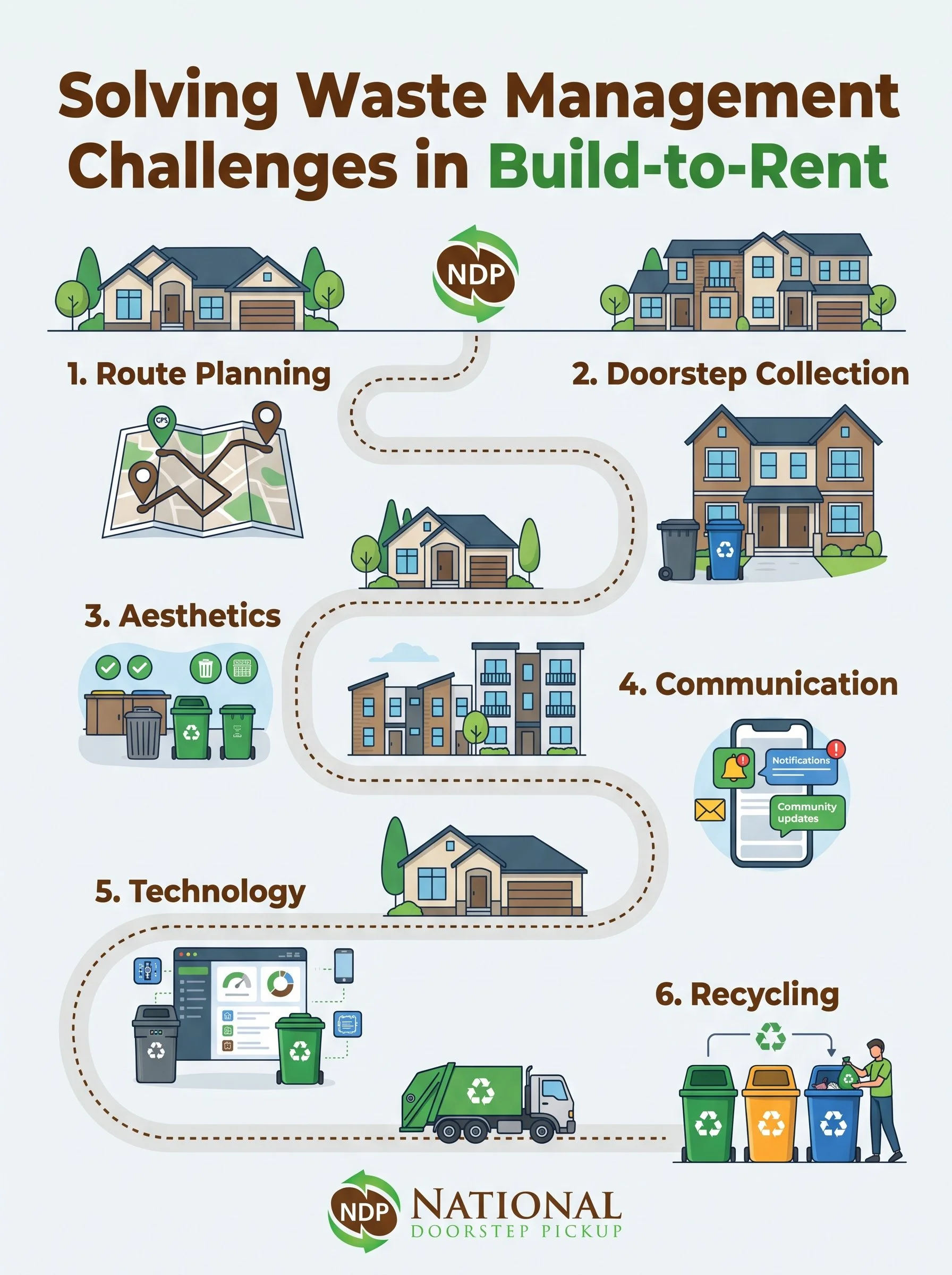
1. Route Planning Becomes Critical in Horizontal Communities
In a garden-style apartment community, a valet trash collection route might move vertically through breezeways, stairwells, and building clusters.
In Build-to-Rent, the route becomes much more similar to a transportation network.
Collectors may need to navigate:
Long residential streets
Cul-de-sacs
Dead ends
Townhome clusters
Detached homes
Rear-loaded garages
Alleys
Gated sections
Multiple phases of development
Separate dumpster or compactor locations
A poorly designed route can dramatically increase collection time.
A well-designed route reduces unnecessary movement.
Effective BTR route planning considers:
Home density
Fifty residences spread across several acres require a different collection approach than fifty townhomes located along two compact streets.
Street configuration
Loops generally allow more efficient collection than repeated entry and exit from cul-de-sacs.
Collection sequence
Collectors should move through the property in a predictable progression rather than repeatedly crossing the same sections.
Disposal locations
The route should naturally terminate near the appropriate dumpster, compactor, or staging area whenever possible.
Traffic patterns
Collection should minimize conflicts with residents entering or leaving the community.
Community expansion
The objective is simple:
Reduce wasted movement while maintaining consistent service at every residence.
At National Doorstep Pickup, route verification can also be supported through Proof of Pickup® technology, creating visibility into collection activity, timing, and service completion.
2. The Curbside Cart Is Part of the Community's Appearance
One of the most overlooked BTR waste-management issues is also one of the most visible:
trash carts.
That model can become problematic inside professionally managed rental communities where ownership is intentionally controlling the appearance of the entire development.
Consider what happens when 200 or 300 homes place carts along the roadway.
Suddenly the streetscape includes:
Hundreds of trash carts
Recycling carts
Overflowing bags
Containers left out after collection
Wind-blown material
Improperly positioned carts
Residents storing containers in visible locations
What was designed as a premium rental community can begin looking like collection day across an unmanaged subdivision.
For BTR operators, container management becomes an aesthetic issue as much as a sanitation issue.
3. Doorstep Collection Can Reduce Dependence on Curbside Set-Out
One alternative is moving the collection point closer to the residence.
Instead of requiring every resident to transport a large municipal-style cart to the curb, certain communities may establish an approved doorstep, garage-area, or designated residential set-out location.
Waste can then be collected along an engineered internal route and transported to the property's central disposal infrastructure.
The model can provide several operational advantages:
Fewer carts lining community streets
Reducing curbside cart exposure can help maintain the visual standards expected in professionally managed BTR developments.
Greater resident convenience
Residents have a shorter distance to move household waste.
More predictable set-out standards
Management can establish clear rules regarding:
Set-out location
Set-out time
Bag requirements
Maximum volume
Prohibited materials
Container return
Recycling separation
Better operational visibility
A managed collection program can create greater accountability than relying entirely on individual resident behavior.
But the collection method must always be designed around the community's actual layout, operating rules, local requirements, and approved waste infrastructure.
4. Centralized Disposal Still Matters
Doorstep collection does not eliminate dumpsters, compactors, or hauling.
It changes how waste reaches them.
Think of the process as two separate logistics systems.
First mile: Residence to disposal point
Second mile: Property to landfill or processing facility
Operators frequently focus heavily on the second mile because hauling contracts are highly visible expenses.
But problems often originate during the first mile.
Residents may:
Overfill carts
Leave bags beside containers
Dispose of waste at unauthorized locations
Contaminate recycling
Miss collection windows
Create overflow around centralized disposal areas
Improving the first mile can improve the performance of the entire waste system.
5. Protecting Community Aesthetics Requires Operational Discipline
BTR competes partly on lifestyle.
Developers invest heavily in:
Landscaping
Architecture
Streetscapes
Clubhouses
Pools
Walking trails
Dog parks
Community entrances
Waste management should reinforce that experience rather than undermine it.
A successful program minimizes the amount of time waste remains visible.
That means controlling three things:
When waste appears
Residents should have clearly defined set-out windows.
Where waste appears
Waste should only be placed at approved collection locations.
How quickly it disappears
Collection schedules should be predictable and consistently executed.
The goal is not simply removing trash.
The goal is maintaining the visual environment residents believe they are renting.
6. Resident Communication Becomes Even More Important
Horizontal communities can make violations harder to identify and operational inconsistencies more difficult to control.
Clear resident education should begin before service starts.
Residents should understand:
Collection days
Set-out times
Approved set-out locations
Bag requirements
Recycling procedures
Bulk-item procedures
Prohibited materials
Holiday schedules
Missed-pickup reporting
Communication should also explain why the rules exist.
Residents are more likely to follow a program when they understand that set-out standards help prevent:
Animal access
Leaks
Odors
Wind-blown trash
Pest activity
Unsightly streets
Blocked sidewalks or access points
A successful BTR waste program is partly a collection system and partly a resident-behavior system.
7. Technology Can Improve Accountability Across Large Footprints
A sprawling property creates another challenge:
management cannot physically observe every collection point every night.
Digital service verification can help close that visibility gap.
National Doorstep Pickup's Proof of Pickup® approach is designed to provide operational documentation around collection activity.
That can help property teams answer questions such as:
Was this area serviced?
When was collection performed?
Was there a resident violation?
Was waste improperly prepared?
Was a collection issue documented?
In a horizontal community containing hundreds of individual residences, that level of operational visibility becomes increasingly valuable.
Technology turns a geographically dispersed service into something management can monitor systematically.
8. Recycling Requires Its Own Logistics Plan
Recycling should not simply be added to the waste program as an afterthought.
The collection process needs to account for:
Accepted materials
Bag or container requirements
Separation procedures
Contamination
Collection frequency
Local processing capabilities
Municipal or county requirements
Others may be better served by centralized recycling locations.
The appropriate configuration depends on the property.
The important point is that BTR recycling logistics should be intentionally designed just like trash logistics.
9. Bulk Waste Needs a Separate Strategy
Furniture and oversized waste can overwhelm ordinary collection systems.
Common examples include:
Mattresses
Furniture
Large cardboard boxes
Appliances
Move-in packaging
Move-out debris
Allowing these items to accumulate around dumpsters can quickly create visual and operational problems.
BTR operators should establish a separate bulk-waste protocol defining:
Where bulk items belong
Whether pickup must be scheduled
Who removes the material
Whether charges apply
What materials are prohibited
How move-outs are handled
This becomes particularly important during periods of concentrated resident turnover.
10. BTR Waste Programs Should Be Designed Property by Property
There is no universal waste-management configuration for every Build-to-Rent community.
A community containing 150 detached cottages may require one route architecture.
A 400-unit townhome development may require another.
A mixed BTR community containing duplexes, townhomes, and detached residences may require several collection zones.
The strongest programs are built around variables such as:
Unit count + density + street configuration + disposal infrastructure + resident behavior + hauling schedule + local requirements.
That is why simply importing an apartment waste program into a BTR development—or importing a municipal curbside model into a professionally managed rental community—may produce unnecessary friction.
The operating model should match the asset.
Apartments and BTR Are Not Automatically the Same Under Fire and Building Codes
There is another important distinction for operators.
A Build-to-Rent community should not automatically be treated as either a conventional apartment property or as exempt from requirements that might apply to residential waste storage and collection.
Occupancy classification, building configuration, egress conditions, local fire code provisions, municipal ordinances, and the Authority Having Jurisdiction can all affect what collection methods are permissible.
Therefore:
Confirm the approved occupancy classification and local requirements before establishing exterior doorstep storage, containers, mats, or other set-out methods.
Operational convenience should always be designed around the approved code and property configuration—not the other way around.
The Bigger Opportunity: Treat Waste as Infrastructure
Waste management is often treated as a commodity.
A truck arrives.
Trash disappears.
An invoice gets paid.
But in Build-to-Rent, waste touches several dimensions of the resident experience:
Operations.
Curb appeal.
Resident convenience.
Maintenance workload.
Recycling.
Hauling efficiency.
Community cleanliness.
Asset presentation.
That makes waste management less like a commodity and more like community operating infrastructure.
And infrastructure performs best when it is engineered around the property it serves.
The BTR Waste-Management Model Is Changing
Build-to-Rent combines characteristics of multifamily operations with the physical layout of single-family housing.
Its waste-management strategy needs to do the same.
The communities that solve this well will not simply ask:
"How do we get the trash picked up?"
They will ask:
"How do we design the shortest, cleanest, most accountable path from every residence to final disposal?"
That shift changes everything.
Route planning becomes intentional.
Curbside container exposure can be reduced.
Resident rules become clearer.
Community aesthetics remain protected.
Operational visibility improves.
And waste management begins working with the design of the BTR community instead of against it.
Building or Operating a BTR Community?
National Doorstep Pickup works with professionally managed residential communities to develop waste-collection programs around the property's actual layout and operating requirements.
From route planning and doorstep collection to recycling, bulk waste, resident education, and Proof of Pickup® verification, the objective is straightforward:
Build a cleaner, more accountable waste journey from every residence to final disposal.
Every Door. Every Night.®